Heat pumps, inductions stoves and infrared heating panels: these are a few of the climate-friendly upgrades being installed at some public housing developments, with more to come, officials said Tuesday.


This story was originally published by the nonprofit news site City Limits.
Want a tour of NYCHA’s climate-friendlier future?
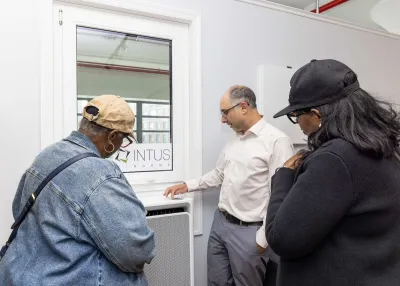
On Monday, the city unveiled a model apartment in Brooklyn designed to show off new, green technology being installed at select public housing developments across the city—heating and cooking equipment that uses clean energy instead of polluting fossil fuels.
The showroom, opened at the Brooklyn Navy Yard, aims to “give NYCHA residents, design-build teams, property managers and other stakeholders an opportunity to see and experience the technologies firsthand as they plan and carry out future public housing renovations,” according to an announcement from the city.
The equipment includes triple-pane insulated windows, heat pumps and far-infrared radiant (FIR) heating panels—which use electricity to warm and cool apartments—as well as induction stoves to replace gas cooking appliances, which experts say reduce pollution from buildings and improve air quality in residents’ homes.
It comes five months after Mayor Zohran Mamdani released a multi-billion dollar, five-year sustainability plan for NYCHA, which aims to make the green upgrades a key part of renovations as the housing authority chips away at its roughly $78 billion repair backlog.
That plan—which so far, is only about half funded—calls for the installation of heat pumps at 20,000 NYCHA apartments and adding induction stoves in another 10,000 units, among other resiliency improvements, like electric vehicle charging stations.
“The technologies in this model apartment show how we are delivering a stronger, more sustainable future for public housing,” Mamdani said in a statement Tuesday. “Cleaner heat, better cooling and modern appliances can make homes more comfortable while helping us build a city that is ready for the climate challenges ahead.”

Pollution from buildings accounts for roughly 70 percent of New York City’s greenhouse gas emissions, which drive climate change.
Several NYCHA developments have already gotten the upgrades: heat pumps are being used, or will be soon, at the Woodside Houses, Morrisania Air Rights, Claremont Consolidated, Beach 41st Street Houses, Bay View Houses and Campos Plaza II, while a pilot program will test out induction stoves at an initial 100 public housing apartments.
Both the stove and heat pump models were sourced through contests, launched in partnership with the state, that challenged companies to submit proposals for electric appliances that could be installed en masse in multifamily buildings.
Officials said the model apartment at the Brooklyn Navy Yard “will continue to be updated as new products become available, creating a living showcase for the technologies that can help modernize NYCHA homes.”
NYCHA residents who want to view the model apartment can arrange a tour through their tenant association, a spokesperson for the housing authority said. Others can contact NYCHA’s Asset & Capital Management Division’s Strategic Partnerships team.
This article was republished from City Limits, an independent, investigative news source.
Read the full story: NYCHA’s Green Future? Officials Open ‘Showroom’ Apartment With Sustainable Features

DSA members accuse Mamdani of 'abandoning values' over housing redevelopment
New York City's mayor plans to replace about 2,000 units of public housing with private, mixed-income housing.

NYC renovations for dangerous, ‘mercilessly crammed’ street delayed until 2027
Construction was supposed to begin this fall.

Mamdani’s pied-à-terre tax survives legal challenge
A panel of judges found that the plaintiffs failed to demonstrate injury as a result of New York City's implementation of the tax.

Planetizen Federal Action Tracker
A weekly monitor of how Trump’s orders and actions are impacting planners and planning in America.

Eastern Nebraska is running out of electricity
Data centers and electrification are straining eastern Nebraska’s grid, throttling economic development.

Study reveals best places in the U.S. for cycling, walking
New research from Streetlight Data examines bicycle and pedestrian miles per capita in the 100 largest U.S. cities by population.

Officials look to alter BART extension as price goes through the roof
Tariffs and the war with Iran are behind the rising cost.

To power data centers, Utah company may build hundreds of nuclear reactors on state land
In its permit application, Valar asked for the county to confirm that changes within its outlined plan would still be covered by the permit.

San Antonio is using environmental review to stall ICE detention center
San Antonio sued last month to pause work on the new detention center until the federal government studied its effect on the surrounding area.

FREE Course: Walkable City 1: Why Walkability?
After describing his path towards focusing on walkability as the essence of good planning, Jeff Speck marches through his five principal reasons for making more walkable places.
Reinventing Malls: Planning Alchemy—Turning Gray Fields Into Gold
The course focuses on the opportunities and imperatives that shape reinvention of mall sites.

City of Charlotte
City of Rosemead
Rutgers University, Edward J. Bloustein School of Planning and Public Policy
University of Michigan School for Environment and Sustainability (SEAS)
Hunter College, City University of New York (CUNY)
The Architects Foundation
City of Cambridge
The Pocatello Development Authority
The Urban Renewal Agency of the City of Pocatello