Plans to develop lithium mines and data centers are dividing residents of a remote Southern California region.


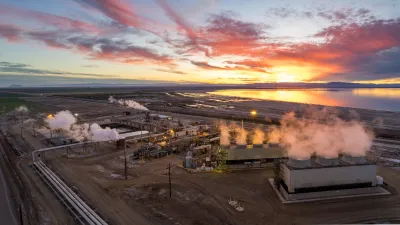
A remote area of the Southern California desert is poised to become a renewable energy mecca after a large lithium deposit was discovered in the area around the Salton Sea.
As an article by Rebecca Plevin and Zoë Meyers in Capital & Main explains, the plans are dividing local communities. Local politicians say the lithium find could mean an economic boom for the region, turning it into "a critical supplier for a global economy that is transitioning toward electric vehicles." But residents worry about whether the jobs and amenities will actually materialize — and at what cost. "A county report found that increased geothermal operations could result in increased seismic activity in the area, and that the Lithium Valley development plans would likely require the use, transportation and disposal of hazardous materials during construction and operation."
Meanwhile, "The lithium mining plans, which three companies are pursuing, may not be fully realized for decades. Two nonprofits have sued over what they believe were shoddy environmental reviews, and the county and the Imperial Irrigation District, the major utility in the region, disagree over how to supply the huge amounts of water and power necessary for lithium extraction."
FULL STORY: California’s Lithium Valley Dreams Meet Reality at the Only Restaurant in Town

Integrating Human Rights Into Energy and Extractive Sector Transitions
Why just transition efforts must move beyond economic considerations by embedding human rights principles into business practices to ensure equitable, transparent, and accountable outcomes for affected communities and workers.
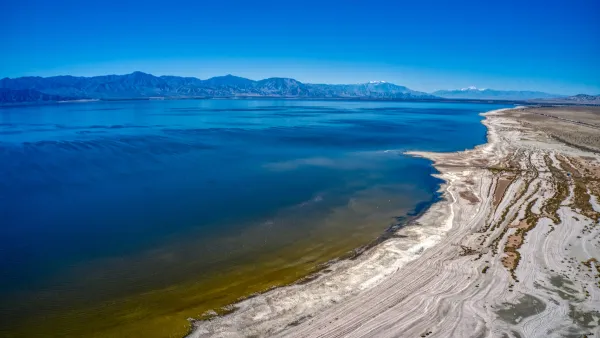
Report: Southern California’s Salton Sea Region Holds Vast Lithium Reserves
Imperial County, a quiet agricultural region in the Southern California desert, could become the nation’s leading lithium source.

Court unfreezes $20B in federal climate grants
A U.S. Court of Appeals ruled that the Trump administration potentially violated the Inflation Reduction Act by attempting to claw back grants awarded under the Greenhouse Gas Reduction Fund program.

Planetizen Federal Action Tracker
A weekly monitor of how Trump’s orders and actions are impacting planners and planning in America.

The state-sanctioned urbicide of Austin
People don’t kill cities. Freeways do.

US to reduce Colorado River water deliveries to Mexico
A new Colorado Treaty amendment reduces Mexico’s Colorado River water allocation by 250,000 acre feet.

Baltimore to break ground on $50 million Transit Priority Project
The project will bring faster bus trips, safer streets and better bike connections to Baltimore.

Airbnb launches $250 million 'last-dollar financing' housing accelerator, makes first investment in Austin
The company will put $6.4 million towards affordable housing development in Texas’ capital.

Guerilla urbanists are building DIY bus stop benches in Chicago
A before-and-after of one of the bus stops with a new bench. The new benches are not officially sanctioned or permitted, but the residents who placed them hope they will be the start of a network of DIY benches across the city.

FREE Course: Walkable City 1: Why Walkability?
After describing his path towards focusing on walkability as the essence of good planning, Jeff Speck marches through his five principal reasons for making more walkable places.
Reinventing Malls: Planning Alchemy—Turning Gray Fields Into Gold
The course focuses on the opportunities and imperatives that shape reinvention of mall sites.

Eagle County Government
Harvard University Graduate School of Design
Nashville Planning Department
The Architects Foundation
University of Cincinnati Online
The Pocatello Development Authority
The Urban Renewal Agency of the City of Pocatello
Journal of the American Planning Association