The removal of two vehicle lanes will make way for pedestrian and cycling infrastructure and public space.



New York City Mayor Zohran Mamdani has announced new design concepts that would pedestrianize parts of the city’s famed Park Avenue for 11 blocks between 46th and 57th street. The designs would add plants, seating and “streetscape amenities,” and remove one vehicle travel lane in each direction.
AMNY reports: “Officials said this would allow medians to expand and accommodate seating, plantings and other pedestrian and cycling amenities. New crosswalks would connect the medians along the corridor. Details on bike lane connections have not been announced yet. However, transit reps said potential cycling improvements are being studied in coordination with the city’s broader bike network. A typical median could include planting areas, a north-south bike lane and a pedestrian pathway.”
The plan was originally set into motion a year ago by former mayor Eric Adams. The city will continue collecting public feedback through May.
Read the full story below.
Read the full story: DOT to cut driving lanes on Park Avenue to allow more green space, pedestrian safety

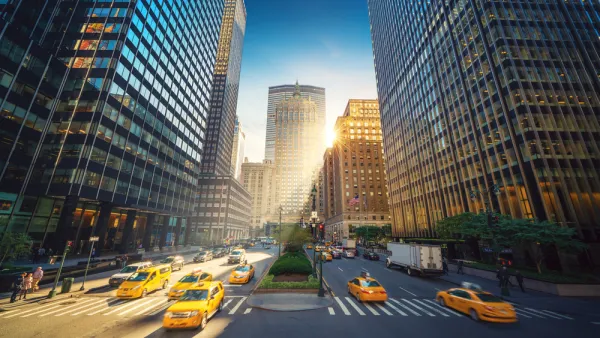
The Once and Future Park Avenue Promenade
The debate about whether the pedestrian-oriented changes made to the New York City streetscape during the pandemic should be permanent has a high-profile battleground on Park Avenue.
Even 'Starchitects' Need a Good Pitch to Win
'Starchitects' compete for prime real estate in New York City, and selling their stuff isn’t as easy as one might think. See four famous architects in action as they pitch designs for a new office tower on Park Avenue.

Planetizen Federal Action Tracker
A weekly monitor of how Trump’s orders and actions are impacting planners and planning in America.

California plans to bury El Niño’s downpour
If the state plays its cards right, it may be able to store a billion acre-feet of El Niño’s water in aquifers.

Chicago breaks ground on $3 billion megadevelopment
The new neighborhood, titled Foundry Park, will one day host 3,700 residences.

Satanic Place Names
From streams and lakes to valleys and canyons, I mapped more than 1,000 places named after the Devil.

California High-Speed Rail Authority CEO resigns after $600,000 scandal
Under Ian Choudri, the authority used taxpayer dollars to fund first class flights and trips to nightclubs.

Want to study the Missouri River? Soon, you may need unanimous approval from 10 states
Legislation would require 10 governors’ permission to study or build projects moving water outside the basin.

FREE Course: Walkable City 1: Why Walkability?
After describing his path towards focusing on walkability as the essence of good planning, Jeff Speck marches through his five principal reasons for making more walkable places.
Reinventing Malls: Planning Alchemy—Turning Gray Fields Into Gold
The course focuses on the opportunities and imperatives that shape reinvention of mall sites.

City of Rosemead
Rutgers University, Edward J. Bloustein School of Planning and Public Policy
One Hundred Miles
Hunter College, City University of New York (CUNY)
The Architects Foundation
University of Cincinnati Online
City of Cambridge
Montrose County
The Pocatello Development Authority