The project was expected to generate about $79 million annually in property taxes.


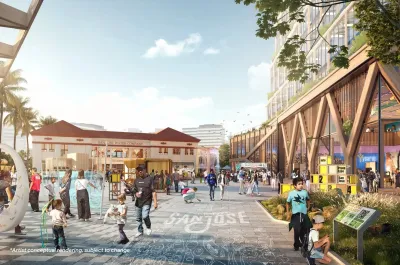
A plan by Google to redevelop an 80-acre portion of downtown San Jose is no longer moving forward, leaving the area, where some buildings have already been demolished, vacant. As Julia Prodis Sulek reports in The Mercury News, Google paused the project three years ago, “leaving much of the site as flattened slabs of concrete and empty asphalt parking lots.”
The project could have been “everything that urbanists dream of,” a mixed-use hub of offices, retail, recreation, and housing for as many as 25,000 Google employees and other residents. Now, San Jose, which sold Google 16 city-owned parcels for the project, has little legal recourse for forcing Google to build anything on the site.
According to Sulek, “A nearly 700-page development agreement approved unanimously by the City Council in 2021 included no penalties if the project never moves forward. Google pledged as much as $200 million for community programs, with most of that money released as construction milestones are reached. If Google never builds anything, it would be required to contribute only about half of that amount.”
The stalled project is now becoming “a chokehold on the city,” says David Mulvehill, a partner in several restaurants in the area. Google has leased some warehouses and lots on the site to businesses, but much of it remains empty and closed-off. When a local bike shop that was leasing a warehouse on the property offered to buy it, Google declined.
FULL STORY: San Jose bet its future on a Google megacampus downtown. Now the land sits mostly empty.

Downtown San Jose Could Get Taller
In the Bay Area's biggest city, the debate over density pits two economic drivers against each other.

Office Conversions Have Increased Every Year This Decade
Since the pandemic, office vacancy rates remain high, leading many cities to adjust zoning codes to accommodate adaptive reuse.
Downtown Portland Ready for Maine's Tallest Building
The city of Portland anticipates a major new urban development addition called the “Old Port Square” project.

Planetizen Federal Action Tracker
A weekly monitor of how Trump’s orders and actions are impacting planners and planning in America.

The state-sanctioned urbicide of Austin
People don’t kill cities. Freeways do.

US to reduce Colorado River water deliveries to Mexico
A new Colorado Treaty amendment reduces Mexico’s Colorado River water allocation by 250,000 acre feet.

5 New England states march closer to 800 megawatt wind energy project
Securing federal approval for the project may be complicated under the Trump administration, which has historically been hostile towards domestic wind power.

Baltimore to break ground on $50 million Transit Priority Project
The project will bring faster bus trips, safer streets and better bike connections to Baltimore.

Airbnb launches $250 million 'last-dollar financing' housing accelerator, makes first investment in Austin
The company will put $6.4 million towards affordable housing development in Texas’ capital.

FREE Course: Walkable City 1: Why Walkability?
After describing his path towards focusing on walkability as the essence of good planning, Jeff Speck marches through his five principal reasons for making more walkable places.
Reinventing Malls: Planning Alchemy—Turning Gray Fields Into Gold
The course focuses on the opportunities and imperatives that shape reinvention of mall sites.

Eagle County Government
Harvard University Graduate School of Design
Nashville Planning Department
The Architects Foundation
University of Cincinnati Online
The Pocatello Development Authority
The Urban Renewal Agency of the City of Pocatello
Journal of the American Planning Association