On a 23-hour trip covering less than 250 miles, a journalist probes the future of trains in Texas.


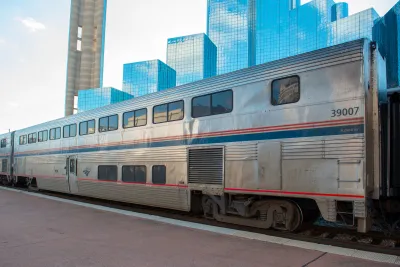
After reading that the sub-250 mile trip from Dallas to Houston takes an audacious 23 hours on Amtrak rail, journalist Benton Graham took the trip himself and chronicled the odyssey for Bloomberg. What he found was a state divided on the future of rail — some believing its future is bright, others wondering if it’s already too late.
“[Republican Representative Pat Curry] isn’t convinced that Texas needs high-speed rail but says it warrants a study, something that could be approved during the legislative session in 2027. ‘I think one of the parts of the study has to be: Has technology left us behind? Are we too late?’ he said. He wonders whether, with autonomous vehicle technology advancing, Texas might have other, better transportation solutions coming just over the horizon,” Graham writes.
Along the way, Graham introduces readers to a packed train of unlikely rail enthusiasts, from enthusiastic 20-somethings wanting to relive their Thomas the Tank Engine childhood fantasies for the first time, to Amtrak veterans who have spent decades riding the rails. Read the full account at the link below.

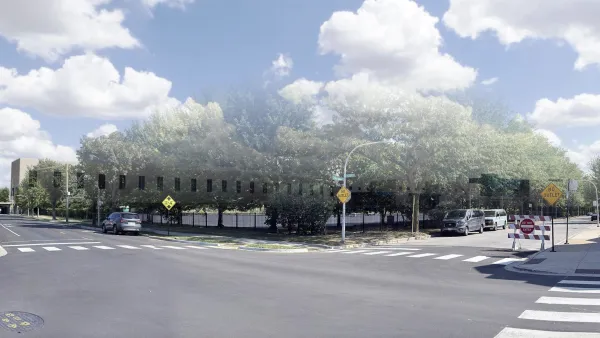
Feds to more closely scrutinize proposed Amtrak facility’s environmental impact
The Federal Railroad Administration had initially said the facility qualified for a less extensive environmental review.

Amtrak cuts ribbon on Seattle Airo maintenance facility
The $250 million, nearly 100,000-square-foot building can house an entire Cascades Airo trainset.
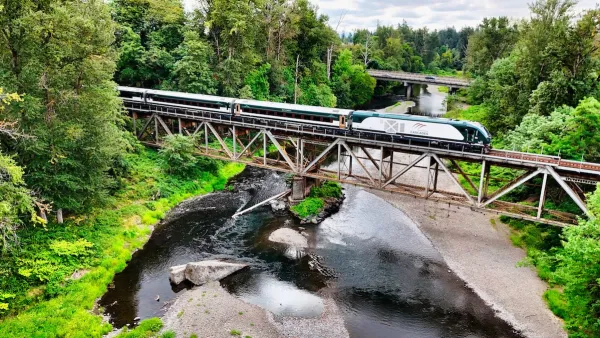
Airo trainsets begin service on Amtrak Cascades route
The trains feature panoramic windows, complementary wifi and over 300 seats per train set.

Planetizen Federal Action Tracker
A weekly monitor of how Trump’s orders and actions are impacting planners and planning in America.

California plans to bury El Niño’s downpour
If the state plays its cards right, it may be able to store a billion acre-feet of El Niño’s water in aquifers.

Chicago breaks ground on $3 billion megadevelopment
The new neighborhood, titled Foundry Park, will one day host 3,700 residences.

Satanic Place Names
From streams and lakes to valleys and canyons, I mapped more than 1,000 places named after the Devil.

California High-Speed Rail Authority CEO resigns after $600,000 scandal
Under Ian Choudri, the authority used taxpayer dollars to fund first class flights and trips to nightclubs.

Want to study the Missouri River? Soon, you may need unanimous approval from 10 states
Legislation would require 10 governors’ permission to study or build projects moving water outside the basin.

FREE Course: Walkable City 1: Why Walkability?
After describing his path towards focusing on walkability as the essence of good planning, Jeff Speck marches through his five principal reasons for making more walkable places.
Reinventing Malls: Planning Alchemy—Turning Gray Fields Into Gold
The course focuses on the opportunities and imperatives that shape reinvention of mall sites.

City of Rosemead
Rutgers University, Edward J. Bloustein School of Planning and Public Policy
One Hundred Miles
Hunter College, City University of New York (CUNY)
The Architects Foundation
University of Cincinnati Online
City of Cambridge
Montrose County
The Pocatello Development Authority