Tierra Colectiva, a community land trust in the Denver neighborhoods of Globeville and Elyria-Swansea, combines community organizing, traditional CLT development, and more unusual roles in a large affordable housing development.


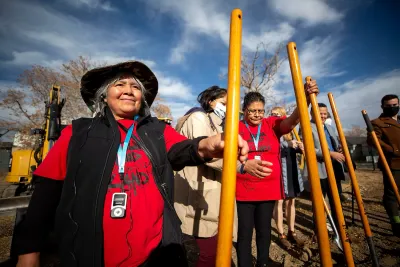
In Denver’s historically working-class neighborhoods of Globeville and Elyria-Swansea, a community land trust called Tierra Colectiva is redefining what anti-displacement looks like. Born out of local organizing in response to rising rents and disinvestment, the group combines traditional CLT homeownership with large-scale collaboration — partnering with developers and funders to create a 170-unit affordable apartment building that includes deeply affordable family units and a community-owned commercial space.
Even when it doesn’t own the land, Tierra Colectiva leverages partnerships to ensure residents have a voice in shaping their neighborhood’s future. With projects like a community food forest, new affordable housing sites, and advocacy around the city’s planned National Western Center expansion, the group is proving that community-led development can coexist with city growth — if residents have the power to help shape it.
FULL STORY: Denver Land Trust Fights Displacement Whether It Owns the Land or Not

Push and Pull: The Link Between Walkability and Affordability
The increased demand for walkable urban spaces could make them more and more exclusionary if cities don’t pursue policies to limit displacement and boost affordability.

When Costs of Living Outpace Housing Costs
Even when they qualify for affordable rents, tenants in high-cost neighborhoods find themselves shut out of essential amenities and services.

Shared-Equity Homeownership: A Primer
Alternative models of homeownership involving shared equity may be able to offset the urban housing crunch. They include the subjects of this discussion: community land trusts and housing co-ops.

The state-sanctioned urbicide of Austin
People don’t kill cities. Freeways do.

US to reduce Colorado River water deliveries to Mexico
A new Colorado Treaty amendment reduces Mexico’s Colorado River water allocation by 250,000 acre feet.

New Jersey’s second-largest city bans standalone data centers
Jersey City will continue to allow co-location facilities, such as those meant for research institutions that store their own data.

Amtrak not solely to blame for New Jersey commuter rail's unreliability, report finds
A new study from the Garden State Initiative found that NJ Transit’s budget grew 20% across a 4 year period, but reliability declined significantly over the same period.

EPA erases limits on planet-warming pollution from power plants
Under Monday’s plan, power plants would still have some limits on how much mercury, arsenic and other contaminants they can emit.

Phoenix announces new on-demand transit service, more frequent RAPID buses
Both new services will launch in October, and are part of Phoenix's Project Effective Access Solutions for Easing Congestion.

FREE Course: Walkable City 1: Why Walkability?
After describing his path towards focusing on walkability as the essence of good planning, Jeff Speck marches through his five principal reasons for making more walkable places.
Reinventing Malls: Planning Alchemy—Turning Gray Fields Into Gold
The course focuses on the opportunities and imperatives that shape reinvention of mall sites.

Eagle County Government
Harvard University Graduate School of Design
Nashville Planning Department
The Architects Foundation
University of Cincinnati Online
The Pocatello Development Authority
The Urban Renewal Agency of the City of Pocatello
Journal of the American Planning Association