A newly created legal process allows development to proceed if builders agree to bring in renewable water sources and reduce their groundwater use by 25%.


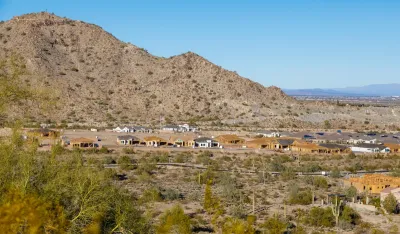
The Arizona Department of Water Resources partially lifted a moratorium on new development, allowing water company EPCOR to build up to 60,000 new homes.
As Tony Davis explains in High Country News, “The ADWR issued the moratorium in June 2023 after concluding that the Phoenix area’s long-depleted aquifer no longer had enough water to serve all the developments planned for the region for 100 years as required by the 1980 Groundwater Management Act.”
EPCOR used a newly created legal process to earn the right to build their planned developments “as they agree to bring in outside renewable water supplies.” Developers are then expected to cut their groundwater use by 25 percent. Kathleen Ferris, a former ADWR director, says the move is part of “an incremental approach to weaning water providers away from groundwater onto renewable water supplies,” but that the new rule won’t allow the building of as many new homes as were planned before the moratorium.
FULL STORY: Phoenix subdivision builds move ahead, despite water concerns

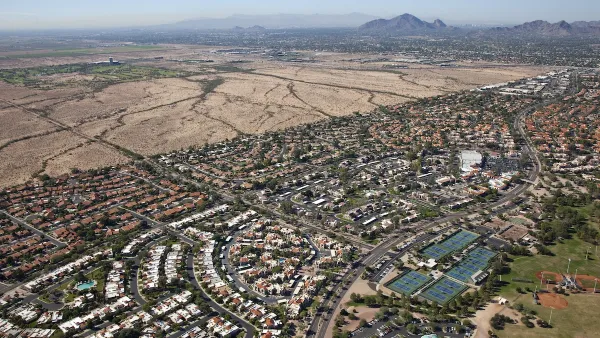
Nearly Half a Million New Arizona Homes Halted Due to Water Crisis
The Arizona Department of Water Resources has put a moratorium on new water supply permits, making the future of planned residential developments uncertain.

Unsustainable Sprawl Testing Water Supplies in the Valley of the Sun
As more and more people move to the suburbs blossoming in the Phoenix metro area, local water officials are increasingly concerned about the region's ability to keep up with demand.
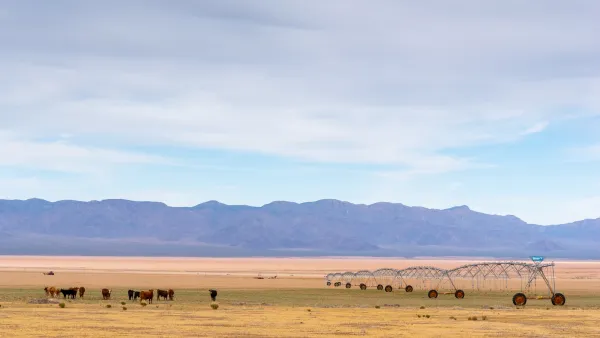
Arizona Tightens Groundwater Restrictions to Rein in Agribusinesses
The state is creating an ‘active management area’ in the western part of the state, where agribusinesses including a Saudi alfalfa exporter have practically free rein over water supplies.

Planetizen Federal Action Tracker
A weekly monitor of how Trump’s orders and actions are impacting planners and planning in America.

The state-sanctioned urbicide of Austin
People don’t kill cities. Freeways do.

US to reduce Colorado River water deliveries to Mexico
A new Colorado Treaty amendment reduces Mexico’s Colorado River water allocation by 250,000 acre feet.

Baltimore to break ground on $50 million Transit Priority Project
The project will bring faster bus trips, safer streets and better bike connections to Baltimore.

Airbnb launches $250 million 'last-dollar financing' housing accelerator, makes first investment in Austin
The company will put $6.4 million towards affordable housing development in Texas’ capital.

Guerilla urbanists are building DIY bus stop benches in Chicago
A before-and-after of one of the bus stops with a new bench. The new benches are not officially sanctioned or permitted, but the residents who placed them hope they will be the start of a network of DIY benches across the city.

FREE Course: Walkable City 1: Why Walkability?
After describing his path towards focusing on walkability as the essence of good planning, Jeff Speck marches through his five principal reasons for making more walkable places.
Reinventing Malls: Planning Alchemy—Turning Gray Fields Into Gold
The course focuses on the opportunities and imperatives that shape reinvention of mall sites.

Eagle County Government
Harvard University Graduate School of Design
Nashville Planning Department
The Architects Foundation
University of Cincinnati Online
The Pocatello Development Authority
The Urban Renewal Agency of the City of Pocatello
Journal of the American Planning Association