Interisland flights are Hawaiʻi’s biggest transportation carbon producer. Plaintiffs in the state’s landmark Navahine settlement argue they stand in the way of the right to a clean and healthful environment


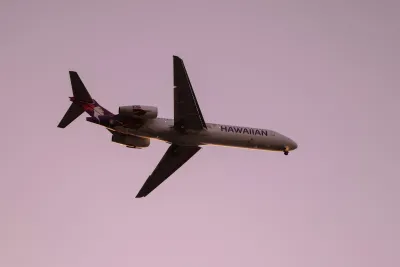
In 2024, Hawai’i saw a landmark settlement approved by the Hawai‘i Circuit Court that required the Hawai’i Department of Transportation (HDOT) to achieve a ‘“Zero Emissions Target’ for ground, sea and air interisland transportation sectors by 2045.” Now, the plaintiffs in the historic Navahine settlement, a group of teenagers, are pushing back against HDOT’s plan to use sustainable aviation fuel or SAF (the airplane equivalent of biodiesel often made from corn ethanol) for interisland flights. Honolulu Civil Beat reports the story.
“The department’s proposed plan to use the fuel aligns with the view of the aviation industry and fuel producers — as well as a local grower of oily plants that can be converted into sustainable aviation fuel — that SAF is the most practical choice to reduce emissions. But the plaintiffs have a different view,” writes Stewart Yerton.
“The bottom line is to be completely carbon or 100% emission free by 2045: that’s just the bottom line,” Rylee Brooke Kamahele, a 17-year-old plaintiff told HCB. While the settlement names SAF as a solution to meet interim targets, the plaintiffs argue for electric planes as a long term solution — technology HDOT says is simply too far out to meet the target in within 20 years.
FULL STORY: Teens Who Sued Hawai‘i Say State’s Climate Plan For Aviation Doesn’t Fly

Hawaii to Embark on Nation's Largest Mileage Fee Demonstration Program
Unlike the more limited Oregon and California road usage charge programs currently in operation, Hawaii's program envisions over one million motorists participating in the demonstration program.

Planetizen Federal Action Tracker
A weekly monitor of how Trump’s orders and actions are impacting planners and planning in America.

The state-sanctioned urbicide of Austin
People don’t kill cities. Freeways do.

US to reduce Colorado River water deliveries to Mexico
A new Colorado Treaty amendment reduces Mexico’s Colorado River water allocation by 250,000 acre feet.

5 New England states march closer to 800 megawatt wind energy project
Securing federal approval for the project may be complicated under the Trump administration, which has historically been hostile towards domestic wind power.

Baltimore to break ground on $50 million Transit Priority Project
The project will bring faster bus trips, safer streets and better bike connections to Baltimore.

Airbnb launches $250 million 'last-dollar financing' housing accelerator, makes first investment in Austin
The company will put $6.4 million towards affordable housing development in Texas’ capital.

FREE Course: Walkable City 1: Why Walkability?
After describing his path towards focusing on walkability as the essence of good planning, Jeff Speck marches through his five principal reasons for making more walkable places.
Reinventing Malls: Planning Alchemy—Turning Gray Fields Into Gold
The course focuses on the opportunities and imperatives that shape reinvention of mall sites.

Eagle County Government
Harvard University Graduate School of Design
Nashville Planning Department
The Architects Foundation
University of Cincinnati Online
The Pocatello Development Authority
The Urban Renewal Agency of the City of Pocatello
Journal of the American Planning Association