FEMA is replacing traditional trailers, which quickly deteriorate and are unfit for long-term habitation, with modular, fire-resistant homes designed to last.



The Federal Emergency Management Agency (FEMA) is using a new type of modular housing to offer ‘dignified’ shelter to wildfire survivors in Maui, reports James S. Russell for The New York Times.
In the past, FEMA provided travel trailers that quickly deteriorated, leaving people to live in poor or dangerous conditions after a few weeks. To address this, one company is building more durable, modular houses complete with finished bathrooms and kitchens. “The Lahaina houses, a model known as Conexus, were produced by Liv-Connected, a manufactured housing spinoff of the New York architecture firm DXA Studio, which has been innovating emergency housing with manufacturing techniques.”
The homes are built with fire-resistant cement-containing panels, and factory-built modular housing can be produced at scale. However, with FEMA facing an existential crisis, funding for temporary housing could be in jeopardy, leaving cities and states on the hook.
FULL STORY: In Lahaina, ‘Dignified’ Havens for Wildfire Survivors


State AGs Call for FEMA to Classify Extreme Heat, Smoke as ‘Major Disasters’
State and local officials say explicitly naming heat and wildfire smoke would give local agencies more certainty in developing their mitigation strategies.

AirBnb Commits Empty Los Angeles Listings for Emergency Housing Within 24 Hours of Future Disasters
The company’s nonprofit arm formalized an agreement to offer free housing to residents after disasters.
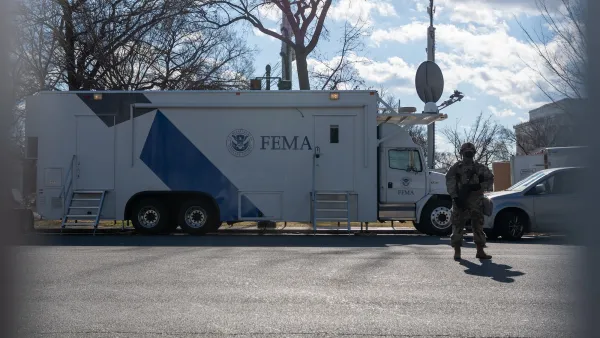
Judge Says FEMA Can’t Withhold Grant Funds Under ‘Arbitrary and Capricious’ Conditions
The decision favors a coalition of 12 states that sued the Trump administration over new conditions for disaster recovery and emergency relief funds.

Planetizen Federal Action Tracker
A weekly monitor of how Trump’s orders and actions are impacting planners and planning in America.

The state-sanctioned urbicide of Austin
People don’t kill cities. Freeways do.

US to reduce Colorado River water deliveries to Mexico
A new Colorado Treaty amendment reduces Mexico’s Colorado River water allocation by 250,000 acre feet.

5 New England states march closer to 800 megawatt wind energy project
Securing federal approval for the project may be complicated under the Trump administration, which has historically been hostile towards domestic wind power.

Baltimore to break ground on $50 million Transit Priority Project
The project will bring faster bus trips, safer streets and better bike connections to Baltimore.

Airbnb launches $250 million 'last-dollar financing' housing accelerator, makes first investment in Austin
The company will put $6.4 million towards affordable housing development in Texas’ capital.

FREE Course: Walkable City 1: Why Walkability?
After describing his path towards focusing on walkability as the essence of good planning, Jeff Speck marches through his five principal reasons for making more walkable places.
Reinventing Malls: Planning Alchemy—Turning Gray Fields Into Gold
The course focuses on the opportunities and imperatives that shape reinvention of mall sites.

Eagle County Government
Harvard University Graduate School of Design
Nashville Planning Department
The Architects Foundation
University of Cincinnati Online
The Pocatello Development Authority
The Urban Renewal Agency of the City of Pocatello
Journal of the American Planning Association