The Florida East Coast Railway is charging the private railway with secretly making expansion plans despite a financial shortfall and insufficient infrastructure.


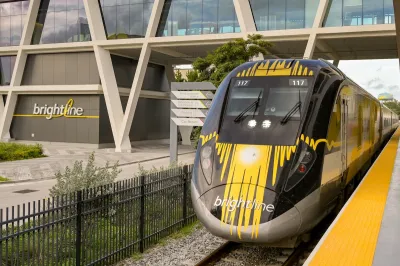
The Florida East Coast Railway (FECR) is suing Brightline, the privately operated passenger rail line that connects Miami to Orlando, complicating the company’s expansion plans.
According to an article by Joshua Ceballos and Aaron Leibowitz in the Miami Herald, “In its suit, filed July 11 in Miami-Dade Circuit Court, Florida East Coast Railway notes the many accidents that have occurred on its tracks involving Brightline, saying that adding more trains to the line ‘would heighten the risk of potentially severe accidents.’” Brightline currently has exclusive rights to run passenger trains on that corridor.
In its complaint, FECR charges that “Desperate to salvage some of its investors’ funds, Brightline has covertly engaged in a years-long campaign to stave off its own financial problems by loading FECR’s tracks with more passenger trains.”
FECR is asking a judge to block any further agreements to expand Brightline service, arguing that Brightline does not have the authority to add more trains to the tracks, and that it did not disclose its expansion plan to FECR.
Read the full story: FEC Railway sues Brightline over commuter rail expansion plan

Brightline Founder Predicts a Passenger Rail Resurgence
The HSR operator wants to expand to more US regions.
A Passenger Rail Revolution?
An injection of federal funding could help make train travel a key component of the U.S. transportation network.

High-Speed Rail To Begin Serving Orlando Next Week
Florida’s Brightline high-speed train will open its station at Orlando International Airport on September 22.

Planetizen Federal Action Tracker
A weekly monitor of how Trump’s orders and actions are impacting planners and planning in America.

California plans to bury El Niño’s downpour
If the state plays its cards right, it may be able to store a billion acre-feet of El Niño’s water in aquifers.

Chicago breaks ground on $3 billion megadevelopment
The new neighborhood, titled Foundry Park, will one day host 3,700 residences.

Satanic Place Names
From streams and lakes to valleys and canyons, I mapped more than 1,000 places named after the Devil.

California High-Speed Rail Authority CEO resigns after $600,000 scandal
Under Ian Choudri, the authority used taxpayer dollars to fund first class flights and trips to nightclubs.

Want to study the Missouri River? Soon, you may need unanimous approval from 10 states
Legislation would require 10 governors’ permission to study or build projects moving water outside the basin.

FREE Course: Walkable City 1: Why Walkability?
After describing his path towards focusing on walkability as the essence of good planning, Jeff Speck marches through his five principal reasons for making more walkable places.
Reinventing Malls: Planning Alchemy—Turning Gray Fields Into Gold
The course focuses on the opportunities and imperatives that shape reinvention of mall sites.

City of Rosemead
Rutgers University, Edward J. Bloustein School of Planning and Public Policy
One Hundred Miles
Hunter College, City University of New York (CUNY)
The Architects Foundation
University of Cincinnati Online
City of Cambridge
Montrose County
The Pocatello Development Authority