The mayor wants to examine the true benefits and impacts of a state law meant to boost affordable housing production that allows developers to exempt their projects from property taxes.



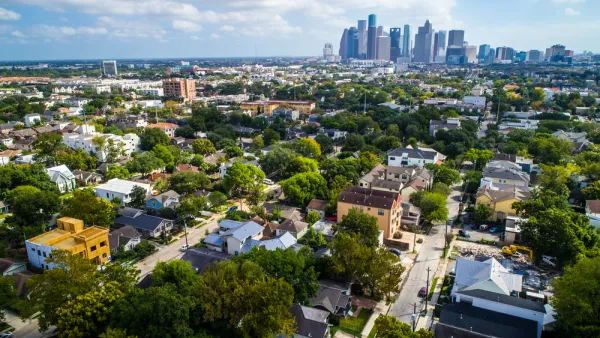
After residents in the upscale Tanglewood neighborhood of Houston resisted plans to build affordable housing there, Mayor Sylvester Turner has put a halt on similar affordable housing deals citywide “until he can examine them more closely,” writes R.A. Schuetz in the Houston Chronicle.
The controversy centers around a 2015 state law regarding public facility corporations, “which allows local housing authorities to take properties off the tax roll if developers make some of the units affordable.” Critics say the law doesn’t clarify what “affordable” means or limit rents to a percentage of income. “[Mayor Turner] emphasized that his concern was whether developers were creating enough affordable units to warrant such a large tax break.” As Schuetz points out, “a 2020 study by the University of Texas School of Law found that, because of the law’s lack of clarity around the definition of affordability, the ‘affordable’ units it created were often market rate.”
Meanwhile, some residents worry that removing tax revenue from new developments will harm local schools and infrastructure, even as developers “stretch the definition” of affordability and fail to benefit the lowest-income households. According to a Houston Chronicle investigation, some landlords don’t accept residents with housing vouchers. The mayor says the program will remain suspended “Until I can get a much better understanding of who’s getting what and for what.”
Read the full story: After backlash in high-income Tanglewood, Houston pauses affordable housing deals across city

Houston Mayor Rebukes Housing Authority on Tax Break Deals
The mayor sternly denounced the city’s housing authority for going forward with tax break deals that critics say don’t bring enough new affordable housing to the city and reduce tax revenue for local schools and utilities.

55% of Houston renters are cost-burdened, analysis shows
Of America’s 10 largest cities, Houston had the second-most renters spending more than 30% of their income on housing in 2024.

Houston Habitat for Humanity builds modular homes in one-third the construction time of traditional houses
The nonprofit known for facilitating affordable homeownership is working to cut costs as traditional construction becomes more expensive.

Planetizen Federal Action Tracker
A weekly monitor of how Trump’s orders and actions are impacting planners and planning in America.

The state-sanctioned urbicide of Austin
People don’t kill cities. Freeways do.

US to reduce Colorado River water deliveries to Mexico
A new Colorado Treaty amendment reduces Mexico’s Colorado River water allocation by 250,000 acre feet.

Nation's most wind-powered state turns to coal as data centers increase energy demand
For the first time in decades, Iowa has increased its generation of coal power.

NYC cools commuters with city's first rain garden above a bus stop
New York City officials say the plants in the rain garden can absorb 16 gallons of rainwater during heavy storms.

Brightline West’s future may rely on $6 billion federal loan
The company has until Nov. 2 to make a $400 million equity investment into its proposed high-speed rail line.

FREE Course: Walkable City 1: Why Walkability?
After describing his path towards focusing on walkability as the essence of good planning, Jeff Speck marches through his five principal reasons for making more walkable places.
Reinventing Malls: Planning Alchemy—Turning Gray Fields Into Gold
The course focuses on the opportunities and imperatives that shape reinvention of mall sites.

Eagle County Government
Harvard University Graduate School of Design
Nashville Planning Department
The Architects Foundation
University of Cincinnati Online
The Pocatello Development Authority
The Urban Renewal Agency of the City of Pocatello
Journal of the American Planning Association