Streaming on YouTube, the 1939 film "The City" is a powerful cinematic account of advocating for planned communities.


"The City" (1939) revolutionized the art of documentary filmmaking, says Richard Brody. According to Brody, the film "suggests the mighty purview, the theoretical span, and the personal perspective that a film of this kind could embody—and that is often missing from many recent documentaries in spite of their technical freedoms."
Originally conceptualized by Catherine Bauer, an affordable housing advocate, the film makes the argument for public housing as a fundamental right. It advocates for planned communities and "decentralized small cities, organized around factories and other work sites and sources of employment, each with copious parks and recreational areas, shops, schools, and services, linked to one another by vast arrays of roads (large and numerous enough to obviate traffic but landscaped, as parkways, to be as edifying as the towns themselves)," writes Brody.
Brody goes on to describe the film's five acts and coda as an enthusiastic account of the power of planned communities. He recommends the film, directed and filmed by Ralph Steiner and Willard Van Dyke, which is available to stream on YouTube.
Read the full story: What to Stream: “The City,” a Challenging Classic Documentary of Visionary Urban Planning
Long Island public housing applicants face longest wait times in America
Applicants to large, medium and small housing authorities in Long Beach all face exceptionally long waiting periods.

The unsung bureaucrat: Planners in film and TV
Is there anything sexy about urban planning?
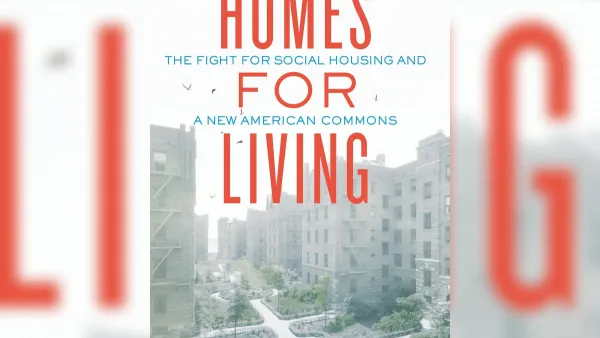
Book review: Co-ops, commons and the conundrum of cashing in on the American dream
Jonathan Tarleton’s "Homes for Living: The Fight for Social Housing and a New American Commons" shows what happens when a loophole in housing legislation opens the door to the privatization of a common good — and when an affordable home suddenly becomes a commodity.

Planetizen Federal Action Tracker
A weekly monitor of how Trump’s orders and actions are impacting planners and planning in America.

California plans to bury El Niño’s downpour
If the state plays its cards right, it may be able to store a billion acre-feet of El Niño’s water in aquifers.

Desperate measures: Advocates weigh draining Lake Powell to fill Colorado River
Draining the reservoir could reduce evaporation losses by a couple hundred thousand acre-feet.

Mamdani’s pied-à-terre tax survives legal challenge
A panel of judges found that the plaintiffs failed to demonstrate injury as a result of New York City's implementation of the tax.

Eastern Nebraska is running out of electricity
Data centers and electrification are straining eastern Nebraska’s grid, throttling economic development.

Seattle passes record-breaking transit services expansion
Proposition 1 will double the city’s transit tax to add 95,000 more bus trips and preserve 180,000 bus trips annually.

FREE Course: Walkable City 1: Why Walkability?
After describing his path towards focusing on walkability as the essence of good planning, Jeff Speck marches through his five principal reasons for making more walkable places.
Reinventing Malls: Planning Alchemy—Turning Gray Fields Into Gold
The course focuses on the opportunities and imperatives that shape reinvention of mall sites.

City of Rosemead
Rutgers University, Edward J. Bloustein School of Planning and Public Policy
One Hundred Miles
University of Michigan School for Environment and Sustainability (SEAS)
Hunter College, City University of New York (CUNY)
The Architects Foundation
City of Cambridge
Montrose County
The Pocatello Development Authority