The lie that laid claim to the skyscraper’s origins is well documented. Why do we still believe it?


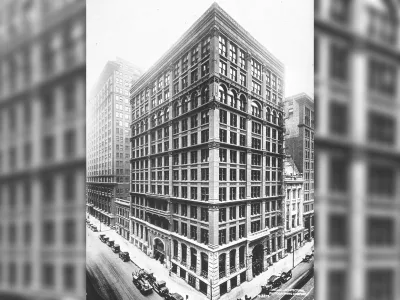
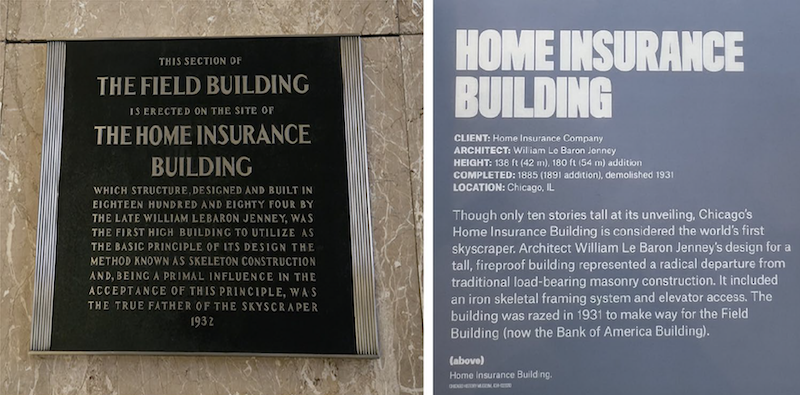
In 1907, when the architect William Le Baron Jenney died, the press and public universally mourned the loss of the "inventor of the skyscraper," based on his design of the nine-story Home Insurance Building (HIB), completed in Chicago in 1885.
The only problem is that Jenney did not, in fact, invent the skyscraper, nor was his building the first one. Rather, his designation was a result of a successful PR campaign waged by him and his colleagues. The campaign was so successful that the Jenney Myth remains alive and well, despite having little basis in truth.
How and why did Jenney hoodwink the public? And why does the myth persist?

What is a skyscraper?
First, however, we need to define a "skyscraper." From a historical perspective, a skyscraper is a relatively tall building that requires an elevator and features a curtain-walled façade with a riveted, all-steel skeletal frame, with additional steel for wind bracing.
Against this standard, the HIB fails fully. Jenney’s novelty was to embed (hollow, concrete-filled) iron columns inside the street-facing masonry walls, reducing their thickness to allow more sunlight into the offices. These iron columns were then attached to the iron girders and cast-iron lintel pans (also filled with concrete). If one removed the façade, the structure would appear as a fully iron-framed skeleton.
But the load-bearing masonry walls and the iron framing worked in tandem, making it a hybrid structure, which Jenney originally admitted when he wrote about the building in 1885. Without the masonry walls, the building would have been, as engineering historian Donald Friedman has described it to me, "a house of cards" — unstable against lateral forces.
It was the first building to contain steel — but only for the floor beams on the upper three stories. The steel beams were a last-minute substitution made at the request of the Carnegie mills. They were not part of Jenney's original design. The building was in no way a "steel skeleton" as Jenney later claimed. Just as important was that Jenney’s building was neither pivotal nor "necessary" in the sense that if Jenney had never lived, the skyscraper would have emerged all the same.
The PR campaign
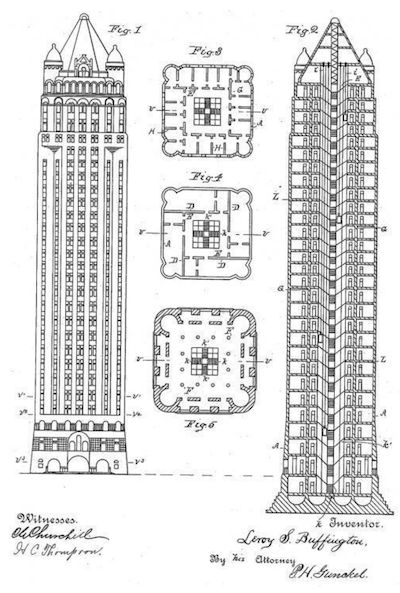
So why and how did Jenney win the title of "inventor of the skyscraper"? In 1888, a rival architect, Leroy Buffington of Minneapolis, won a patent for his iron-framed "cloudscraper." In 1892, he began suing people for patent infringement. While Jenney was never served lawsuit papers, he received a letter from Buffington warning him to "refrain from infringement of said patent or any of its claims." As his personal letters indicate, Jenney was worried.
And then, in 1896, an opportunity arose that allowed Jenney to make it seem like he beat Buffington to the punch, in case he was sued. In that year, F. T. Gates, President of the Bessemer Steamship Company, wrote to the trade journal, The Engineering Record (ER), inquiring to which "architect or engineer the honor is due of discovering and practically working out the idea of lofty steel construction of buildings?"
When Jenney saw this letter, he started sending personal letters to people involved in the HIB’s construction, asking them to write to the ER in support of him. Jenney even wrote a letter to Gates stating, "My claim is that in 1883 I invented and put into practical use in the Home Ins. Bldg. Chicago, what is now known as Skeleton Construction. . .." Gates responded that he found Jenney’s statement convincing.
Gates’s inquiry prompted several people to write in with their opinions. But most supported Jenney, either because he directly asked them to or because they were his friends, colleagues, or proteges.
In the July 11, 1896 issue, Jenney publicly claimed that he was the father of the skyscraper, writing in the ER, "The skeleton construction was a radical departure from anything that heretofore appeared and was exclusively my invention." His words, however, are simply untrue. His building was not a radical departure but rather one experimental structure among dozens built between 1870 and 1895.
Then, in the July 25 issue, Daniel H. Burnham, one of the most well-known architects of the day, chimed in with a series of false claims, stating:
This principle of carrying the entire structure on a carefully balanced and braced metal frame, protected from fire, is precisely what Mr. William L. B. Jenney worked out. No one anticipated him in it, and he deserves the entire credit belonging to the engineering feat which he was the first to accomplish.
The phrase "no one anticipated him" is incorrect and disregards the history of iron framing that long predated the HIB. The phrase "braced metal" is also misleading since there was no metal wind bracing. The wording that Jenney and Burnham used was designed to obviate Buffington’s claims by arguing that Jenney’s building had priority.
Then, in February 1897, Gates wrote back to the ER, declaring Jenney the winner of this letter-writing "competition." But what did Gates know about the arcane arts of structural engineering? He only knew what Jenney and his colleagues fed him. In this way, Jenney had engineered his victory — he told Gates he was the inventor of the skyscraper, so Gates declared it to be so. After that, it became "conventional wisdom" that Jenney invented the skyscraper.
The Modernists’ agenda
The Jenney Myth was then amplified by the Modernists in the mid-20th century. Architects in Europe, like those affiliated with the Bauhaus, argued that buildings should be, in the spirit of Le Corbusier’s phrase, "machines for living." To bolster their claims, they sought historical precedents and found the early commercial high-rises in Chicago useful for their arguments, which they believed provided the seeds of Modern Architecture.
One can see this clearly in the 1941 book, Space, Time and Architecture, by Sigfried Giedion, one of the most influential mid-20th-century European writers on Modernism. Drawing on Jenney’s PR campaign for inspiration, Giedion makes Jenney the hero of the story, writing:
The Chicago school is bound up with the creation of the modern office building — in other words, with the creation of an administration center. All sorts of engineering problems entered into the solution reached in the Chicago buildings and the founder of the Chicago school, William Le Baron Jenney…
The Jenney Myth was further carried forward in the 1950s and 1960s by Northwestern University Professor Carl Condit, whose popular works on the history of Chicago skyscrapers and the "Chicago School" were widely read.
The pushback: Too little too late
By the 1980s, however, scholars demonstrated forcefully that Jenney's claims were false. The most notable research was conducted by two architectural historians, Gerald Larson and Roula Geraniotis. Based on an analysis of a structural fragment housed in Chicago’s Griffin Museum of Science and Industry, they confirmed that HIB’s iron frame was neither self-supporting nor allowed for a curtain wall. They also reviewed the long history of iron framing to show there was nothing revolutionary about the HIB. Even Condit reversed his position in the 1980s, stating, "We can no longer argue that the Home Insurance Building was the first skyscraper. It was not."
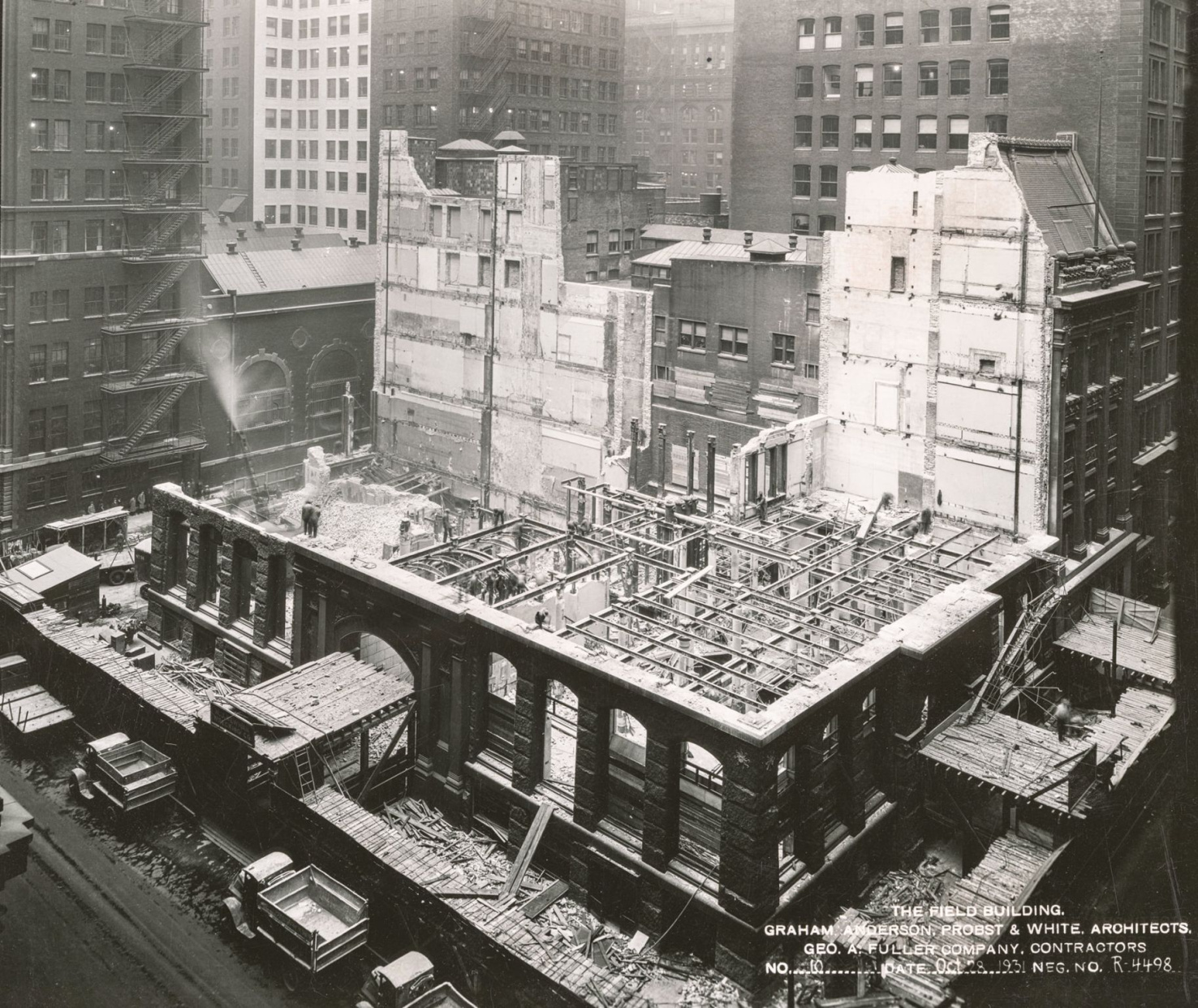
Nonetheless, the revisions were too little, too late. The proof provided by academics was quite technical, and so the discussion never fully left the academy. For that matter, scholars who study the "first skyscraper" question have come to a consensus that there is no such thing as the first one. A "skyscraper" is a complex, multidimensional, social, economic, architectural, and engineering phenomenon. Its emergence in the late 19th century was an evolutionary process, marked by advances here and there, but also by mistakes and false starts. There was no one pivotal individual, nor any “Eureka!” moment. Many people added something to the process. But this is not what the public wants to hear. People demand certainty, and the Jenney Myth offers it. For that matter, the canard is so deeply embedded in pop culture, books, articles, and Wikipedia pages, that the myth keeps itself alive of its own accord. And, Chicago still peddles it for boosterism and self-pride, truth be damned.
The creation of the Jenney Myth is a case of history being written by the "winners" because Jenney and his colleagues were so well-respected and revered that the public believed them, even though they were stretching the truth to ensure that Chicago got what they felt it deserved — the title of "home of the skyscraper." In this regard, the PR campaign was a towering achievement, but it must be demolished.
—
Jason M. Barr is a professor of economics at Rutgers University-Newark. He is the author of Cities in the Sky: The Quest to Build the World’s Tallest Skyscrapers (Scribner Books, 2024). This article is a summary of his paper, "The Jenney Myth: How the Home Insurance Building Was Declared the 'World’s First Skyscraper'," published in the Journal of Urban History and available for free the whole month of May, 2026.

Tallest Building in US Proposed for OKC
The building would stand 1,907 feet high, twice as tall as any other building in the Oklahoma City skyline.

Austin’s Changing Skyline
Multiple proposed skyscrapers are changing the shape of once low-slung downtown Austin, signaling the growth of the city as a technology and manufacturing hub.
Vancouver’s Spiral High-Rise Creatively Skirts Zoning Rules
To meet zoning constraints, the twisting skyscraper uses an innovative design that optimizes its small footprint.

Planetizen Federal Action Tracker
A weekly monitor of how Trump’s orders and actions are impacting planners and planning in America.

Amtrak, CN end decades-long dispute with eight-year agreement
The new operating agreement establishes an updated framework for the companies to work together, including processes to resolve disputes.

Judges permit Denver to divert 77,000 acre feet from the Colorado River for reservoir expansion
Overuse and climate change have caused the Colorado River’s water levels to plummet.

New density bill would require 7 California cities to establish regional transit hubs
The bill would also require major cities in California to permit high-rise residential buildings.

San Francisco supervisor looks to establish city’s first department of housing
The proposed agency would coordinate planning and financing around housing, as well as support affordable housing production.

South Chicago development proposal would 'upzone' neighborhoods to increase density
The South Chicago Land Use Framework plan also aims to promote pedestrian and transit-oriented developments.

FREE Course: Walkable City 1: Why Walkability?
After describing his path towards focusing on walkability as the essence of good planning, Jeff Speck marches through his five principal reasons for making more walkable places.
Reinventing Malls: Planning Alchemy—Turning Gray Fields Into Gold
The course focuses on the opportunities and imperatives that shape reinvention of mall sites.

City of Wisconsin Rapids
Harvard University Graduate School of Design
KFH Group Inc.
The Architects Foundation
University of Cincinnati Online
The Pocatello Development Authority
The Urban Renewal Agency of the City of Pocatello


