“The great American roadside” to some, “vulgar and desecrating” to others, “parkitecture” is a truly American phenomenon. And it comes at a cost.


In the late 19th century, Midtown was still an upstart neighborhood, challenging Downtown’s primacy as New York’s commercial, entertainment, and shopping hub. Midtown’s rise started with the migration of wealthy people uptown, followed by the businesses and institutions that served them. Bergdorf Goodman and Lord and Taylor stores turned Fifth Avenue into the “Ladies Mile” shopping district; Macy’s made 34th Street a destination with its block-long flagship store; and a new theater district blossomed at the intersection of Broadway and 42nd Street, where the New York Times established its headquarters.
A parallel process was taking place in late 19th century Boston. Copley Square became the downtown of Boston’s fashionable Back Bay neighborhood, attracting major institutions like the Museum of Fine Arts and the Central Library along with office buildings and hotels. Other big cities got their midtowns in the 1920s and ’30s.
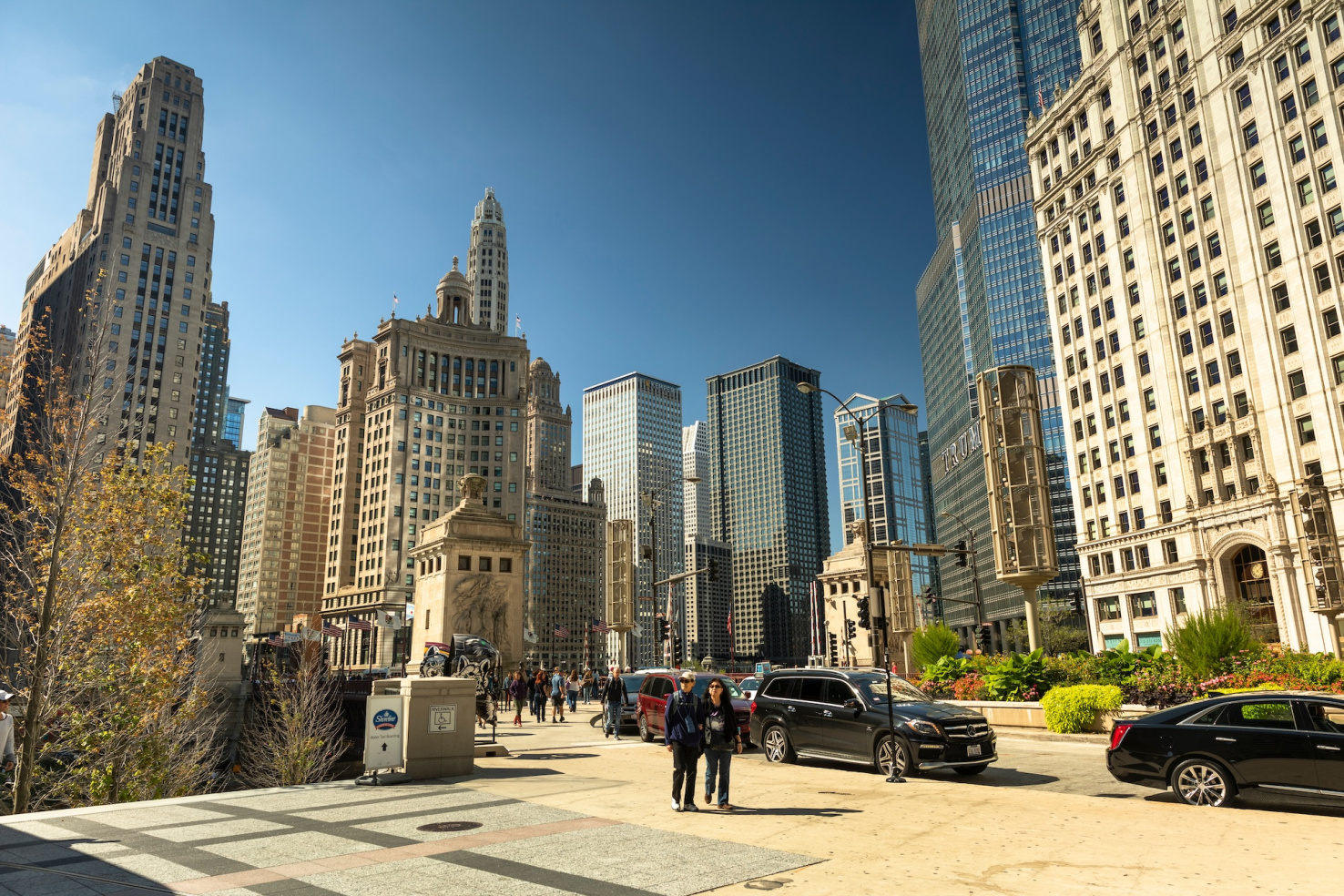
In Chicago, the Magnificent Mile shopping district stretched from the Loop toward the city’s upscale north side neighborhoods. In Los Angeles, Hollywood emerged as a new business and entertainment district closer to the hills where movie stars and moguls were settling. The Central West End in St. Louis, New Center in Detroit, University Circle in Cleveland, and Midtown Atlanta developed similarly during this era.
These midtowns all more or less resembled traditional downtowns, with a broad diversity of commercial and residential buildings, minimal provision for parking, and easy transit access. But subsequent outlying centers would diverge more and more from this mold.
L.A.’s Miracle Mile, stretching along Wilshire Boulevard about five miles west of downtown and three miles south of Hollywood, offered the first inklings of a different development model. The miracle started when Bullocks opened in 1929, the first major department store to locate outside of a downtown or midtown commercial district. The copper-accented art deco building sat amidst empty lots and single-family homes, far from streetcar service or any other significant attraction. It didn’t matter. More Angelenos, especially those of means, were getting around by car, and Bullocks, unlike most downtown department stores, had a generous lot to accommodate them.
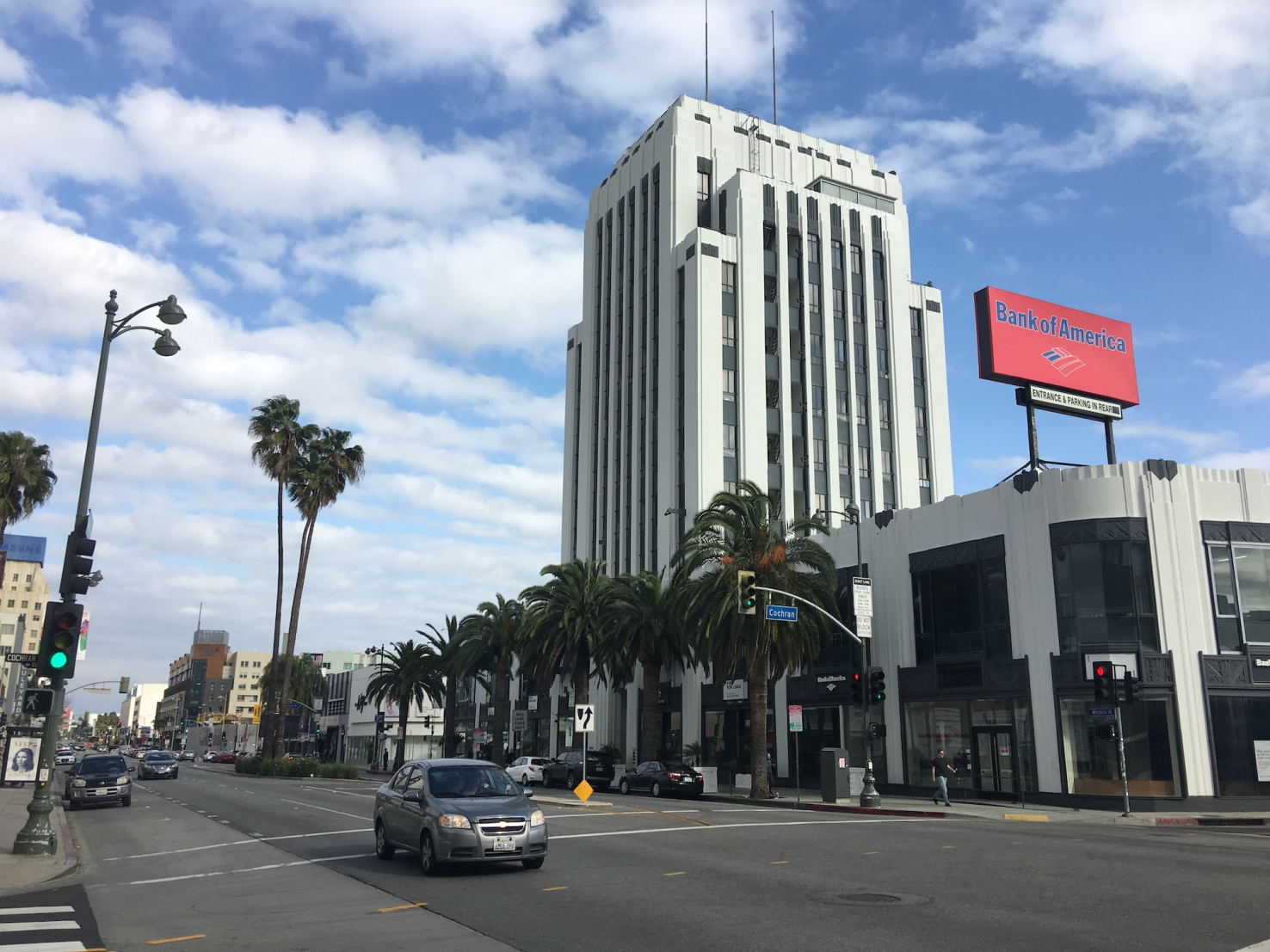
Over the following decade, several more department stores and office buildings went up along Miracle Mile. These uniformly art deco buildings, streamlined and gleaming white, created a totalizing modern environment signifying that this was a new kind of urban space, a “linear downtown.” LA’s third downtown extended further west along Wilshire Boulevard in the ensuing decades, as skyscrapers rose up in Century City and Westwood. This high-rise corridor will soon get the subway service that it so clearly deserves. But Wilshire’s urban form is an anomaly.
Elsewhere in the country, the linear downtown went out in favor of the commercial strip, an urban environment whose design was wholly defined by the need to accommodate the car.
It is, poetically, from the gas station that the architecture of the automotive commercial strip flows.
Before World War I, enterprising gas station owners began offering a greater array of services, including oil changes and tire replacement. The key to the “super service station” was its drive-in architecture, which enabled motorists to navigate the complex and its various offerings in their cars. Instead of facing outward toward the street and sidewalk, as pre-car storefronts so conspicuously did, super service stations faced inward toward their own interior motor court. It may not have looked like much, but it was a revolution in urban design.
The continued evolution of parkitechture eventually led to Washington, DC’s Park and Shop, completed in 1930. This L-shaped, parking lot hugging development anchored by a Piggly Wiggly supermarket established the design conventions of the strip mall.
Building layout was not the only element of commercial architecture reshaped by the automobile. Prospective customers were no longer on the sidewalk; they were on the road, traveling at ever greater speeds. As commercial strips flourished on suburban stroads, individual businesses needed towering signs to make themselves known.
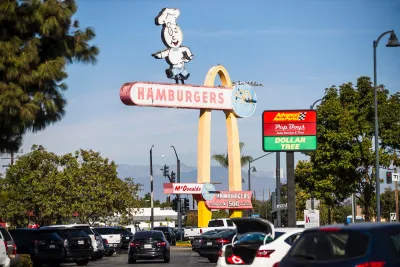
Some created memorable designs based on their products or brand, called “googie” or “duck” architecture for the famous Long Island Duckling building. Regional fast-food chains, from Bob’s Big Boy to White Castle, were particularly enamored of this kind of architecture, turning their restaurants into advertisements.
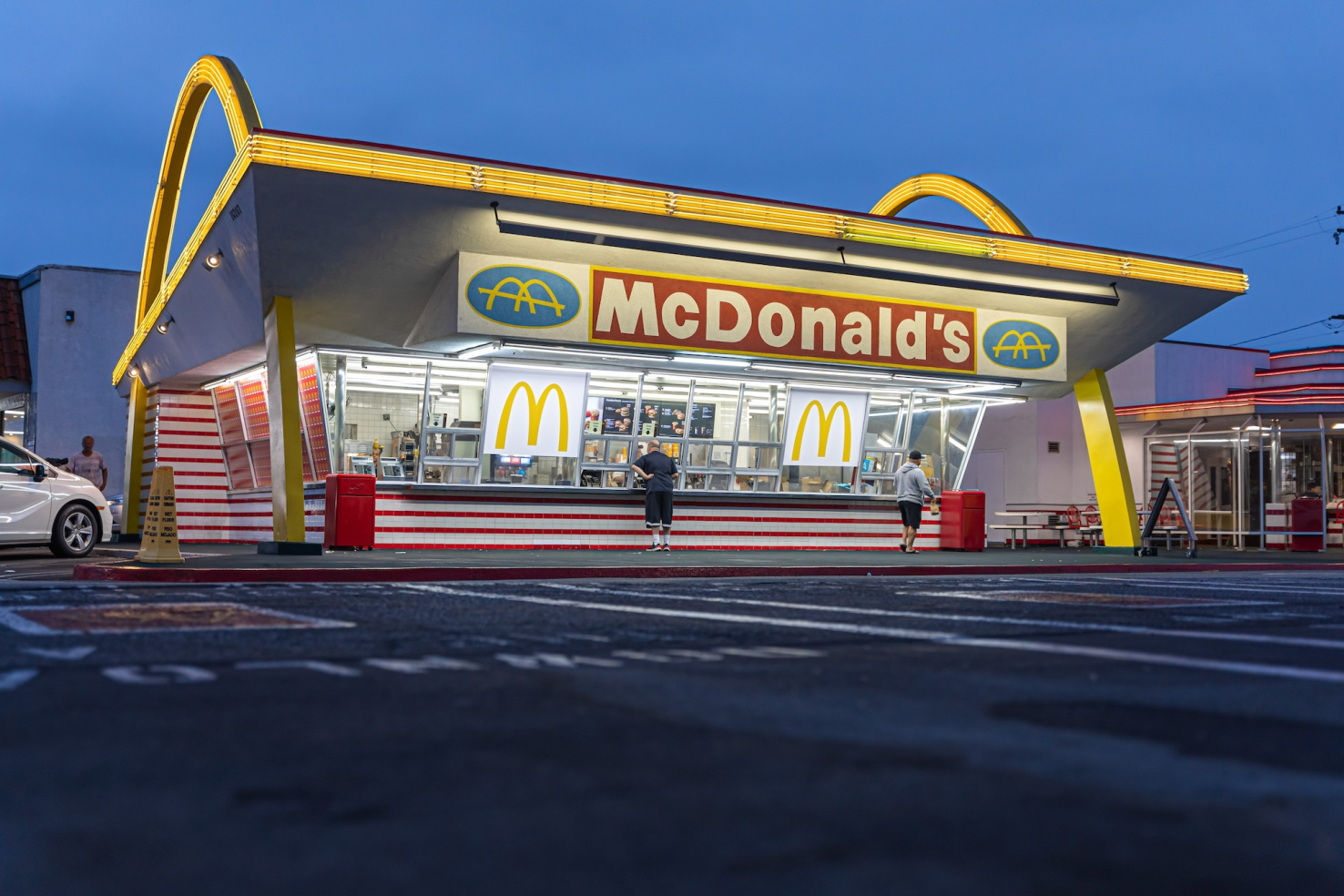
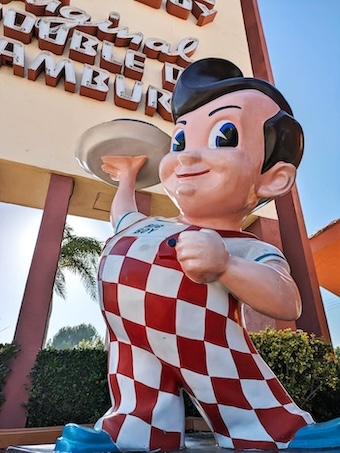
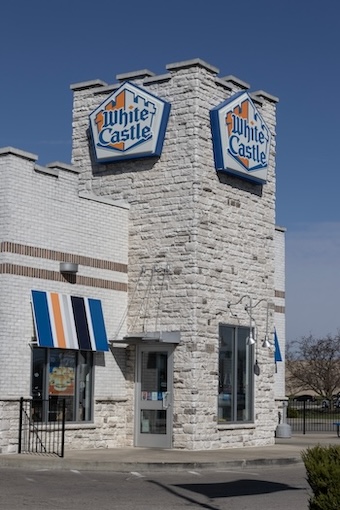
This new commercial landscape was polarizing. “The Great American Roadside,” one writer triumphantly (and presciently) declared, would be “the most hugely extensive market the human race has ever set up.” Other observers saw a tacky “hot dog trail,” stretching “its vulgar, desecrating length over hill and valley, beach and cliff.
These diverging perspectives, already being aired in the 1930s, would continue to define the critical discourse around new suburban centers of commerce. But even then, critics were blind to the real problems of strip-style development. Googie architecture and playful roadside advertisements are today viewed as architectural landmarks, not aesthetic abominations.
The truly vulgar aspect of these environments is their relationship to the rest of the metropolis. No longer would shopping or office districts be integrated with the rest of the city. Commercial areas would be for commerce alone. This pattern of urban development has profound drawbacks, no matter the quality of the architecture.
This piece is an excerpt from The Unfinished Metropolis, Ben Schneider’s new book exploring how America’s favorite things to build — freeways, single-family homes, malls, and downtown office towers — are keeping us stuck in the past. In The Unfinished Metropolis, Schneider argues for the reclamation of the lost art of city-building in the modern day. Read more excerpts, and more of Ben’s work here.
From The Unfinished Metropolis: Igniting the City-Building Revolution Copyright © 2025 by Benjamin Schneider by permission of Island Press, Washington, D.C.


Planetizen Federal Action Tracker
A weekly monitor of how Trump’s orders and actions are impacting planners and planning in America.

Amtrak, CN end decades-long dispute with eight-year agreement
The new operating agreement establishes an updated framework for the companies to work together, including processes to resolve disputes.

Judges permit Denver to divert 77,000 acre feet from the Colorado River for reservoir expansion
Overuse and climate change have caused the Colorado River’s water levels to plummet.

NYC DOT wants faster, more permanent street upgrades
The city is examining ways to build more concrete infrastructure without getting entangled in 'decades-long' projects.

'Something we’ve never seen before:' rising utility rates could strain city finances nationwide
Data centers, climate change and other factors have caused utility rates in the United States to increase by 38% since 2020.

Trump to overrule local leaders, lease millions of acres of America’s Pacific Island territories’ seafloors to mining companies
International law says that the Indigenous people of America’s territories have a right to prior and informed consent regarding projects that impact their countries.

FREE Course: Walkable City 1: Why Walkability?
After describing his path towards focusing on walkability as the essence of good planning, Jeff Speck marches through his five principal reasons for making more walkable places.
Reinventing Malls: Planning Alchemy—Turning Gray Fields Into Gold
The course focuses on the opportunities and imperatives that shape reinvention of mall sites.

Harvard University Graduate School of Design
KFH Group Inc.
Greater Baltimore Committee
The Architects Foundation
University of Cincinnati Online
The Pocatello Development Authority
The Urban Renewal Agency of the City of Pocatello

