The field of academic publishing has become complex and crowded. What does it mean for urban planners?




Planetizen is very excited to welcome esteemed researcher and academic Ann Forsyth back for a new monthly column on urban planning research, education, careers and more. See Ann's previous columns, which offered advice to planning students here.
Information has exploded in the past few decades, including research information relevant to planning. One notable change that has been highly visible but perhaps less well understood in planning practice is the rise of open-access research journals where articles are free online. This is, on the one hand, a great benefit, but it also brings risks. I’ll explain how this happened, highlight potential problems, and propose what planners can do. There isn’t a simple fix, but rather a need to balance the ease of accessing relevant research with curiosity about its origins.
The Golden (OA) era of publishing
In the early 2000s, the emerging internet offered a new opportunity to broaden access to research knowledge, potentially disseminating it for free online rather than through subscription-based journals that were increasingly expensive. Grant funders were also interested in having the work they had paid for be more widely available. However, publishing has costs — for example, for managing peer reviews, supporting the editor, copyediting, and supporting databases — which are normally paid for by subscribers. So, in the absence of subscriptions, new models emerged to cover those costs. The one that has perhaps become the most pervasive is called Gold Open Access (OA). There are many shades of open access, including those in which universities, governments, and philanthropies directly pay costs and authors do not. However, in Gold OA, once an article is accepted, the author pays a publication charge, which in reputable journals can range from about $1,000 to over $10,000. Unsurprisingly, it took off first in the sciences, where grants are more common and larger, but the practice has broadened out over time.
This new model provided opportunities for entirely new kinds of open-access journals. These now exist alongside subscription (paywall) journals and hybrid journals that offer both subscription and open access. A major new type was Gold OA journals run as a business. While they come in many formats, some of high quality, two more controversial types stand out. One was predatory journals that often charged lower fees but used fraudulent practices to solicit papers, and had limited peer review and quality control measures, a model relying on low costs. A second was megajournals, those with over 2,000 articles per year, including some with over 10,000.
Because the Gold OA funding model relies on payments from authors of accepted articles, such journals have focused on quantity of publication over quality, often using special or themed issue formats. There have been several controversies over quality issues, and one major publisher, Hindawi, which Wiley bought, no longer exists as a brand. When faced with an online journal article it can be really hard to figure out which type of OA it represents, and this is true even for researchers.
Opportunities and challenges
This new landscape of open-access publications has some benefits. No longer do readers such as planning practitioners need to subscribe individually or access journals at their agency or by visiting a university library; instead, millions of articles are available for free on the internet. While predatory journals are a real problem, and quality has been an issue in megajournals, there are benefits to authors in publishing in some Gold OA journals. For example, some OA journals will take longer articles than are typical in subscription journals which can be a real benefit in qualitative studies where quotes and images provide evidence. Others will publish replication studies that do the important but often unexciting work of seeing if it is possible to repeat earlier work. Still others might publish case studies that, while not as analytical as is often expected in research journals, are still useful. Proponents point to less editorial gatekeeping as a benefit. In planning, we have always dealt with a wide range of evidence, including reports and working papers, so this may not be so new.
However, it does raise some problems. An important one is that the onus of judging the quality of the research is left to the reader. And yet it may not be obvious to the reader which kind of journal they are accessing. Many journals use new forms of peer and editorial review, for example, review after publication, not before, which can be confusing to readers and also means unreviewed papers are live for a long time. There are also so many articles that it is possible to cherry-pick to match one’s pre-existing opinion rather than have the balance of evidence challenge preconceptions. Even researchers can be taken in by reputable-looking journals that are not so reputable.
Furthermore, researchers face publication fees. I am affiliated with two universities. Harvard has had a policy of not paying publication charges but has expected faculty to use grants to do so. Accordingly, I have been sparing about which papers I have paid to make OA, focusing on those I felt would really be of interest to practitioners. Recently affiliated with the University of Sydney, I now have fees for many publishers covered by an agreement through the Australia-New Zealand Council of Australasian University Librarians (CAUL). Such arrangements shape what research is available in open access.
Even more questions
What can practitioners do? Do not turn away from research, but as you would do with reports and working papers, be somewhat critical about the work you find online. Major publishers — like Taylor and Francis, Sage, Elsevier, Wiley, and Springer Nature — do tend to manage quality better, though, to compete in the OA space, they have been launching many new journals. There is certainly a role for academics in translating research into practice guidance and thus reducing the burden on practitioners, but with so many demands on faculty time and so many specific practice questions, it can be hard to find a fit. I think there may be an emerging role for librarians to help the profession manage information more effectively, though the enduring question is: who would pay? Into this come AI models which are opaque as to the sources of their training information, raising even more questions. Overall, it is a time where the information landscape presents both opportunities and costs to practitioners interested in engaging research evidence.
For further information (yes, all free online):
Forsyth, A. (2026). The Changing Landscape of Scholarly Publishing and Urban Planning. Journal of Planning Literature, 41(2), 294-307. https://doi.org/10.1177/08854122251330207 (open access, refereed journal article)
Forsyth, A. (2019). Scholarly Publication in an Information Age: Where JAPA Fits. Journal of the American Planning Association, 85(4), 389–392. https://doi.org/10.1080/01944363.2019.1648947 (free to view, editorial)
Sharp Phillip A., Bonvillian William B., Desimone Robert, Imperiali Barbara, Karger David R., Mavhunga Clapperton Chakanetsa. 2023. Access to Science And Scholarship: Key Questions About the Future of Research Publishing. Cambridge, MA. Unpublished Report. https://access-to-science.pubpub.org/.

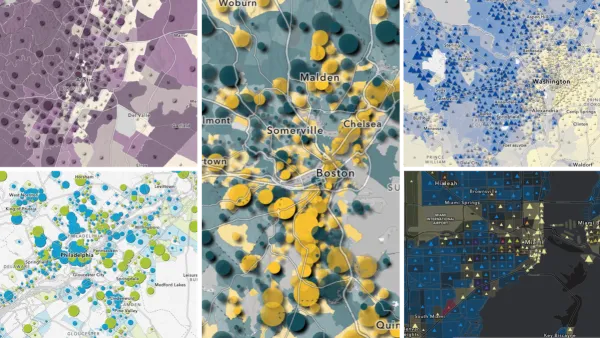
Explore US Demographics With the New ACS Atlas Collection
Esri's new ACS Atlas Collection offers interactive applications that visualize the latest U.S. demographic and socio-economic data, enabling users to explore over 175 curated web maps across various thematic areas.
Youth, Inexperience, and a Sense of Mission
Forty years ago this week, I arrived in Tallahassee to take my first full-time university job. It was a nervous moment. After nearly eight years of graduate school, I was about to learn if I was any good at the career I'd prepared so long to begin.

Back to School: Planetizen’s Top 10 Master’s Programs for Urban Planners
Planetizen’s Editorial Director James Brasuell joins the Planning Commission Podcast to discuss their new list of the Top 10 Schools for Urban Planners.

Planetizen Federal Action Tracker
A weekly monitor of how Trump’s orders and actions are impacting planners and planning in America.

Northwest rail fans eager for Sept. 30 debut of Amtrak’s Airo fleet
Get ready for that new train smell and more seats. But they won’t go faster or run more frequently on the Cascades route in Washington and Oregon.

Trump is considering data centers on 6 states' public land — some state officials say they had no idea
If the administration approves the proposed projects, data center and data center-related developments will cover 17,600 acres of public land.

California may destroy its beaches trying to save homes from El Niño
Boulders and seawalls can protect homes from waves, but ultimately destroy sandy beaches.

California high-speed rail accomplishes only one legislative goal in 2026
The majority of the agency's failed pitches were never developed into written proposals.

Sharp cuts to federal passenger rail, public transit funding arrive today
The American Public Transportation Associations estimates the stopgap bill will result in an over 80% cut to federal passenger rail investment and 20% cut to public transit investment.

FREE Course: Walkable City 1: Why Walkability?
After describing his path towards focusing on walkability as the essence of good planning, Jeff Speck marches through his five principal reasons for making more walkable places.
Reinventing Malls: Planning Alchemy—Turning Gray Fields Into Gold
The course focuses on the opportunities and imperatives that shape reinvention of mall sites.

City of Thousand Oaks
City of Wisconsin Rapids
Harvard University Graduate School of Design
The Architects Foundation
University of Cincinnati Online
Northern Illinois Transit Authority (NITA)
The Pocatello Development Authority
The Urban Renewal Agency of the City of Pocatello

