What we miss when we turn elsewhere into evidence


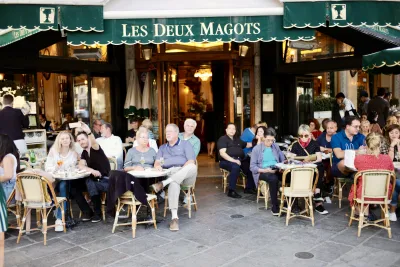
The suspect post is all too familiar: it contains a photograph or video from elsewhere, with a caption that explains its meaning. Parisian front-facing café tables and chairs become unimpeachable evidence of sought-after civic life. A protected bike lane proclaims victory in the war on cars. Crowded public transport proves “if we build it, they will come.”
More often than not, the elephant in the room is the American city allegedly unable to compete.
This imagery and messaging remain popular, even if redundant.
I think it’s worth reexamining why these posts persevere, since Facebook and LinkedIn lack the otherwise attractive “American in Paris” elegance of George Gershwin, Ernest Hemingway, or F. Scott Fitzgerald. Those legacy creatives were absorbed by elsewhere. Today’s social media authors travel there to learn a lesson they may already have in mind.
What catches my attention is the recurring confidence of comparison: the assumption, based on one’s own experiences, that we can — and should — learn a lot from cities such as Amsterdam, Copenhagen, Paris, Curitiba, Tokyo, and Melbourne. I’m not immune, having long been a true believer in experiencing and photographing new places and formulating long-form protocols for doing so. I have offered suggestions on “how to document cities, away from home,” premised on noticing things we might easily overlook in more familiar realms.
But at the same time, “the promise of elsewhere” has me fixated on reconsidering why we look to other places for inspiration rather than what we can learn from places we already know.
We should also be careful how we treat what we might learn upon arrival. Upon visiting somewhere new, we risk something more self-serving: proving a proposition already formulated before we arrive.
The form of a social media post containing photos, videos, and commentary is straightforward. Social media platforms require efficiency, and readers prefer clear messaging. The post is therefore a proclamation, a takeaway, not likely to say “I’m not yet sure of what I see.”
Rather, consistent with the “convert’s reflex,” the caption often arrives before the inquiry has really begun. And that is where my discomfort remains.
On the one hand, foreign examples suggest that many American streets are car-centric, transit systems are under-built, or public spaces range from ignored to over-designed to over-controlled. Yet, simplistic, two-dimensional social media can obscure contextual realities and overlook places overseas that might not readily support key assertions.
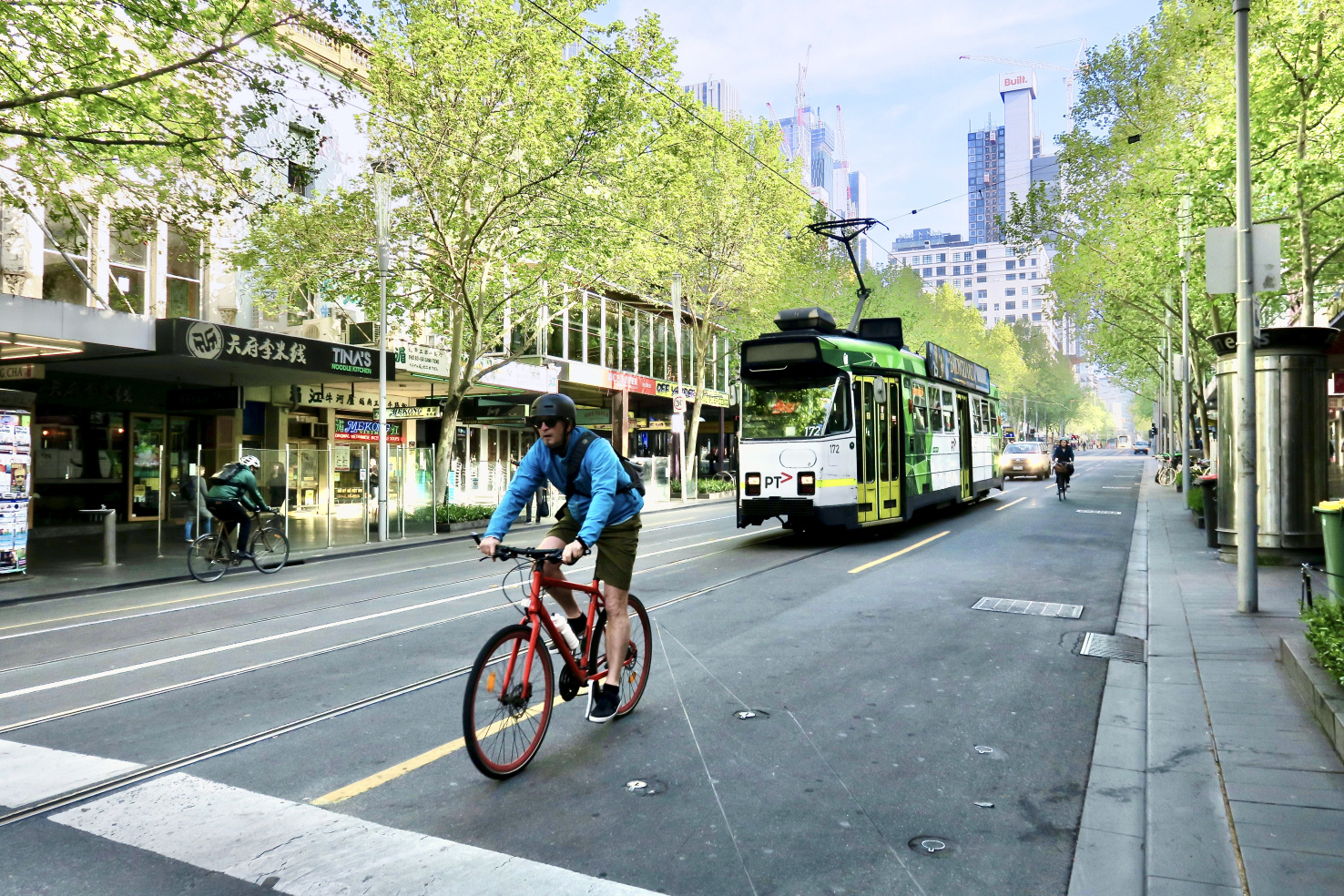
For instance, an Amsterdam bike lane has many components. Chris and Melissa Bruntlett remind us that Dutch biking infrastructure depends on culture and customs, decades of evolved cycling management, street design improvements, and increasingly sophisticated bicycle parking. A public square or reclaimed motorway in Paris — often championed in the urbanist ecosystem online — is also more than it seems. It reflects Parisian density, shifting maintenance budgets, and a willingness on the part of a strong mayoral administration (most recently socialist Anne Hidalgo) to navigate controversy. A Melbourne tram stop is not a simple transit feature. It reflects a particular metropolitan transit-use pattern and broad service expectations.
Each of these examples relies on its vernacular situations, including regulations, densities, politics, maintenance approaches, public habits and expectations, and particular histories that are not fully visible in social media photos, videos, or verbiage.
Images and captions that appear to be conclusions may mislead us. Their lessons become too easy: copy and paste images and forms, remove cars, and all else will follow. The result is the familiar before-and-after fantasy in which a Utrecht street, a Barcelona plaza, or a Paris boulevard is set beside an American “stroad” (thanks, Chuck Marohn, for the term). It seems as simple as finding the courage to post, the imagination to illustrate and compare, and the resources and capacity to implement.
In some situations, this simplicity may work. But without understanding what made the example work as shown abroad, bringing change home risks becoming more conceptual than useful, and more rhetorical than implementable.
We need to admit that elsewhere can easily flatter us. Suddenly, we can play informed investigators, evidence gatherers who return with unassailable proof that, ironically, the city itself has not yet cross-examined. In contrast, familiar places are less astounding — they actually complicate our first impressions because we know their context all too well. From the start, they remind us of the drab, seamless web of politics, money (including who gets and who pays), habit, interpersonal histories, and local resistance to change over time.
Learning from elsewhere is appropriate, but we should be careful about drawing conclusions too soon.
The better photograph or video from afar is not always the one that immediately seems to prove a provocative point. Rather, it may be the one that asks what we are actually seeing, and, more importantly, what we can realistically carry home.
This piece originally appeared on Resurgence: A Journey.


Planetizen Federal Action Tracker
A weekly monitor of how Trump’s orders and actions are impacting planners and planning in America.

Amtrak, CN end decades-long dispute with eight-year agreement
The new operating agreement establishes an updated framework for the companies to work together, including processes to resolve disputes.

Northwest rail fans eager for Sept. 30 debut of Amtrak’s Airo fleet
Get ready for that new train smell and more seats. But they won’t go faster or run more frequently on the Cascades route in Washington and Oregon.

LAX SkyLink opening delayed again, contractor won’t commit to new deadline
The project was supposed to open its doors to the public in 2023.

Caltrain may slash over one-third of its stations
If Bay Area voters reject two transit tax measures, Caltrain, BART and AC Transit will see steep service cuts.

A 'dangerous' precedent: North Carolina successfully pressures communities into voting for toll roads
Two mayors resigned from the Charlotte Regional Transportation Planning Organization after it voted in favor of the toll roads.

FREE Course: Walkable City 1: Why Walkability?
After describing his path towards focusing on walkability as the essence of good planning, Jeff Speck marches through his five principal reasons for making more walkable places.
Reinventing Malls: Planning Alchemy—Turning Gray Fields Into Gold
The course focuses on the opportunities and imperatives that shape reinvention of mall sites.

City of Thousand Oaks
City of Wisconsin Rapids
Harvard University Graduate School of Design
The Architects Foundation
University of Cincinnati Online
The Pocatello Development Authority
The Urban Renewal Agency of the City of Pocatello

