20 years post Katrina, New Orleans has shored up and reinvented itself to absorb millions upon millions of gallons of stormwater. Their success holds lessons for landscape architects all over the world.



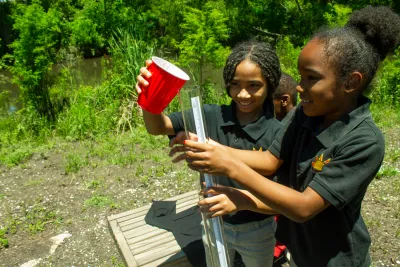
“Long before this place was known as New Orleans, it was called Bulbancha, meaning ‘place of many tongues,’ and a center for connection, trade, and unity — geographically located on one of the nation's oldest and major river systems,” Layla Creppel, an indigenous environmental scientist (Oglala Sioux/Lumbee/Tuscarora), shared at the American Society of Landscape Architects’ (ASLA) conference in October. New Orleans was an apropos location for the October event, which coincided with the 20th anniversary of Hurricane Katrina and highlighted climate adaptive design.
I attended to take the pulse on the latest in the industry and learn about New Orleans’ post-Katrina projects. Throughout the week, I observed a resilient city offering replicable models and a design field playing an increasingly prominent role in global issues. In addition to creating outdoor places of beauty, joy, and natural respite, landscape architecture is uniquely positioned to address challenges like extreme weather events, resource scarcity, biodiversity loss, pollution, food insecurity, and social disconnection.
New Orleans is sinking
New Orleans experiences frequent flooding due to hurricanes, storm surge, heavy rainfall, low elevation, and subsidence (sinking ground). Although most Katrina devastation was caused by a preventable failed levee network, and the city subsequently improved its levees, floodwalls, pump stations, floodgate systems, and other hard infrastructure, the levees continue to sink each year. In some areas, subsidence is occurring around two inches annually.
Enter nature-based design. Post-Katrina, the city has shifted from simply draining water to “living with water” — a common refrain in design circles and a wise approach for Louisiana, a state that is roughly half water and wetlands. Recognizing that everyone benefits when we design with nature, not against it, New Orleans is working to weave climate-resilient design into every project, large or small.

Conference keynote and former Louisiana Lieutenant Governor and New Orleans Mayor Mitch Landrieu echoed this: “As landscape architects, you understand something fundamental that took us years to learn. You can't fight nature. You’ve got to learn how to live with it, and that's no more evident than how we live with water… This is why your profession matters. You're just not making things look pretty — although, to be clear, beauty really matters — you're literally reshaping how communities can survive and thrive in the face of change.”
Landrieu, who was on a boat in the Ninth Ward helping rescue stranded people after Katrina, brought added context and historical significance to the plenary. “Katrina basically destroyed everything that we know and that we love in the blink of an eye,” he said. “But when disaster strikes, you cannot just rebuild what was. You gotta take a minute and imagine what could be… So instead of rebuilding for the past, we had to rebuild for a different future.”
Landscape architects not only help restore ecosystems and rebuild in ways that strengthen ecological and social resilience, they also often serve as “second responders” after disasters — entering communities to assess damage. In Los Angeles, they stepped in to prevent the removal of mature oak trees that survived the Eaton Fire and shielded nearby homes. Inspiration abounds alongside tragedy.
Here is a sampling of post-Katrina New Orleans resilience projects — ranging from large-scale efforts to urban acupuncture:
- Gentilly Resilience District: The city’s showcase stormwater project will relieve pressure on the drainage system. Mirabeau Water Garden will store up to 10 million gallons of rainwater in a retention pond, offsetting flooding while restoring groundwater and reducing subsidence. The Pontilly Hazard Mitigation Project will convert vacant land into two large parks, 38 pocket parks, 16 green alleyways, 13 blocks of bioswales, a 90,500-square-foot golf course bioswale, pervious pavers in parking zones, and 24 street basins with bioretention cells.
- Terrebonne Basin Barrier Islands: Barrier islands often serve as first lines of defense in storms. Projects here have restored over eight miles of shoreline and 1,250 acres of marsh, dune, and beach to buffer inland communities, wetlands, and economic infrastructure (fishing, oil, gas, and Port Fourchon).
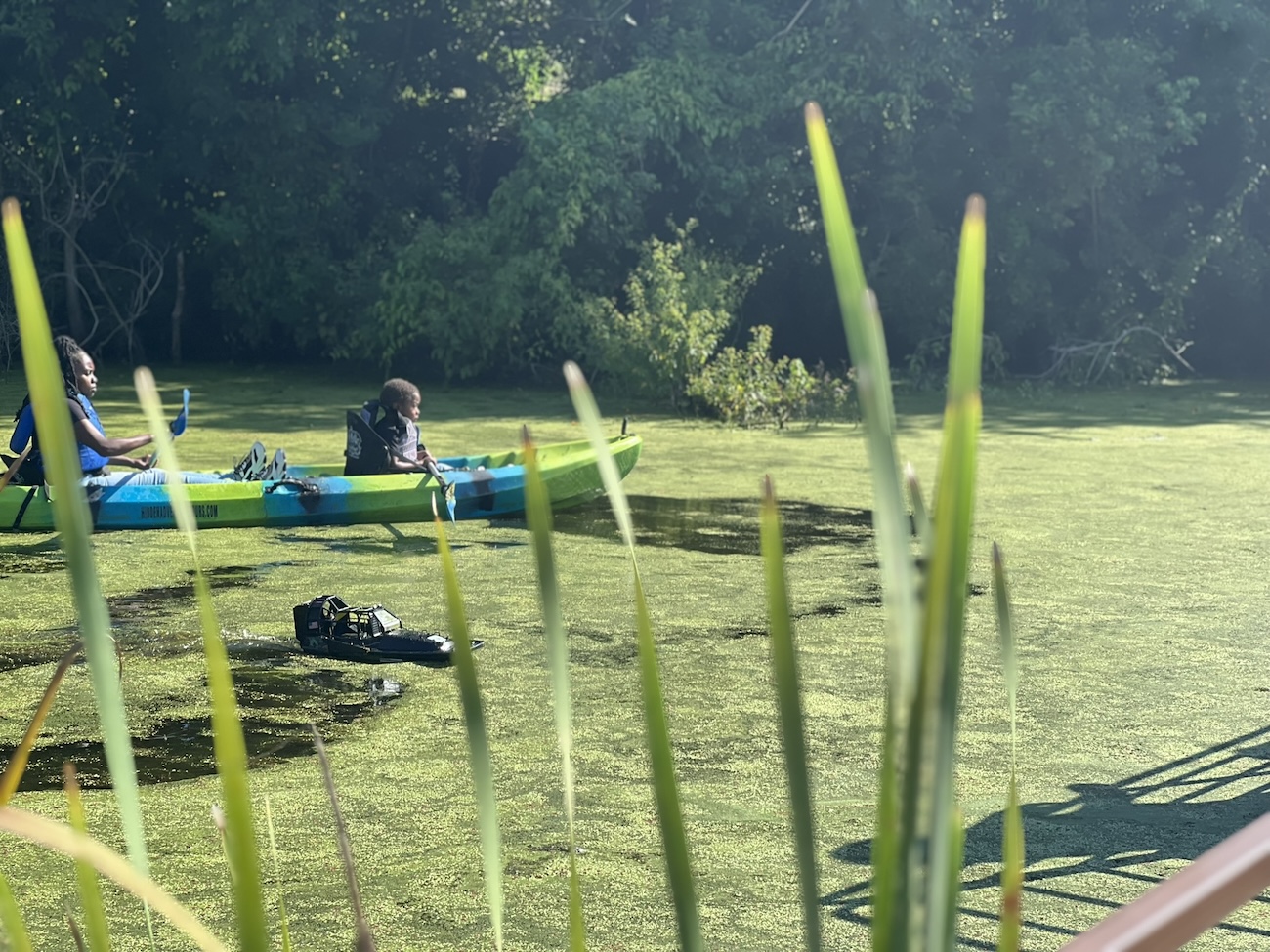
- Sankofa Wetland Park & Nature Trail: Wetlands absorb storm surge and serve as a critical buffer for inland areas, and this Lower Ninth Ward community-led project will restore 40 acres of wetlands decimated by Katrina. The already-completed eight-acre section attracts migratory birds and native wildlife, flora, and fauna. Future bioretention ponds will retain 8 million gallons of stormwater.
- Gretna City Park: Part of the Gretna Resilience District, this park stores up to 6.5 million gallons of stormwater. It features a lagoon with an open-water pond connection and kayak launch, over 400 trees, 1.5 miles of trails, two pedestrian bridges, and a large open-air pavilion.
- Lafitte Greenway: This 2.6-mile rail line-turned-linear park features a bike lane, playgrounds, sports facilities, music venues, farmers market, and soon a farm, along with over 500 trees, bioswales, permeable pavement, and bioretention cells.
- Parisite Skatepark: Located under a highway, the skatepark uses stormwater gardens to capture water and pollutants spilling off the above interstate, reducing flooding and filtering contaminants.
- 2025 ASLA Legacy Project: Working with groups in the Seventh Ward and Tremé, the city’s oldest African American neighborhood, the local ASLA group designed green infrastructure along North Claiborne Avenue to capture stormwater, including from the elevated highway constructed in 1966 that demolished the cultural and economic heart of the neighborhood, including hundreds of homes, businesses, and a median park with hundred-year-old oak trees.
Designing for the future
New Orleans demonstrates, through both its failings and triumphs, that the most effective projects are created through inclusive engagement and collaborative design. Partnerships with local groups are also being deployed around the world — like resilience hubs, which provide electricity, water, food, and emergency amenities in existing community buildings post-disaster. Designers are convincing more flood zone developers to reserve ground floors only for parking and other movable assets. Mobile restaurants are being designed for floodplains. Even small applications have far-reaching benefits when employed en masse.
Unfortunately, federal funding cuts have stalled many long-awaited projects. Simultaneously, insurance costs and requirements are changing due to the growing number and severity of weather events. Conference sessions reflected both concern and urgency.

Thankfully, landscape architects are not alone in devising solutions. Many fields have long contributed to advancing eco-design, including MBAs in Sustainable Management who make the business case for such efforts. Public-private partnerships are expanding, and the ASLA recently earned STEM designation for the field, unlocking new grant opportunities. Its new climate action and biodiversity plans use a life cycle analysis framework, potentially attracting partners across disciplines, including green business. This is an important moment for collaboration to replace parallel and duplicative initiatives.
“We share one planet, one future, one responsibility to care for both people and place,” Kona Gray, ASLA’s Immediate Past President, said at the plenary. “Mother Nature continues to be our teacher. She shows us that diversity creates strength, that collaboration creates resilience, that patience and persistence can heal. She reminds us that we are not separate from the systems we design for.”
Landscape architecture is at a pivotal moment due to a confluence of challenges and opportunities, all pointing to the need for bold leadership. As we convened at Bulbancha, at a conference center where 30,000 evacuees took shelter post-Katrina, this urgency was palpable and reflected in Landrieu’s closing call: “You're in a fight right now for our future. So I would say to you: think big, think bold, think outside of the boundaries. Go home and design like the future depends on it. Because it does.”
Read a longer version of this piece here.

Report Outlines Strategies for Resilient Wildfire Recovery in LA
Project Recovery offers a roadmap for rebuilding more sustainable and climate-resilient communities after wildfires and other disasters.
What We Didn't Learn From Katrina
Cities are immensely complex self-organizing systems, not mere top-down designs—but they do need top-down interventions in strategic places. Unfortunately, we still have inadequate models and tools.
In a Warmer, Wetter and More Disaster-prone World: “Nature is the Greatest Designer”
A conversation with the American Society of Landscape Architects’ CEO Torey Carter-Conneen and board president Kona Gray.

The state-sanctioned urbicide of Austin
People don’t kill cities. Freeways do.

US to reduce Colorado River water deliveries to Mexico
A new Colorado Treaty amendment reduces Mexico’s Colorado River water allocation by 250,000 acre feet.

New Jersey’s second-largest city bans standalone data centers
Jersey City will continue to allow co-location facilities, such as those meant for research institutions that store their own data.

Amtrak not solely to blame for New Jersey commuter rail's unreliability, report finds
A new study from the Garden State Initiative found that NJ Transit’s budget grew 20% across a 4 year period, but reliability declined significantly over the same period.

EPA erases limits on planet-warming pollution from power plants
Under Monday’s plan, power plants would still have some limits on how much mercury, arsenic and other contaminants they can emit.

Phoenix announces new on-demand transit service, more frequent RAPID buses
Both new services will launch in October, and are part of Phoenix's Project Effective Access Solutions for Easing Congestion.

FREE Course: Walkable City 1: Why Walkability?
After describing his path towards focusing on walkability as the essence of good planning, Jeff Speck marches through his five principal reasons for making more walkable places.
Reinventing Malls: Planning Alchemy—Turning Gray Fields Into Gold
The course focuses on the opportunities and imperatives that shape reinvention of mall sites.

Eagle County Government
Harvard University Graduate School of Design
Nashville Planning Department
The Architects Foundation
University of Cincinnati Online
The Pocatello Development Authority
The Urban Renewal Agency of the City of Pocatello
Journal of the American Planning Association

