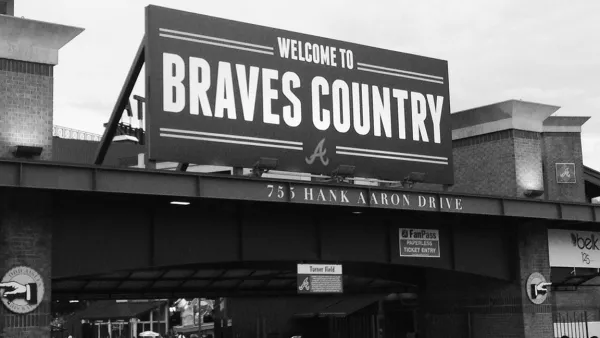
A columnist absolutely eviscerates the Atlanta Braves organization as it plays its final game in Turner Field in Atlanta. The team is departing the city for a new suburban stadium in Cobb County.


"When Major League Baseball’s Atlanta Braves wrap up their final game at Turner Field on Oct. 2 against the Detroit Tigers, they’ll be throwing away a gift they never deserved," according to an article by Marketwatch columnist Jason Notte. "They’re tossing aside a 20-year-old ballpark in Atlanta proper for a $700 million SunTrust Park in Georgia’s suburban Cobb County for one of the most specious reasons imaginable: The city wasn’t paying them enough money or attention to stay."
According to Notte, Turner Field was a gift to the baseball gods, thanks to the legacy of the 1996 Summer Olympics, hosted in Atlanta. After NBC, sponsors, and the Atlanta Committee for the Olympic Games paid the $209 million cost for the stadium, it was "converted into a ballpark and handed over to the Atlanta Fulton County Recreation Authority in 1997. That group leased the building to the Braves while letting them operate it."
The greed of the Braves, as Notte describes it, came later, after the team's fortunes turned on the field and the team's management came looking for concessions off the field.
By 2012, the Braves were demanding complete control of Turner Field (for which they hadn’t paid a dime), 55 acres of city- and Fulton County-owned land around Turner Field (which it didn’t want to bid for) and complete control over redevelopment. The city pointed out that this flouted any number of laws, which sent the Braves scurrying over to Cobb County by July 2012. Just four months later, the Braves announced their deal for a new stadium and retail development in Cobb County.
According to Notte, the deal the team made with Cobb County, which he also analyzes, is more about private benefit that public partnership.
FULL STORY: Ungrateful Atlanta Braves take the money and run

Doubts Over Development Benefits of New Atlanta Braves Stadium
The Atlanta Braves are planning a new stadium, opening in 2017, in suburban Cobb County. How much residual development investment should local stakeholders expect?
New Apartments Rise at the Former Home of the Atlanta Braves
Where the boys of summer once played, hundreds of households now call home.

First the Olympics, Then the Braves, and Now Georgia State Football
The Atlanta Braves left Turner Field, located in the Southeast Atlanta neighborhood of Summerhill, in 2016 to heavy criticism. Now the stadium has new life as the home to the Georgia State football program.

The state-sanctioned urbicide of Austin
People don’t kill cities. Freeways do.

US to reduce Colorado River water deliveries to Mexico
A new Colorado Treaty amendment reduces Mexico’s Colorado River water allocation by 250,000 acre feet.

New Jersey’s second-largest city bans standalone data centers
Jersey City will continue to allow co-location facilities, such as those meant for research institutions that store their own data.

Amtrak not solely to blame for New Jersey commuter rail's unreliability, report finds
A new study from the Garden State Initiative found that NJ Transit’s budget grew 20% across a 4 year period, but reliability declined significantly over the same period.

EPA erases limits on planet-warming pollution from power plants
Under Monday’s plan, power plants would still have some limits on how much mercury, arsenic and other contaminants they can emit.

Phoenix announces new on-demand transit service, more frequent RAPID buses
Both new services will launch in October, and are part of Phoenix's Project Effective Access Solutions for Easing Congestion.

FREE Course: Walkable City 1: Why Walkability?
After describing his path towards focusing on walkability as the essence of good planning, Jeff Speck marches through his five principal reasons for making more walkable places.
Reinventing Malls: Planning Alchemy—Turning Gray Fields Into Gold
The course focuses on the opportunities and imperatives that shape reinvention of mall sites.

Eagle County Government
Harvard University Graduate School of Design
Nashville Planning Department
The Architects Foundation
University of Cincinnati Online
The Pocatello Development Authority
The Urban Renewal Agency of the City of Pocatello
Journal of the American Planning Association