When Elon Musk talks, lots of people listen. Some also respond.


In case you missed it, Elon Musk last week announced a new "Master Plan," this one subtitled "Part Deux," in an apparent nod to a 1993 comedy film starring Charlie Sheen.
The master plan, like the movie, is a sequel. Musk's first master plan was released ten years ago, describing a plan to create Tesla's line of electric vehicles. The new master plan picks up where the original left off, setting the following agenda:
Create stunning solar roofs with seamlessly integrated battery storage
Expand the electric vehicle product line to address all major segments
Develop a self-driving capability that is 10X safer than manual via massive fleet learning
Enable your car to make money for you when you aren't using it
Following that proclamation, a debate has emerged. On one side, those who believe Musk has failed to grasp crucial concepts about how transportation works. On the other side, those who eagerly anticipate the future described by the new master plan.
The former is argued by Jarrett Walker on his Human Transit blog. "Musk assumes that transit is an engineering problem, about vehicle design and technology," according to Walker. "In fact, providing cost-effective and liberating transportation in cities requires solving a geometry problem, and he’s not even seeing it."
On the other side, Alissa Walker writing for Curbed: "Tesla is actually shifting from an electric car company to a sustainable transportation company. And this could mean something revolutionary for our cities."
Read the full story: Master Plan, Part Deux


Tesla’s Self-Driving Still Not Working in Las Vegas Tunnels
The Boring Company had previously said it was working with Tesla to use its self-driving system in its tunnels below Las Vegas to save costs on drivers, but two years later, there is no clear timeline for “full autonomy.”
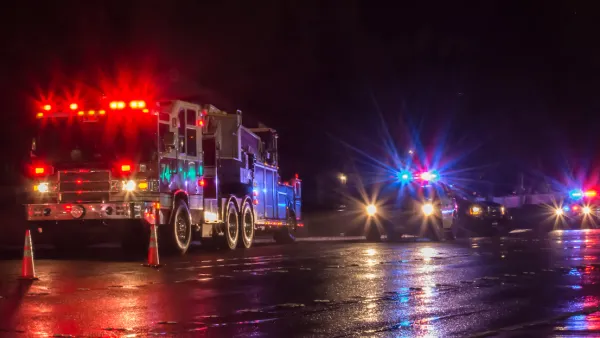
Dashcam Footage Shows Tesla Colliding With First Responder
The car failed to recognize the stopped emergency vehicle until just two seconds before the crash.
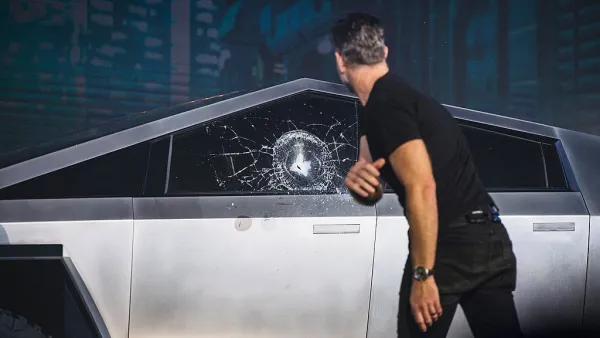
Opinion: Stop Trusting Elon Musk—on Tunnels, on Teslas, on Everything
Musk has leveraged social media intrigue and a hot streak on the market to become the standard bearer for autonomous vehicle technology. Trust Tesla at public peril, argues James Brasuell in this opinion piece.

Planetizen Federal Action Tracker
A weekly monitor of how Trump’s orders and actions are impacting planners and planning in America.

Amtrak, CN end decades-long dispute with eight-year agreement
The new operating agreement establishes an updated framework for the companies to work together, including processes to resolve disputes.

Judges permit Denver to divert 77,000 acre feet from the Colorado River for reservoir expansion
Overuse and climate change have caused the Colorado River’s water levels to plummet.

NYC DOT wants faster, more permanent street upgrades
The city is examining ways to build more concrete infrastructure without getting entangled in 'decades-long' projects.

'Something we’ve never seen before:' rising utility rates could strain city finances nationwide
Data centers, climate change and other factors have caused utility rates in the United States to increase by 38% since 2020.

Trump to overrule local leaders, lease millions of acres of America’s Pacific Island territories’ seafloors to mining companies
International law says that the Indigenous people of America’s territories have a right to prior and informed consent regarding projects that impact their countries.

FREE Course: Walkable City 1: Why Walkability?
After describing his path towards focusing on walkability as the essence of good planning, Jeff Speck marches through his five principal reasons for making more walkable places.
Reinventing Malls: Planning Alchemy—Turning Gray Fields Into Gold
The course focuses on the opportunities and imperatives that shape reinvention of mall sites.

Harvard University Graduate School of Design
KFH Group Inc.
Greater Baltimore Committee
The Architects Foundation
University of Cincinnati Online
The Pocatello Development Authority
The Urban Renewal Agency of the City of Pocatello