With transportation the largest contributor to greenhouse gas emissions in California, San Mateo will be the first city to reduce emissions by using biogas produced at its wastewater treatment plant for use in city vehicles.


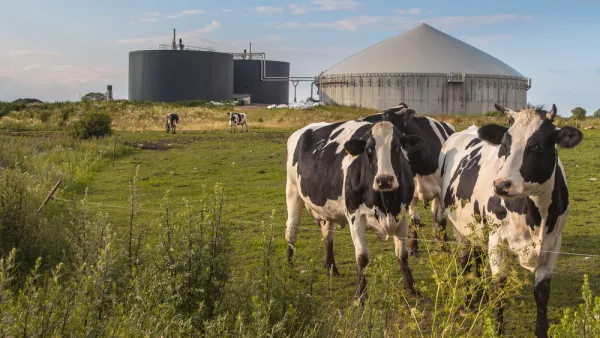
San Mateo broke ground Dec. 11 "on California’s first city-run biogas conversion project to produce compressed natural gas (CNG) at its wastewater treatment plant," writes Samantha Weigel for The Daily Journal. The primary purpose of the project, in addition to producing "the biofuel equivalent of 500 gallons of gasoline every day," is to increase the city's sustainability by reducing greenhouse gas emissions, adds Weigel.
"It’s definitely part of our Climate Action Plan [184-page PDF] and sustainability goals to switch from gas engines and diesel engines to alternative fuels," The effect of using the byproduct is we can utilize it instead of burning it off or essentially wasting it,” said Public Works Director Brad Underwood.
Furthermore, by purchasing at least 50 new clean natural gas vehicles — likely pickup trucks for the Public Works as well as Parks and Recreation departments — the city will become less reliant on traditional fuel. As vehicles are the number one contributor to the city’s greenhouse gas emissions, this project supports long-term environmental initiatives.
Weigel emphasised that point in a January piece on the city's Climate Action Plan:
San Mateo’s largest greenhouse gas emissions generators are vehicles, making up 58 percent of its total. Approximately 35 percent is attributed to commercial and residential energy consumption and 3 percent comes from solid waste, according to Pacific Municipal Consultants.
Greenhouse gas emissions are reduced in two ways with the new project:
- "Typically, the plant just burns off the biogas that’s created as part of the treatment process at the facility that accepts wastewater from San Mateo, Foster City, Hillsborough, Belmont and unincorporated portions of the county," writes Weigel, though she adds some burning will continue after the project is completed as not all biogas can be captured.
- Biogas, a renewable or biofuel, has the lowest "carbon intensities" of any transportation fuel according to the Low Carbon Fuel Standard Program of the California Air Resources Board (CARB).
San Mateo received a $2.45 million grant from the California Energy Commission "to construct a digester that will capture underutilized biogas, which naturally occurs while treating wastewater, and turn it into compressed natural gas (CNG) that will be used to fuel new city-owned vehicles," writes Weigel. It "includes a distribution system that serves like a pump at a traditional gas station." Total cost is nearly $5 million.
Greenhouse gas emissions are reduced in two ways with the new plant.
- "Typically, the plant just burns off the biogas that’s created as part of the treatment process at the facility that accepts wastewater from San Mateo, Foster City, Hillsborough, Belmont and unincorporated portions of the county," writes Weigel, though she adds some burning will continue after the project is completed.
- Biogas, a renewable or biofuel, has the lowest "carbon intensities" of any transportation fuel according to the Low Carbon Fuel Standard Program of the California Air Resources Board (CARB).
CARB has a rating for "Landfill gas (bio-methane) cleaned up to pipeline quality NG; compressed in Calif." (11.26), and "Dairy Digester Biogas to CNG (13.45) per its rating table (PDF). By contrast, gasoline has rating of 95.86.
Apparently, biogas from wastewater treatment plants has yet to be rated. CARB was contacted to see if they will do so.
The only other fuel that comes close is biodiesel: "Conversion of waste oils (Used Cooking Oil) to biodiesel (fatty acid methyl esters -FAME) where “cooking” is not required" (11.76).
Using the energy potential in biogas is nothing new for wastewater treatment plants (WWTPs), but only a minority of them use the biogas as a transportation fuel. According to the Department of Energy's Alternative Fuels Data Center on "Renewable Natural Gas (Biomethane) Production:
There are more than 16,000 WWTPs in the United States, and about 1,500 employ anaerobic digestion to produce biogas that is used on site. The Janesville Wastewater Treatment Plant in Wisconsin is an example of a plant that uses biogas to produce RNG for use in vehicles.
"It really adds up in terms of carbon reductions that the city gets from this," proclaimed Mayor Joe Goethals.
It’s carbon that would otherwise just be admitted into the atmosphere and instead we’re using it to offset the gasoline that our fleet would otherwise use. So it’s a very exciting project and we’re glad to be the model for the state on this,” Goethals said.
"Anticipating completion is in August, (2016)" adds Weigel.

Renewable Natural Gas Makes Inroads in California, Oregon, and Missouri
What is expected to be the nation's largest dairy biogas operation opened in the Central Valley. To the north, Gov. Kate Brown signed the nation's first bill to establish goals to add renewable gas to pipelines, and pigs in Missouri also made news.
Renewable Natural Gas and Electricity Should Power Los Angeles Bus Fleet
It's not one or the other but both, argues Denny Zane of Move LA in a guest commentary for the Los Angeles Daily News about the decision that Los Angeles County Metro will make on June 22 on the future of the nation's second largest bus fleet.
San Francisco's Diesel Bus and Truck Fleet Just Got Much Greener
San Francisco's diesel vehicles have been using a biodiesel blend for years, but in a move that illustrates the differences among biofuels, Mayor Ed Lee announced that the fleet will now use 100 percent renewable diesel fuel.

Planetizen Federal Action Tracker
A weekly monitor of how Trump’s orders and actions are impacting planners and planning in America.

The state-sanctioned urbicide of Austin
People don’t kill cities. Freeways do.

US to reduce Colorado River water deliveries to Mexico
A new Colorado Treaty amendment reduces Mexico’s Colorado River water allocation by 250,000 acre feet.

Baltimore to break ground on $50 million Transit Priority Project
The project will bring faster bus trips, safer streets and better bike connections to Baltimore.

Airbnb launches $250 million 'last-dollar financing' housing accelerator, makes first investment in Austin
The company will put $6.4 million towards affordable housing development in Texas’ capital.

Guerilla urbanists are building DIY bus stop benches in Chicago
A before-and-after of one of the bus stops with a new bench. The new benches are not officially sanctioned or permitted, but the residents who placed them hope they will be the start of a network of DIY benches across the city.

FREE Course: Walkable City 1: Why Walkability?
After describing his path towards focusing on walkability as the essence of good planning, Jeff Speck marches through his five principal reasons for making more walkable places.
Reinventing Malls: Planning Alchemy—Turning Gray Fields Into Gold
The course focuses on the opportunities and imperatives that shape reinvention of mall sites.

Eagle County Government
Harvard University Graduate School of Design
Nashville Planning Department
The Architects Foundation
University of Cincinnati Online
The Pocatello Development Authority
The Urban Renewal Agency of the City of Pocatello
Journal of the American Planning Association