Ohio rail advocates received good news from the Federal Railroad Administration: The Buckeye State will be included in an FRA study to expand its now meager service, but support from Republican Gov. John Kasich is unlikely judging from his record.


"Ohio’s passenger rail offerings will be looked at as part of a recently-announced $2.78 million federal study of rail planning in the Midwest, which proponents hope will change the future of travel here," writes Amanda Seitz for the Dayton Daily News.

Credit: All Aboard Ohio
Minnesota Department of Transportation: Midwest Regional Rail Initiative
"Amtrak only runs two lines in Ohio, one through Cleveland and the other in Cincinnati," writes Seitz. "The Cincinnati stop is infamous for its bad timing — it drops off passengers only three times a week around 3 a.m. at Union Terminal in downtown Cincinnati."
“We’re disconnected,” said Derek Bauman, the southwest Ohio director for All Aboard Ohio, a group that advocates for more rail travel in the state.
The funding was awarded as a result of a November 2014 application to the Federal Railroad Administration (FRA) by the Midwest Interstate Passenger Rail Commission (MIPRC), notwithstanding Gov. John Kasich's decision to drop the state's membership in the multi-state planning group, notes Seitz. Progressive Railroading clarifies that the $2.78 million will be split with a study of passenger rail expansion in the Southeast.
Both All Aboard Ohio and the Northeast Indiana Passenger Rail Association announced the award on their websites.
The funding process was initiated with a request by MIPRC "for FY 2015 federal transportation appropriations to the US House Transportation, Housing & Urban Development (THUD) subcommittee of Appropriations."
Seitz cautioned the advocates that the expansion plans "have almost zero support at the state level."
Readers may remember that when Gov. Kasich, now a Republican presidential candidate, took office in 2011, he rejected $450 million in federal stimulus funds for improving rail service to Ohio's three major cities: Cleveland, Columbus, and Cincinnati, saying it "would cost too much and run too slowly to be more convenient than driving or flying."
Then-Transportation Secretary Ray LaHood appealed directly to Gov. Kasich and new Wisconsin Gov. Scott Walker to accept the funds, warning them they could not be redirected to road or freight rail projects in the states as they had hoped to do.
However, on the local level, government may be far more hospitable to Amtrak service. Residents of Oxford in southwest Ohio, pop. 21,371 at the 2010 census, had petitioned successfully for a rail stop, "but it’s likely the city and Miami (University) will pay for construction of the stop," writes Seitz.
Read the full story: Southwest Ohio Leaders Push for More Rail, Amtrak Travel

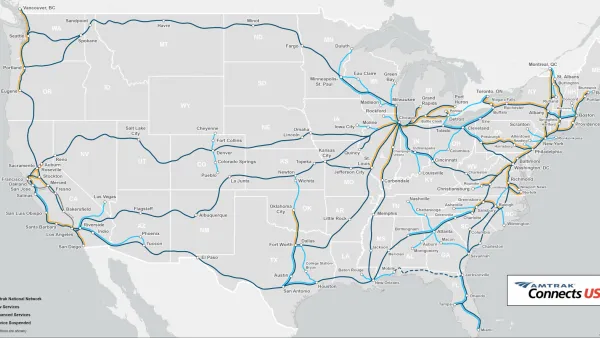
Political Support for Amtrak’s All Aboard Ohio Plans Follows Federal Infrastructure Funding
Gov. Mike DeWine’s sudden interest in working with Amtrak might have something to do with $66 billion in Infrastructure Investment and Jobs Act funding recently announced by the Federal Railroad Administration.

D.C. Has Concerns About Parking and the Cost of Maglev Proposal
Washington, D.C. officials are urging modifications to key components of a proposal to build a maglev system between D.C. and Baltimore, citing disruptions to neighborhoods and cost concerns.
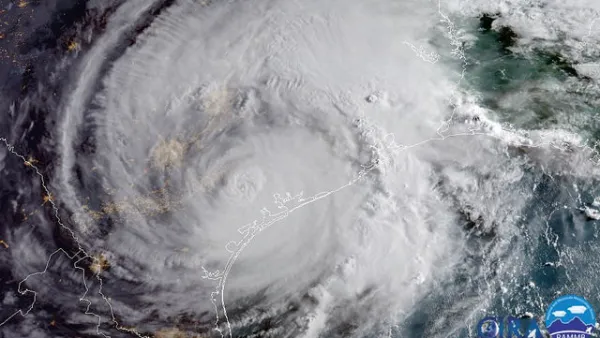
Hurricane Effect: Rising Gas Prices
One need not be on the Gulf Coast to experience some of the effects of Hurricane Harvey, a category 4 storm that landed near Corpus Christi on Friday night. Gas prices are expected to rise five to ten cents per gallon in some regions, then recede.

Planetizen Federal Action Tracker
A weekly monitor of how Trump’s orders and actions are impacting planners and planning in America.

Amtrak, CN end decades-long dispute with eight-year agreement
The new operating agreement establishes an updated framework for the companies to work together, including processes to resolve disputes.

Judges permit Denver to divert 77,000 acre feet from the Colorado River for reservoir expansion
Overuse and climate change have caused the Colorado River’s water levels to plummet.

Boston has spent millions making the Green Line more accessible — and there’s no end in sight
While the city has invested millions into expanding and adding platforms to the Green Line to make it more accessible, new train cars set to arrive next year will be too tall for disabled passengers to board without raising the current platforms.

Idaho may see an 18% drop in federal surface transit funding — the largest estimated cut in the US
Transit systems in rural communities are much more reliant on federal funding to provide their services.

How ‘post-disaster gentrification’ alters neighborhoods after natural calamities
After hurricanes, fires or other calamities, the original residents of a community are often replaced by younger, wealthier residents.

FREE Course: Walkable City 1: Why Walkability?
After describing his path towards focusing on walkability as the essence of good planning, Jeff Speck marches through his five principal reasons for making more walkable places.
Reinventing Malls: Planning Alchemy—Turning Gray Fields Into Gold
The course focuses on the opportunities and imperatives that shape reinvention of mall sites.

City of Wisconsin Rapids
Harvard University Graduate School of Design
KFH Group Inc.
The Architects Foundation
University of Cincinnati Online
The Pocatello Development Authority
The Urban Renewal Agency of the City of Pocatello