Phoenix voters, by 55 percent according to preliminary results, chose to increase their sales tax from .4 to .7 percent on Tuesday, continuing until 2051 to pay for $17 billion in transportation improvements.


Overcoming Republican opposition, "Phoenix voters approved a major boost in transportation funding for new light rail lines, bus expansion and street improvements over the next several decades in Tuesday's election," writes Brenna Goth for The Republic (AZCentral.com).
About 35,000 votes have yet to be counted, or about 26 percent of the total ballots cast. Another update won't come until Friday, according to the City Clerk Department. [Check election results here.]
The measure will triple Valley Metro light rail mileage, as noted here earlier.
The city-only measure [PDF], mistakenly described as a Maricopa County measure here earlier, was an affirmation of support for Phoenix Mayor Greg Stanton, a staunch advocate of Prop 104, and the city council.
“This is a great night for the future of the city of Phoenix,” Stanton said, referring to the Prop 104 victory. The Democratic mayor, who was also on the ballot, won a second term in a landslide, reports The Republic's Dustin Gardiner,
"Phoenix’s sales tax rate is 8.3 percent and will increase to 8.6 percent Jan. 1 with the transit tax increase," adds Goth.
FULL STORY: Phoenix voters pass Prop. 104 transit tax

Phoenix Sales Tax Measure Key to County's Transit Future
On August 25, voters in Phoenix and Maricopa County will determine the outcome of Proposition 104, a transportation sales tax measure that would raise $17 billion for a wide variety of transportation improvements, including extended light rail.
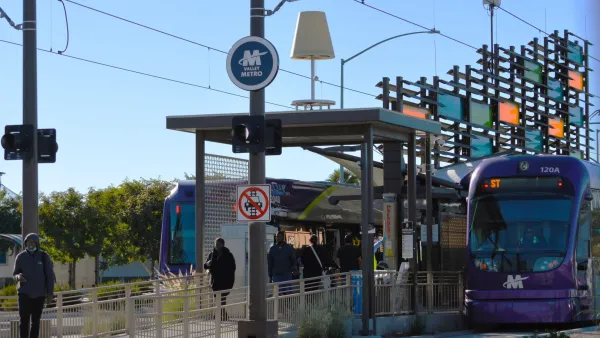
Phoenix Nixes Light Rail Plans, Shifts Focus to Expanding Transit in West Phoenix
The city is shelving plans for a proposed light rail expansion, opting instead to explore other alternatives for bringing rapid transit to West Phoenix.
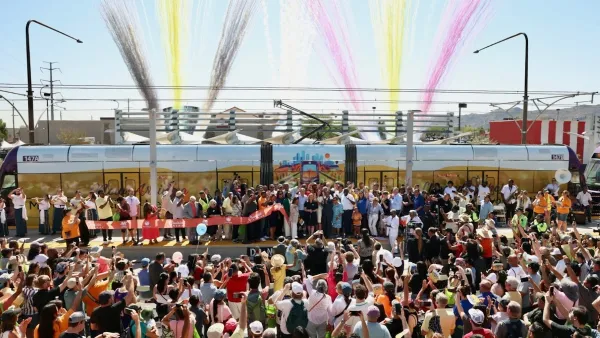
Phoenix Light Rail Extension Opens
The South Central line extends 5.5 miles of rail into South Phoenix neighborhoods, bringing the city’s total light rail network to 35 miles.

The state-sanctioned urbicide of Austin
People don’t kill cities. Freeways do.

US to reduce Colorado River water deliveries to Mexico
A new Colorado Treaty amendment reduces Mexico’s Colorado River water allocation by 250,000 acre feet.

New Jersey’s second-largest city bans standalone data centers
Jersey City will continue to allow co-location facilities, such as those meant for research institutions that store their own data.

Amtrak not solely to blame for New Jersey commuter rail's unreliability, report finds
A new study from the Garden State Initiative found that NJ Transit’s budget grew 20% across a 4 year period, but reliability declined significantly over the same period.

EPA erases limits on planet-warming pollution from power plants
Under Monday’s plan, power plants would still have some limits on how much mercury, arsenic and other contaminants they can emit.

Phoenix announces new on-demand transit service, more frequent RAPID buses
Both new services will launch in October, and are part of Phoenix's Project Effective Access Solutions for Easing Congestion.

FREE Course: Walkable City 1: Why Walkability?
After describing his path towards focusing on walkability as the essence of good planning, Jeff Speck marches through his five principal reasons for making more walkable places.
Reinventing Malls: Planning Alchemy—Turning Gray Fields Into Gold
The course focuses on the opportunities and imperatives that shape reinvention of mall sites.

Eagle County Government
Harvard University Graduate School of Design
Nashville Planning Department
The Architects Foundation
University of Cincinnati Online
The Pocatello Development Authority
The Urban Renewal Agency of the City of Pocatello
Journal of the American Planning Association