When the director of transportation for the state of Iowa admits that the highway system is overbuilt, Charles Marohn asks the question: which of the 49 remaining DOT heads will also speak honestly about their systems?


Charles Marohn provides a dispatch from a recent Urban Land Institute event in Iowa, where he saw Paul Trombino, the director of the Iowa Department of Transportation, say something remarkable for a person in his position. "And so the reality is, the system is going to shrink," said Trombino.
Marohn's take on that sentence: "While I've had a couple say this in private, talk of contraction is not something I've heard any other DOT director say in public. This is a big deal."
Marohn provides the context provided by more of Trombino's statements and extends the challenge inherent in Trombino's acknowledgement, writing: "Most DOT directors understand that we've overbuilt, that there will never be the money to maintain everything they are asked to maintain. (I would question the ones who don't, their adherence to dogmatic politics or their competence.) I've not heard another DOT chief admit this problem publicly. They need to."
Read the full story: IOWA DOT CHIEF: THE SYSTEM IS GOING TO SHRINK

Peak Car? Check Your Data
There is evidence that automobile travel is peaking while demand for non-auto modes is growing, but double-check your data sources to be sure.

Generation Z Is Driving Less, But History Indicates It Won’t Last
Think Generation Z will usher in the long-awaited post-car future of transit advocates’ dreams? Think again (about the example set by the Millennials).
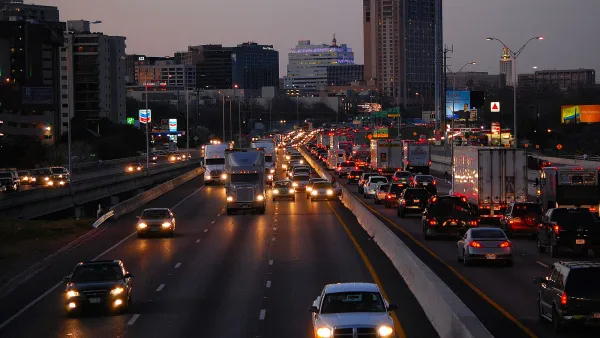
Austin Leaders Denounce 20-Lane Freeway Project
TxDOT is pushing ahead with plans for a massive freeway expansion project through downtown Austin despite opposition from virtually all local leaders.

Planetizen Federal Action Tracker
A weekly monitor of how Trump’s orders and actions are impacting planners and planning in America.

Eastern Nebraska is running out of electricity
Data centers and electrification are straining eastern Nebraska’s grid, throttling economic development.

Study reveals best places in the U.S. for cycling, walking
New research from Streetlight Data examines bicycle and pedestrian miles per capita in the 100 largest U.S. cities by population.

DSA members accuse Mamdani of 'abandoning values' over housing redevelopment
New York City's mayor plans to replace about 2,000 units of public housing with private, mixed-income housing.

All sides of BRT debate unhappy with CDOT’s most recent move
The Colorado Department of Transportation is no longer considering center-running bus lanes for Colorado Boulevard.

Massachusetts bogs generate both power, and cranberries
Putting solar panels above farmland is one way Massachusetts is advancing toward its goal of net-zero carbon emissions by 2050.

FREE Course: Walkable City 1: Why Walkability?
After describing his path towards focusing on walkability as the essence of good planning, Jeff Speck marches through his five principal reasons for making more walkable places.
Reinventing Malls: Planning Alchemy—Turning Gray Fields Into Gold
The course focuses on the opportunities and imperatives that shape reinvention of mall sites.

City of Rosemead
Rutgers University, Edward J. Bloustein School of Planning and Public Policy
One Hundred Miles
University of Michigan School for Environment and Sustainability (SEAS)
Hunter College, City University of New York (CUNY)
The Architects Foundation
City of Cambridge
The Pocatello Development Authority
The Urban Renewal Agency of the City of Pocatello