Following a string of developments in 2014 pushing the California Department of Transportation (Caltrans) toward more multi-modal planning, a new Strategic Management Plan lays out ambitious goals for the increased use of alternative modes.


"Caltrans released its new Strategic Management Plan [PDF], and it includes priorities and performance targets that show the department is serious about reforming itself," according to Melanie Curry.
"The new plan includes active transportation and Vision Zero, within its priority number one, 'Safety and Health.' It also cites a goal of tripling bicycle mode share and doubling walking and transit mode share by 2020–that means not just the number of trips, but the percentage of total trips in California."
Curry's analysis of the new Strategic Management Plan lays out the details about the massive sea change taking place at the California Department of Transportation.
The "Related" links below offer insight into some of the other legislative and regulatory actions that indicate a new way of doing things at the Department of Transportation for the largest state in the country.
Read the full story: Caltrans Goals: Triple Biking, Double Walking and Transit by 2020
Making Climate Change a Priority for Transportation Planning
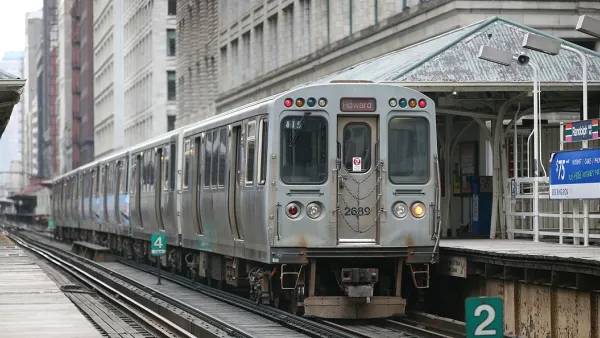
The threat of climate change has not guided transportation planning in Chicago, and the city and region could be doing much more to promote sustainable transportation, according to the article.

Vancouver's Ride-Hail-Free Mobility Landscape
While ride-hailing is on the horizon for the Canadian city, the experience so far without the mode provides useful insight into its effects on regional mobility.

Keeping An Open Mind: How Some Cities Are Reducing Emissions While Supporting Economic Vitality
As cities swell and car use soars, U.S. cities should take note of some bold, even radical, emissions-reducing policies being deployed around Europe.

Planetizen Federal Action Tracker
A weekly monitor of how Trump’s orders and actions are impacting planners and planning in America.

California plans to bury El Niño’s downpour
If the state plays its cards right, it may be able to store a billion acre-feet of El Niño’s water in aquifers.

Desperate measures: Advocates weigh draining Lake Powell to fill Colorado River
Draining the reservoir could reduce evaporation losses by a couple hundred thousand acre-feet.

Housing is the top priority of Seattle’s sole new councilmember
Jenks campaigned on building 1,000 new units of affordable housing.

New tax cuts may slash $1.5 billion in funding for Miami transit, public parks
Amendment 3 will save Miami-Dade homeowners $2,700 in 2028.

Arizona, Wisconsin, Pennsylvania hope to finally advance climate goals post-midterms
The three states have spent years under Republican or divided control.

FREE Course: Walkable City 1: Why Walkability?
After describing his path towards focusing on walkability as the essence of good planning, Jeff Speck marches through his five principal reasons for making more walkable places.
Reinventing Malls: Planning Alchemy—Turning Gray Fields Into Gold
The course focuses on the opportunities and imperatives that shape reinvention of mall sites.

City of Rosemead
Rutgers University, Edward J. Bloustein School of Planning and Public Policy
One Hundred Miles
University of Michigan School for Environment and Sustainability (SEAS)
Hunter College, City University of New York (CUNY)
The Architects Foundation
City of Cambridge
Montrose County
The Pocatello Development Authority