Ending the use of tax-exempt bonds to finance the construction of pro sports facilities has high level support from President Obama's 2016 draft budget, but it's too early to tell if the proposed ban on such financing mechanisms will be approved.


"President Barack Obama’s 2016 budget, presented to Congress last month, calls for barring the use of tax-exempt bonds to finance professional sports facilities. Such bonds have raised about $17 billion during the past three decades, with proceeds funding construction of major-league stadiums and arenas in cities from Seattle to Baltimore," reports Eliot Brown. A soccer stadium in New York and a basketball stadium in are among the proposed stadium plans that would rely on bong financing to construct.
In the budget proposal, however, the Treasury Department notes that "funding pro facilities with tax-exempt bonds merely has 'shifted more of the costs and risks from the private owners to local residents and taxpayers in general'..." Moreover, "[barring] municipalities from issuing the bonds would save the federal government $542 million over 10 years," according to the Treasury Department's estimation.
The article goes on to cite some of the arguments in favor of tax-exempt bonds to finance sports facilities, including examples provided by the new Yankee Stadium and the under-construction football stadium for the Minnesota Vikings in Minneapolis.
FULL STORY: Use of Taxpayer Money for Pro-Sports Arenas Draws Fresh Scrutiny [paywall]

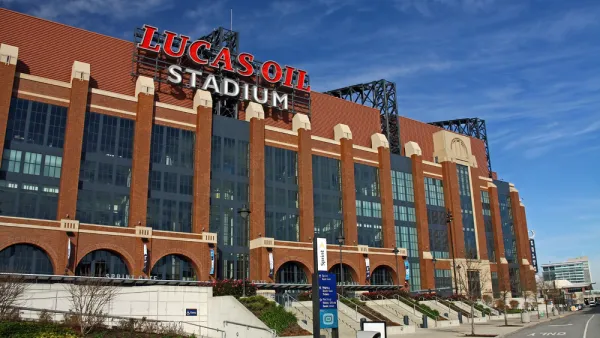
Federal Subsidy for Private Sports Stadiums Since 2000: $3.2 Billion
Are you ready for some football…stadiums to receive massive subsidies from the federal government?
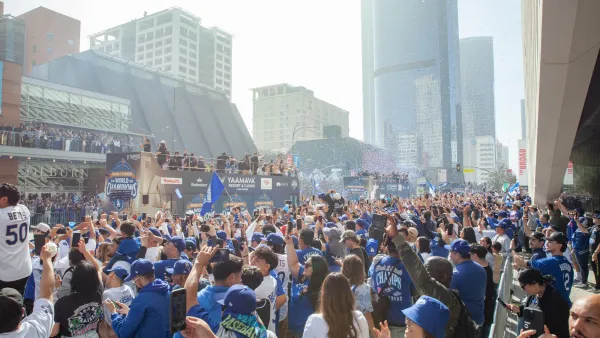
America’s urban FIFA stars won’t be stadiums — it will be our downtowns. Let’s not blow it.
When the World Cup visits cities across America this summer, it’s a rare chance to shift the perception of our downtowns on the global stage. The secret? What makes downtowns great for FIFA makes them great for everyone, all the time.
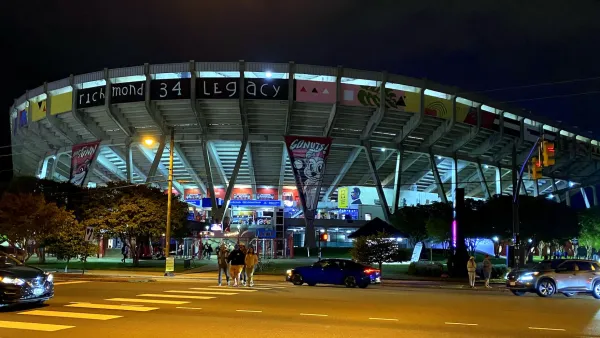
Richmond's new 'stadium district' will include hundreds of homes, offices, jobs
The city is planning for a neighborhood revival in the area around a new baseball stadium.

Planetizen Federal Action Tracker
A weekly monitor of how Trump’s orders and actions are impacting planners and planning in America.

The state-sanctioned urbicide of Austin
People don’t kill cities. Freeways do.

US to reduce Colorado River water deliveries to Mexico
A new Colorado Treaty amendment reduces Mexico’s Colorado River water allocation by 250,000 acre feet.

5 New England states march closer to 800 megawatt wind energy project
Securing federal approval for the project may be complicated under the Trump administration, which has historically been hostile towards domestic wind power.

Baltimore to break ground on $50 million Transit Priority Project
The project will bring faster bus trips, safer streets and better bike connections to Baltimore.

Airbnb launches $250 million 'last-dollar financing' housing accelerator, makes first investment in Austin
The company will put $6.4 million towards affordable housing development in Texas’ capital.

FREE Course: Walkable City 1: Why Walkability?
After describing his path towards focusing on walkability as the essence of good planning, Jeff Speck marches through his five principal reasons for making more walkable places.
Reinventing Malls: Planning Alchemy—Turning Gray Fields Into Gold
The course focuses on the opportunities and imperatives that shape reinvention of mall sites.

Eagle County Government
Harvard University Graduate School of Design
Nashville Planning Department
The Architects Foundation
University of Cincinnati Online
The Pocatello Development Authority
The Urban Renewal Agency of the City of Pocatello
Journal of the American Planning Association