Bill Lindeke writes of the daunting urban design and planning challenge presented by America's post-war fascination with the strip mall.


"Increasingly… cities like St. Paul and Bloomington are trying to change the classic strip-mall formula as they prepare for transit investments," according to Bill Lindeke. "But changing a strip mall is harder than you think."
One of Lindeke's case studies is the Penn-American plan in Bloomington, "where planners like Glen Markegard have been working for years on trying to re-zone property around future transit investments."
The other case study is provided by St. Paul’s West 7th Street, where in "coming years, a streetcar, light rail or bus rapid transit line might run directly down 7th Street, connecting downtown St. Paul to the airport, Ford site and/or Blue Line."
The article goes on to detail the planning and political challenges planners in both cases face in trying to reconcile the business interests and current configuration of strip malls with a more transit oriented future.
Read the full story: The visionary challenges of rethinking the strip mall


St. Paul-Mall of America Streetcar Connection Moving Forward
The Riverview transit corridor has plenty of local support. Now planners will get to work.
Streetcar from St. Paul to Airport Takes an Initial Step Forward
Regional interests around the Twin Cities are considering a proposal that would connect St. Paul to the Minneapolis-St. Paul International Airport and the city of Bloomington by streetcar.
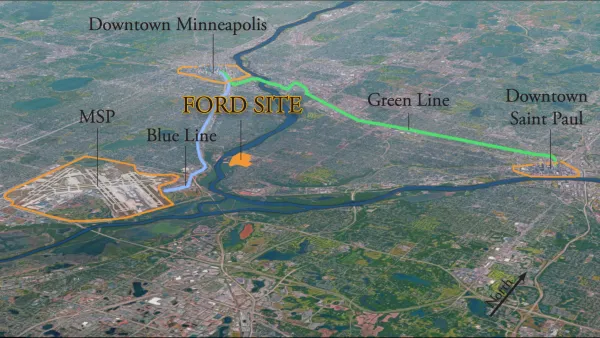
Former Ford Plant in St. Paul Taking Shape as a Massive Mixed-Use Development
A long-awaited plan for the former Ford plant along the Mississippi River is now open for public comment.

Planetizen Federal Action Tracker
A weekly monitor of how Trump’s orders and actions are impacting planners and planning in America.

Chicago breaks ground on $3 billion megadevelopment
The new neighborhood, titled Foundry Park, will one day host 3,700 residences.

This MA town is drowning in its own sewage — and residents like it that way
Susan Murcott, a waste water expert, said if Carlisle didn't address their leaking sewage, the problem could turn “deadly.”

With no reauthorization bill in sight, Texas slashes $6.6 billion from transportation budget
An official said the program may receive additional funding when a federal reauthorization bill passes.

Chicago’s new transit authority has ‘unprecedented’ land development power
The Northern Illinois Transit Authority is allowed to buy and develop land for reasons unrelated to transit, a power that is fairly unique among transit authorities.

Iowa taxpayers are paying thousands to clean manure out of their water
While the Clean Water Act makes states responsible for regulating factory farms that discharge pollutants, Iowa has turned a blind eye to the polluting farms.

FREE Course: Walkable City 1: Why Walkability?
After describing his path towards focusing on walkability as the essence of good planning, Jeff Speck marches through his five principal reasons for making more walkable places.
Reinventing Malls: Planning Alchemy—Turning Gray Fields Into Gold
The course focuses on the opportunities and imperatives that shape reinvention of mall sites.

City of Rosemead
Rutgers University, Edward J. Bloustein School of Planning and Public Policy
One Hundred Miles
The Architects Foundation
University of Cincinnati Online
Montrose County
The Pocatello Development Authority
The Urban Renewal Agency of the City of Pocatello