Steven Bingler and Martin C. Pedersen pen a withering critique of the architecture profession's obsession with glamorous contracts at the expense of context-sensitive, community-focused designs.


Writing an op-ed for the New York Times, Steven Bingler and Martin C. Pedersen identify several negative consequences for the state of the architecture profession.
The problem, according to the article, arises from the profession's obsession with grand artistic statements by "starchitects": "The problem isn’t the infinitesimal speck of buildings created by celebrity architects (some arresting, some almost comic in their dysfunction), but rather the distorting influence these projects have had on the values and ambitions of the profession’s middle ranks."
The op-ed identifies the consequences as architecture becomes a cultural sideshow for the wealthy: "We seem increasingly incapable, however, of creating artful, harmonious work that resonates with a broad swath of the general population, the very people we are, at least theoretically, meant to serve." The inability to serve most people incurs costs at incredible scales, according to the op-ed. "In the meantime, we’ve ceded the rest of the built environment to hacks, with sprawl and dreck rolling out all around us."
Read the full story: How to Rebuild Architecture

Children in 55 countries are redesigning their cities in Minecraft
A U.N.-backed program lets students and community members reimagine sites in their neighborhoods in the game — and translate them into real-life buildings.

Move over, zoning. Housing’s unsung hero is better street design.
The physical layout of infrastructure is the quiet force that shapes housing supply.
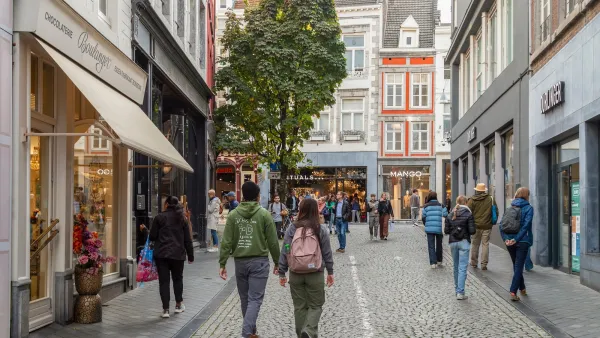
Planning for Love, Part 3: Enhancing human connection through walkability
In the third and final installment of this series, author Hannah Kosoff examines what her research findings say about modern dating and urban form.

Planetizen Federal Action Tracker
A weekly monitor of how Trump’s orders and actions are impacting planners and planning in America.

California plans to bury El Niño’s downpour
If the state plays its cards right, it may be able to store a billion acre-feet of El Niño’s water in aquifers.

Desperate measures: Advocates weigh draining Lake Powell to fill Colorado River
Draining the reservoir could reduce evaporation losses by a couple hundred thousand acre-feet.

US buildings threatened, destroyed by fires set to triple by 2060
Researchers found a high fire risk for socioeconomically vulnerable neighborhoods in the American West.

LA residents may be allowed to paint their own crosswalks
Councilwoman Katy Yaroslavsky put out a motion instructing the Los Angeles Department of Public Transportation to study the feasibility of allowing volunteers to paint crosswalks.

Dallas moves to overhaul its zoning code
The city's zoning reform will allow more multi-family and mixed-use developments.

FREE Course: Walkable City 1: Why Walkability?
After describing his path towards focusing on walkability as the essence of good planning, Jeff Speck marches through his five principal reasons for making more walkable places.
Reinventing Malls: Planning Alchemy—Turning Gray Fields Into Gold
The course focuses on the opportunities and imperatives that shape reinvention of mall sites.

City of Rosemead
Rutgers University, Edward J. Bloustein School of Planning and Public Policy
One Hundred Miles
Hunter College, City University of New York (CUNY)
The Architects Foundation
University of Cincinnati Online
City of Cambridge
Montrose County
The Pocatello Development Authority