Although the D.C. Metro's new Silver Line stations in Northern Virginia are designed for functional rather than high aesthetic ideals, Philip Kennicott's review for the Washington Post focuses on the benefit of the line to the region.


"The architectural design of the new Silver Line stations won’t make your heart sing. They are functional, and there are signs of value engineering throughout," reports Kennicott.
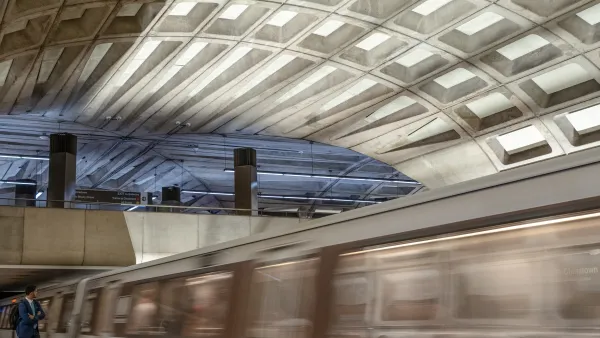
Kennicott acknowledges that the above ground stations would be hard to compete with the "spatial drama" of the Metro stations located in downtown Washington D.C. "And yet," says Kennicott, "there is something exhilarating about standing on their platforms and looking at the steel-and-concrete tracks threading off with serpentine elegance into the distance."
Kennicott also says that "everything that can go wrong from an urban design standpoint has gone wrong [in the cities along the Silver Line," but "the mere fact of the Silver Line being built, and now being extended, is one of the most promising signs of healthy civic life in our region."
Read the full story: In new Silver Line stations, an emphasis on the functional
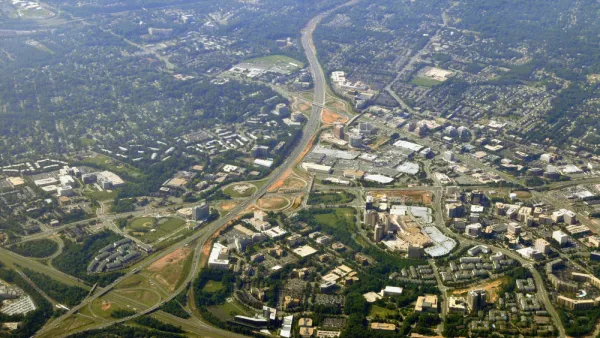
D.C.'s New Metro Line Already Influencing the Suburbs
The Silver Line opened two and a half months ago. Already, with strong ridership in both directions, some businesses are seeing new opportunities.
D.C. Metro's Silver Line Launches Passenger Service
After no small amount of debate, delay, and controversy, the first phase of D.C. Metro's Silver Line will launch passenger service today. The line will connect Washington D.C. to northwestern Virginia, including four stops in Tysons Corner.
D.C. Metro Plans Ambitious Expansion Despite Financial Woes
Facing a $750 million ‘fiscal cliff,’ the agency says it’s important to continue looking forward to ‘visionary’ future plans.

Desperate measures: Advocates weigh draining Lake Powell to fill Colorado River
Draining the reservoir could reduce evaporation losses by a couple hundred thousand acre-feet.

Eastern Nebraska is running out of electricity
Data centers and electrification are straining eastern Nebraska’s grid, throttling economic development.

Malls are becoming the midtowns of the future
Mall and office park redevelopments are a generational opportunity to create new nodes of urbanity.

NYC breaks ground on anti-flooding infrastructure project
New York City's new system will reduce stormwater flows to local sewers by 90%.

One Kentucky town’s secret to affordable housing
The Smoketown Community Land Trust has already built seven affordable homes for community members.

Houston gains petal-shaped cooling infrastructure to make streets more ‘delightful’
The city has installed the pavilions along 15 blocks in Houston.

FREE Course: Walkable City 1: Why Walkability?
After describing his path towards focusing on walkability as the essence of good planning, Jeff Speck marches through his five principal reasons for making more walkable places.
Reinventing Malls: Planning Alchemy—Turning Gray Fields Into Gold
The course focuses on the opportunities and imperatives that shape reinvention of mall sites.

City of Rosemead
Rutgers University, Edward J. Bloustein School of Planning and Public Policy
One Hundred Miles
University of Michigan School for Environment and Sustainability (SEAS)
Hunter College, City University of New York (CUNY)
The Architects Foundation
City of Cambridge
Montrose County
The Pocatello Development Authority