For those who haven't been following the Trust Fund's ticker, it's a bit like the deficit clock except that it runs in the opposite direction, going towards zero or insolvency. The ticker measures the balance in both the highway and transit accounts.


"Today (June 17), as we've been doing each month since January, the Department of Transportation (DOT) updated our Highway Trust Fund tickers. The tickers are charts showing how much money we have left to spend on roads, bridges, and transit --and how quickly it is running out," writes Secretary of Transportation Anthony Foxx in the Fast Lane.
Below is the graph depicting end-of-month balances for the Highway Account of the Highway Trust Fund. Note that it dips into negative numbers at the end of August, a full month before the transportation spending bill, MAP-21, expires on September 30.
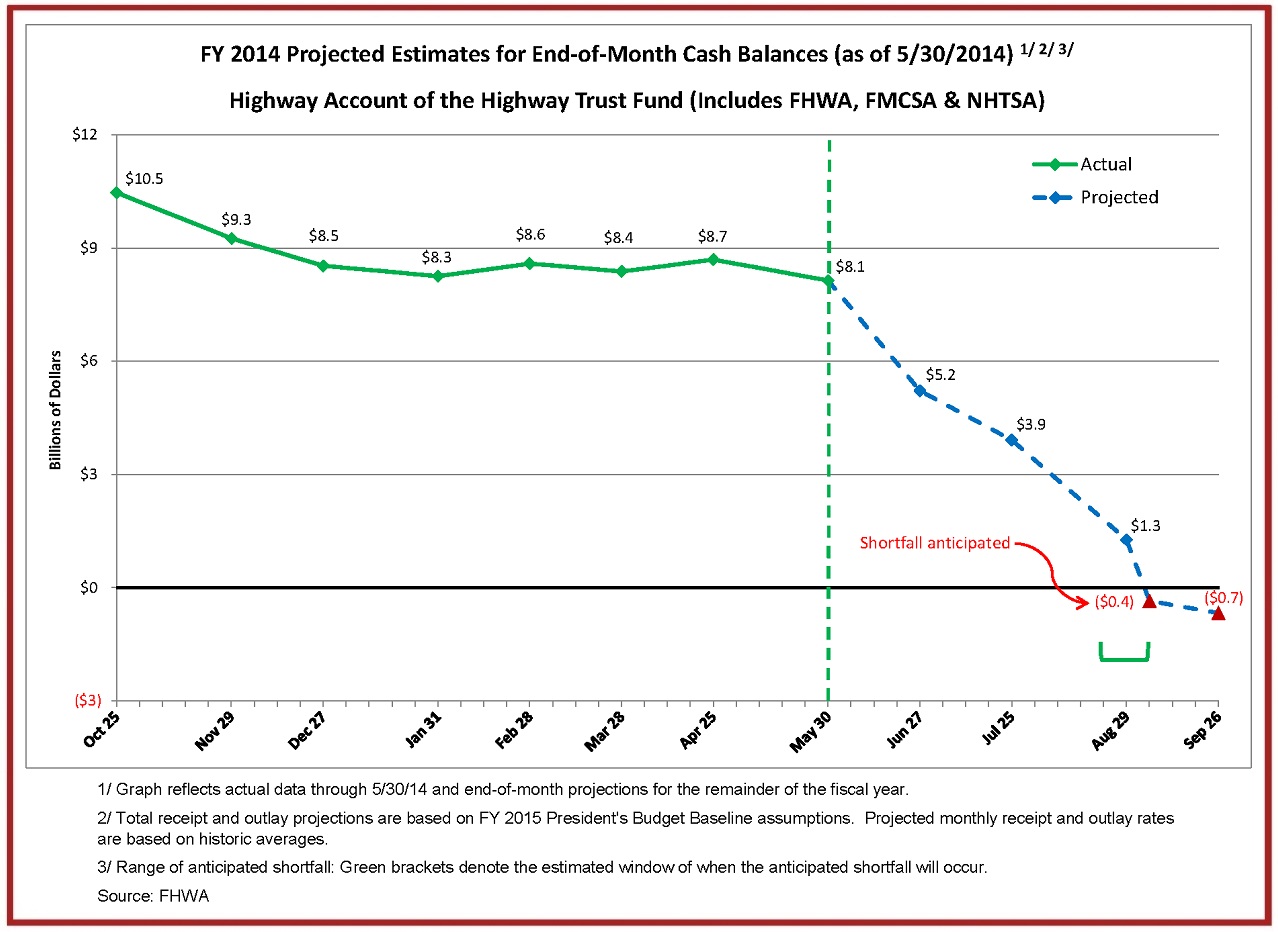
As we noted last month, "DOT prefers to keep a minimum of $4 billion in the highway account in order to properly manage day-to-day financial transactions." The highway account balance drops to that balance in late July, at which point state transportation departments may not receive timely reimbursements for work already done, explaining why some states are acting preemptively.
The mass transit account ticker shows a balance of $1 billion on September 30.
The impending insolvency leaves the Senate Finance Committee, chaired by Senator Ron Wyden (D-Ore.) with the dual task of finding short term funds to keep reimbursements flowing to state DOTs through the end of the fiscal year at a minimum, and six years worth of revenue to fund the Map-21 Reauthorization Act that passed the Environment and Public Works Committee on May 15.
Notice of the ticker update was included in Adam Snider's Politico Morning Transportation of June 18.
FULL STORY: DOT updates Highway Trust Fund tickers as shortfall looms

Senate Passes House Transportation Funding Bill; On to Obama
After the House rejected the Senate's amendments to their Highway Trust Fund extension bill, the Senate passed the bill 81-13 on July 31. Payments to states will continue unchanged through May 2015 when the next hurdle awaits
Federal Transportation Funds to Decrease August 1
U.S. Treasury Secretary Anthony Foxx warned State DOT officials in a July 1 letter that due to declining funds in the highway account of the Highway Trust Fund, he will implement a new reimbursement policy that may cause some states to halt projects.
Senate Committee Releases Six-Year Transportation Reauthorization Bill
The bill to reauthorize the current surface transportation law, "Moving Ahead for Progress in the 21st Century", a.k.a. MAP-21, was released on Monday and will be "marked up" on Thursday. Spending is kept at current levels of $50 billion a year.

The state-sanctioned urbicide of Austin
People don’t kill cities. Freeways do.

US to reduce Colorado River water deliveries to Mexico
A new Colorado Treaty amendment reduces Mexico’s Colorado River water allocation by 250,000 acre feet.

New Jersey’s second-largest city bans standalone data centers
Jersey City will continue to allow co-location facilities, such as those meant for research institutions that store their own data.

Amtrak not solely to blame for New Jersey commuter rail's unreliability, report finds
A new study from the Garden State Initiative found that NJ Transit’s budget grew 20% across a 4 year period, but reliability declined significantly over the same period.

EPA erases limits on planet-warming pollution from power plants
Under Monday’s plan, power plants would still have some limits on how much mercury, arsenic and other contaminants they can emit.

Phoenix announces new on-demand transit service, more frequent RAPID buses
Both new services will launch in October, and are part of Phoenix's Project Effective Access Solutions for Easing Congestion.

FREE Course: Walkable City 1: Why Walkability?
After describing his path towards focusing on walkability as the essence of good planning, Jeff Speck marches through his five principal reasons for making more walkable places.
Reinventing Malls: Planning Alchemy—Turning Gray Fields Into Gold
The course focuses on the opportunities and imperatives that shape reinvention of mall sites.

Eagle County Government
Harvard University Graduate School of Design
Nashville Planning Department
The Architects Foundation
University of Cincinnati Online
The Pocatello Development Authority
The Urban Renewal Agency of the City of Pocatello
Journal of the American Planning Association