Montreal city planners used a simple tactic to illustrate the small portion of area car parking that would need to be foregone in order to build a downtown bike path.


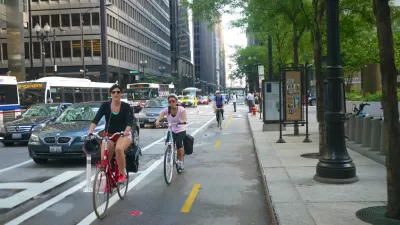
Every city that's ever considered removing auto parking to make room for a protected bike lane has been, understandably, nervous. North America's best city for biking wasn't immune.
But when it was planning its signature downtown bike project in 2005, Montreal got past those concerns with a very simple tactic. Instead of counting only the change in parking spaces on the boulevard De Maisonneuve itself, a measure that might have led to headlines and perceptions that "half of the parking" was being removed, it counted the total number of auto parking spaces — public and private, on-street and off — within 200 meters of the project.
The district, it turned out, had 11,000 parking spaces. Converting one of the corridor's two auto parking lanes to a protected bikeway would remove 300 of them, or just under 3 percent.
"The effect on the debate was suprise," said Jean-Francois Pronovost of Vélo Québec, the bike advocacy and planning nonprofit contracted by the city to study the issue. "No one estimated that there was that number of car parking [spaces] available."

Read the full story: HOW MONTREAL BUILT A BIKE LANE BY DEBUNKING THE AUTOPARKOLYPSE

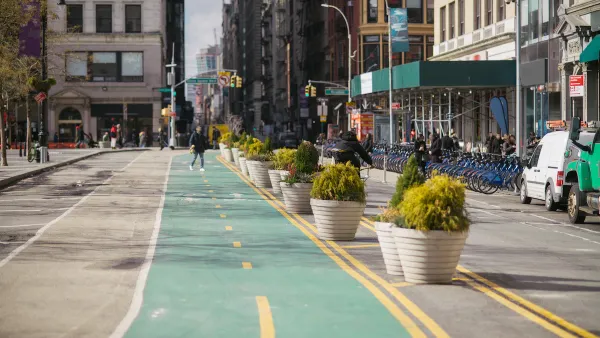
Leading Micromobility Trends for 2024: From Urban Streets to Regional Implementation
The proliferation of micromobility as a viable transportation mode offers the opportunity for cities to reimagine how they allocate public space.
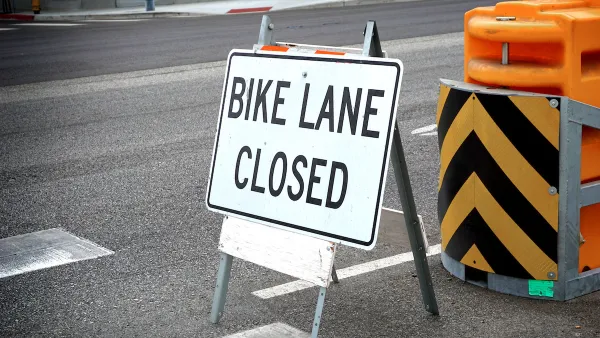
Los Angeles Is Quietly Losing Bike Lanes
While adding new bike lanes can be a long and contentious process, removing them in favor of parking requires no public process.

Bellevue Issues Curb Management Plan
The plan reorients the city’s priorities from vehicle throughput and parking to transit, bike infrastructure, and other public amenities.

Planetizen Federal Action Tracker
A weekly monitor of how Trump’s orders and actions are impacting planners and planning in America.

‘Going backwards:’ Baltimore mayor, students rally against state's transit funding plan
Maryland's proposed six-year plan provides no funding for Baltimore’s BMORE bus program and reduces its road maintenance funding.

Detroit to transform waterfront with $2.2 billion investment
Developers will convert about 18 acres of unused parking lot space into civic spaces.

HUD, USDA agree on framework to simplify housing environmental review standards
Their agreement is a requirement of the 21st Century ROAD to Housing Act.

Cost of water rising at a faster pace than inflation, median household income
California and Maryland residents have seen their water bills grow especially high.

NYC building owners overwhelmingly comply with new emissions limits
The New York City Department of Buildings is fining owners who did not file emissions reports.

FREE Course: Walkable City 1: Why Walkability?
After describing his path towards focusing on walkability as the essence of good planning, Jeff Speck marches through his five principal reasons for making more walkable places.
Reinventing Malls: Planning Alchemy—Turning Gray Fields Into Gold
The course focuses on the opportunities and imperatives that shape reinvention of mall sites.

planning NEXT
City of Thousand Oaks
City of Wisconsin Rapids
The Architects Foundation
University of Cincinnati Online
Northern Illinois Transit Authority (NITA)
The Pocatello Development Authority
The Urban Renewal Agency of the City of Pocatello