Resolution 31515, which officially approved the Bicycle Master Plan, is called a “transformational new way of thinking about bicycle projects within Seattle.” Time, and funding, will tell if the plan lives up to its promise.


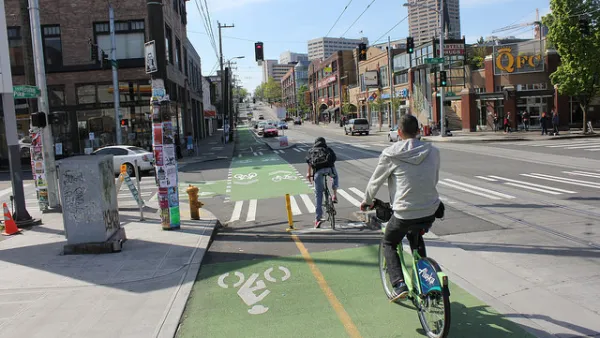
“The Seattle City Council has unanimously agreed to overhaul its Bicycle Master Plan, to provide separated bike lanes as well as a network of calm back-street routes known as greenways,” reports Mike Linblom. Seattle adopted its previous Bicycle Master Plan in 2007.
“The plan, approved Monday, calls for 474 miles of new or improved bike routes, at a cost of about $20 million a year for 20 years. Half would be greenways, plus 102 miles of bike lanes separated from traffic, and 32 miles of off-street trails.”
A separate article by Tom Fucoloro provides additional details about the two-year process of drafting the plan and what it will take to build out the planned network.
“The resolution approving the bike plan does not include funding. Cost estimates put the plan somewhere between $391 – $524 million over 20 years, though not all of that money will come directly from Seattle. Regional, state and federal grants will certainly be used to offset much of the cost, and the city can save money by including bike upgrades with other city work (utilities work, major repaving projects, private development, etc),” according to Fucoloro.
Read the full story: Revamped bike plan to have separated lanes, back-street routes

The Uncertain Future of Seattle's Bicycle Master Plan
By prioritizing a multi-modal approach and preserving existing vehicle space, the Seattle Department of Transportation risks abandoning the goals of its bicycle master plan.
Seattle May Revise Bike Plan, Already
Mike Linbom cites the popularity of greenways for why the city is considering spending $100,000 more than the original plan's cost to update it, after just four years.
Bike Plan Foresees Vastly Different Los Angeles
The recent adoption of a citywide bicycle plan in Los Angeles could bring about broad changes to the city's physical environment.

Planetizen Federal Action Tracker
A weekly monitor of how Trump’s orders and actions are impacting planners and planning in America.

Amtrak, CN end decades-long dispute with eight-year agreement
The new operating agreement establishes an updated framework for the companies to work together, including processes to resolve disputes.

Judges permit Denver to divert 77,000 acre feet from the Colorado River for reservoir expansion
Overuse and climate change have caused the Colorado River’s water levels to plummet.

NYC DOT wants faster, more permanent street upgrades
The city is examining ways to build more concrete infrastructure without getting entangled in 'decades-long' projects.

'Something we’ve never seen before:' rising utility rates could strain city finances nationwide
Data centers, climate change and other factors have caused utility rates in the United States to increase by 38% since 2020.

Trump to overrule local leaders, lease millions of acres of America’s Pacific Island territories’ seafloors to mining companies
International law says that the Indigenous people of America’s territories have a right to prior and informed consent regarding projects that impact their countries.

FREE Course: Walkable City 1: Why Walkability?
After describing his path towards focusing on walkability as the essence of good planning, Jeff Speck marches through his five principal reasons for making more walkable places.
Reinventing Malls: Planning Alchemy—Turning Gray Fields Into Gold
The course focuses on the opportunities and imperatives that shape reinvention of mall sites.

Harvard University Graduate School of Design
KFH Group Inc.
Greater Baltimore Committee
The Architects Foundation
University of Cincinnati Online
The Pocatello Development Authority
The Urban Renewal Agency of the City of Pocatello