Project planners estimate that a $200 million investment in an 11-acre cap park over I-95 that will reconnect the city with the Delaware River could return $1 billion in private investment.


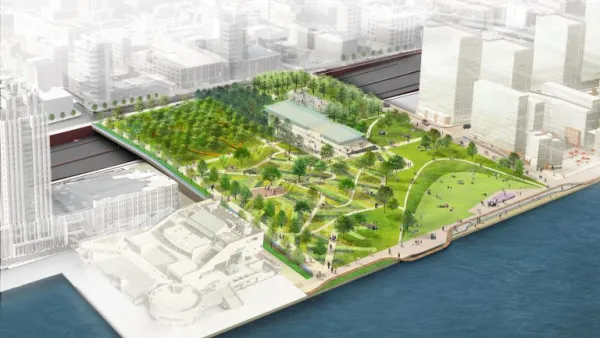
Kellie Patrick Gates relays information shared during a meeting between the Central Delaware Advocacy Group and Delaware River Waterfront Corporation about the progress by project designer Hargreaves Associates on a conceptual plan for a new Penn’s Landing. The project includes 11-acre cap park, which would stretch from Front Street to the Delaware River by capping I-95 and Delaware Avenue.
The current cost estimate for the plan is $205 million in public investment (and the plan is expected to be difficult to fund). But according to Gates, [the] idea is that investment would spur the private parts of the development – the residences, restaurants, shops and the like – to the tune of $800 million or even $1 billion.”
Some details about how the park's conceptual designs are taking shape:
- The park “would be engineered so that trees can be planted on what feels like ground level, and it would end at the waterfront in a large public space, framed by an amphitheater.”
- “Low-rise residential development with mixed uses on the ground floor would start along the middle of the boat basin, and then fill in with mid-rise near the Hyatt and on the opposite end.”
Gates’s article also makes the point, by paraphrasing Delaware River Waterfront Corporation Chairman Matt Ruben, that the Penn’s Landing plan will have a higher economic benefit than typical highway projects because freeway widenings don’t spur economic development in surrounding land uses.
Read the full story: "Conceptual framework" for new Penn's Landing nearing completion
Revealed: $2.2 Billion Redevelopment Plan for Philadelphia's Waterfront
The city of Philadelphia has a new, highly anticipated plan for a valuable site on the Delaware River waterfront.
A Development Bonanza in Philadelphia
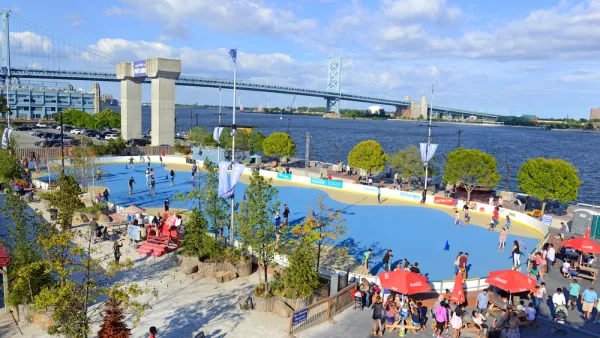
The Philadelphia 76ers are one of the real estate interests with designs on remaking the Penn's Landing site on the Delaware River in Philadelphia. But the team's vision for the waterfront reaches far beyond a single parcel.
Iconic Remnants of Failed Tram on the Philly Waterfront to Be Demolished
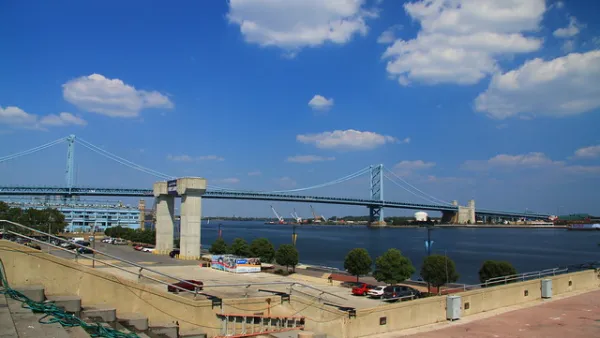
It's the end of an era that never was.

Planetizen Federal Action Tracker
A weekly monitor of how Trump’s orders and actions are impacting planners and planning in America.

California plans to bury El Niño’s downpour
If the state plays its cards right, it may be able to store a billion acre-feet of El Niño’s water in aquifers.

Desperate measures: Advocates weigh draining Lake Powell to fill Colorado River
Draining the reservoir could reduce evaporation losses by a couple hundred thousand acre-feet.

US buildings threatened, destroyed by fires set to triple by 2060
Researchers found a high fire risk for socioeconomically vulnerable neighborhoods in the American West.

LA residents may be allowed to paint their own crosswalks
Councilwoman Katy Yaroslavsky put out a motion instructing the Los Angeles Department of Public Transportation to study the feasibility of allowing volunteers to paint crosswalks.

Dallas moves to overhaul its zoning code
The city's zoning reform will allow more multi-family and mixed-use developments.

FREE Course: Walkable City 1: Why Walkability?
After describing his path towards focusing on walkability as the essence of good planning, Jeff Speck marches through his five principal reasons for making more walkable places.
Reinventing Malls: Planning Alchemy—Turning Gray Fields Into Gold
The course focuses on the opportunities and imperatives that shape reinvention of mall sites.

City of Rosemead
Rutgers University, Edward J. Bloustein School of Planning and Public Policy
One Hundred Miles
Hunter College, City University of New York (CUNY)
The Architects Foundation
University of Cincinnati Online
City of Cambridge
Montrose County
The Pocatello Development Authority