The 495 Express Lanes opened in Virginia in November 2012 and have yet to meet ridership projections. That might not be a problem when built by the public sector, but the road is a $1.4 billion investment by the Australian firm Transurban.


"Build it and they may not come", at least not in the numbers to bring a private company a profit, may be the enduring saga of the 495 Express Lanes. WAMU transportation reporter Martin Di Caro writes that while the 495 Express Lanes (also referred to as the Beltway Express lanes) is showing increased ridership and revenue, it may not satisfy the Transurban's shareholders.
The road lost $51 million in 2013. But Transurban is not deterred. In fact, a Transurban spokesman in the audio version of the article proclaims that "it's an outstanding example of the public-private partnership model working exactly as it is intended to work." The CEO took a similar position.
In a conference call with investors earlier this month, Transurban CEO Scott Charlton defended the firm’s $1.4 billion investment in the $1.9 billion road, according to a report in theNewspaper.com, an online journal about driving. Charlton is quoted telling investors, “We think there is long term value here, recognizing that this is a 75-year concession period."
Taking a different view is Joshua Schank, the president of the Eno Center for Transportation, a D.C.-based research group.
“Vehicles miles traveled in this country essentially peaked in 2005. We are seeing trends that show diminishing growth in travel by car, and more people are choosing either to forgo driving on congested highways every day for a lifestyle that allows them to walk, take transit or bike.”
“What we’ve seen in the D.C. area over the last decade is an infusion of younger people who are choosing to live in the city for longer periods of time and forgo car ownership for longer periods of time than in previous generations,” Schank added.
However, the region's population growth may just prove the 495 Express Lane's savior.
Tysons Corner is anticipating a large job and population boom over the next several decades, adding potential toll road users. And the 95 Express Lanes [not to be confused with Florida's I-95 Express Lanes], also built by Transurban, are scheduled to open early next year. Schank said the new highway will help feed drivers onto the 495 toll lanes.
Read the full story: Beltway Express Lanes Aren't Attracting Drivers Or Money
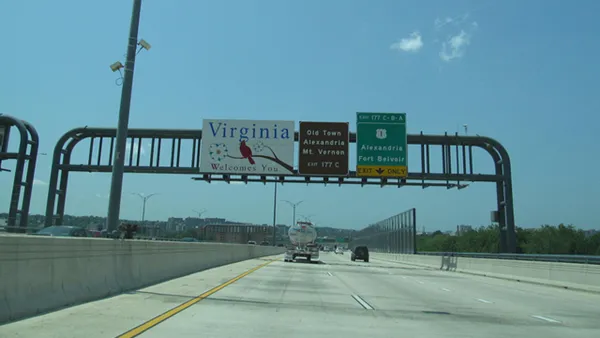
Popularity of Express Lanes Spreads Beyond Virginia
Dan Vock of Governing takes a broad look at congestion pricing, beginning with the success of Virginia's 66 Express Lanes, the ones where tolls initially topped $40. Notwithstanding complaints, managed lanes are spreading, but challenges remain.
Better Management, Not Lane Additions, Will Increase Capacity on Virginia's I-66
New express lanes on I-66 inside the Capital Beltway on I-66 will be significant for two reasons. First, no lanes will be added. HOV lanes will be converted to HOT lanes. Second, revenue will go to options to get drivers out of cars, such as transit
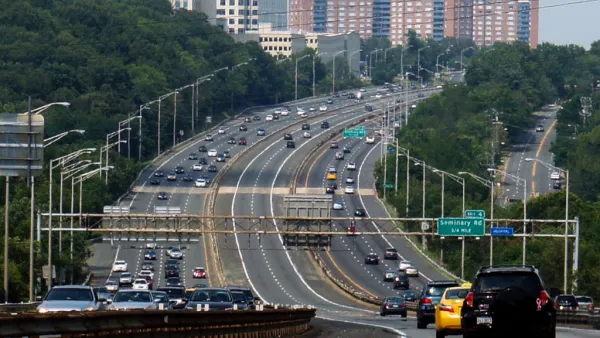
Solo-Occupant Hybrid Vehicles Lose Access to Carpool Lanes
A change in federal law on Monday meant that over 16,000 Virginia motorists must double or triple-up when using carpool lanes in Virginia. Next month, electric vehicles will need three occupants to drive free on I-395 when HOV lanes become HOT.

Planetizen Federal Action Tracker
A weekly monitor of how Trump’s orders and actions are impacting planners and planning in America.

Eastern Nebraska is running out of electricity
Data centers and electrification are straining eastern Nebraska’s grid, throttling economic development.

Study reveals best places in the U.S. for cycling, walking
New research from Streetlight Data examines bicycle and pedestrian miles per capita in the 100 largest U.S. cities by population.

Officials look to alter BART extension as price goes through the roof
Tariffs and the war with Iran are behind the rising cost.

To power data centers, Utah company may build hundreds of nuclear reactors on state land
In its permit application, Valar asked for the county to confirm that changes within its outlined plan would still be covered by the permit.

San Antonio is using environmental review to stall ICE detention center
San Antonio sued last month to pause work on the new detention center until the federal government studied its effect on the surrounding area.

FREE Course: Walkable City 1: Why Walkability?
After describing his path towards focusing on walkability as the essence of good planning, Jeff Speck marches through his five principal reasons for making more walkable places.
Reinventing Malls: Planning Alchemy—Turning Gray Fields Into Gold
The course focuses on the opportunities and imperatives that shape reinvention of mall sites.

City of Charlotte
City of Rosemead
Rutgers University, Edward J. Bloustein School of Planning and Public Policy
University of Michigan School for Environment and Sustainability (SEAS)
Hunter College, City University of New York (CUNY)
The Architects Foundation
City of Cambridge
The Pocatello Development Authority
The Urban Renewal Agency of the City of Pocatello