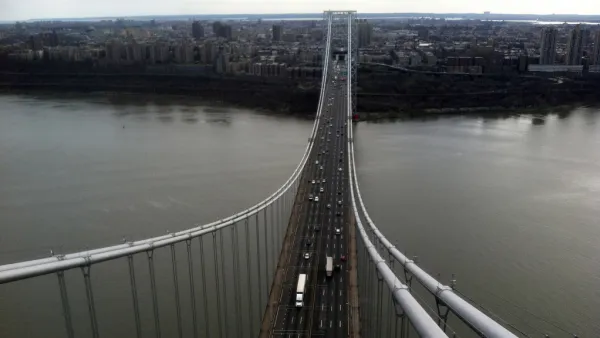
The recent George Washington Bridge lane closure controversy, clouded by the presidential aspirations of New Jersey Governor Chris Christie, is only the most recent failure of management by the Port Authority of New York and New Jersey.


Stephen Smith strongly argues in favor of restructuring the Port Authority of New York and New Jersey by citing a history of failures, both large and small in scale. In fact, the George Washington Bridge lane closures scandal is one of the Port Authority’s “more benign foibles in recent years,” claims Smith.
Although Smith isn’t alone in arguing that “The Port Authority of New York and New Jersey has clearly ceased to be an effective agency, and it’s time to consider alternative arrangements,” he believes many current proposals for a reorganization neglect the fundamental deficiency of the Port Authority: “Its independent authority structure combined with a massive guaranteed funding stream.”
Smith’s radical proposition for improving the Port Authority's management structure and assets won’t be popular at the C-level of the Port Authority: “To return accountability to the critical transportation assets managed by the Port Authority, it’s time to cut off the flow of money. The agency’s lifeblood, its toll revenues, should be returned to a combination of the New Jersey, New York state and New York City general treasuries, to be doled out by their respective legislatures (minus the cost of maintaining the crossings).”
Read the full story: It’s Time to Kill the Port Authority of New York and New Jersey

Bridgegate Winding Down
N.J. Gov. Chris Christie was never charged in the scandal that shut down access to the nation's busiest bridge for three days in September 2013 for political retribution. His aide and an appointment to the Port Authority were sentenced to prison.
Bridgegate Implications for New Jersey and Beyond
In The New York Times Sunday Review, Matt Katz, a political reporter for WNYC and New Jersey Public Radio, gives an update on the federal trial for 'Bridgegate' and also paints a bleak picture for New Jersey, and maybe the United States.
'Bridge-Gate' Attorneys Make Their Case: You Can't Sue Over Traffic
Attorneys representing the state of New Jersey responded to the allegations of a class action lawsuit rising from the "bridge-gate" scandal.

Planetizen Federal Action Tracker
A weekly monitor of how Trump’s orders and actions are impacting planners and planning in America.

Amtrak, CN end decades-long dispute with eight-year agreement
The new operating agreement establishes an updated framework for the companies to work together, including processes to resolve disputes.

Judges permit Denver to divert 77,000 acre feet from the Colorado River for reservoir expansion
Overuse and climate change have caused the Colorado River’s water levels to plummet.

NYC DOT wants faster, more permanent street upgrades
The city is examining ways to build more concrete infrastructure without getting entangled in 'decades-long' projects.

'Something we’ve never seen before:' rising utility rates could strain city finances nationwide
Data centers, climate change and other factors have caused utility rates in the United States to increase by 38% since 2020.

Trump to overrule local leaders, lease millions of acres of America’s Pacific Island territories’ seafloors to mining companies
International law says that the Indigenous people of America’s territories have a right to prior and informed consent regarding projects that impact their countries.

FREE Course: Walkable City 1: Why Walkability?
After describing his path towards focusing on walkability as the essence of good planning, Jeff Speck marches through his five principal reasons for making more walkable places.
Reinventing Malls: Planning Alchemy—Turning Gray Fields Into Gold
The course focuses on the opportunities and imperatives that shape reinvention of mall sites.

Harvard University Graduate School of Design
KFH Group Inc.
Greater Baltimore Committee
The Architects Foundation
University of Cincinnati Online
The Pocatello Development Authority
The Urban Renewal Agency of the City of Pocatello