New streetcar lines in cities like Kansas City, Tucson and Cincinnati are already generating residential development, long before the first passengers hop on board. As Atlanta lays the track for its new system, ATL Urbanist asks: Where's ours?


"As of now, no new non-student residential construction has been started or even announced on the route of the Atlanta Streetcar. The city is losing out on one of the main capabilities of the streetcar that other US cities have enjoyed in theirs: bringing in new residents with new housing," bemoans Darin at the blog ATL Urbanist. This despite years of expert insights into the need for more downtown housing.
"With all of this encouragement by experts to increase residential housing downtown, and with a survey showing the willingness of a huge number of people in the metro area to consider living here, it seems only natural that local politicians would have done everything possible to create a master plan that allows and encourages a windfall of new residential housing to be built," he adds. "City of Atlanta: Do. Not. Screw. This. Up."
Read the full story: Atlanta: where is our streetcar-spurred housing?
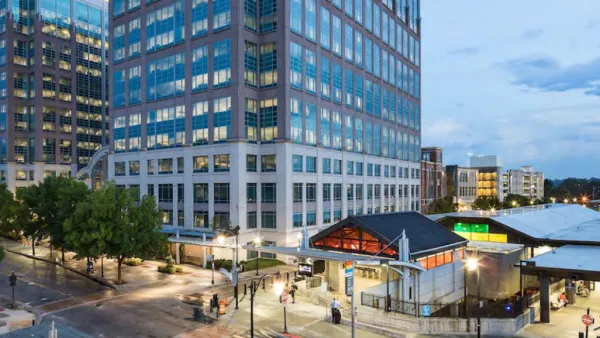
New TOD Breaks Ground in Atlanta Area
The project will include over 500 housing units, commercial and retail space, and park spaces.
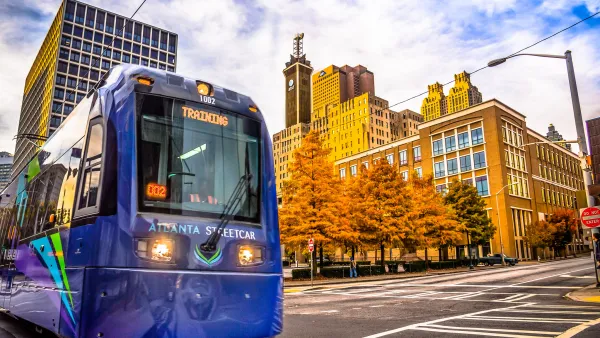
Expansion Planned for Atlanta Streetcar
A proposed expansion of Atlanta's beleaguered downtown streetcar could turn the 'novelty' line into a truly useful transportation option in the car-centric city.

Atlanta Launches $15 Million Transit Oriented Development Fund
The city of Atlanta has some of the longest commutes of any big city in the nation. Supporters hope this fund can help bring a few people out of their cars.

Planetizen Federal Action Tracker
A weekly monitor of how Trump’s orders and actions are impacting planners and planning in America.

California plans to bury El Niño’s downpour
If the state plays its cards right, it may be able to store a billion acre-feet of El Niño’s water in aquifers.

Desperate measures: Advocates weigh draining Lake Powell to fill Colorado River
Draining the reservoir could reduce evaporation losses by a couple hundred thousand acre-feet.

Mamdani’s pied-à-terre tax survives legal challenge
A panel of judges found that the plaintiffs failed to demonstrate injury as a result of New York City's implementation of the tax.

Eastern Nebraska is running out of electricity
Data centers and electrification are straining eastern Nebraska’s grid, throttling economic development.

Seattle passes record-breaking transit services expansion
Proposition 1 will double the city’s transit tax to add 95,000 more bus trips and preserve 180,000 bus trips annually.

FREE Course: Walkable City 1: Why Walkability?
After describing his path towards focusing on walkability as the essence of good planning, Jeff Speck marches through his five principal reasons for making more walkable places.
Reinventing Malls: Planning Alchemy—Turning Gray Fields Into Gold
The course focuses on the opportunities and imperatives that shape reinvention of mall sites.

City of Rosemead
Rutgers University, Edward J. Bloustein School of Planning and Public Policy
One Hundred Miles
Hunter College, City University of New York (CUNY)
The Architects Foundation
University of Cincinnati Online
City of Cambridge
Montrose County
The Pocatello Development Authority