After incurring $4.8 billion in repair costs from superstorm Sandy, NY's MTA had a hard time buying insurance. It's utilizing an innovative tool - called a catastrophe bond - to help prepare financially for a damaging storm surge in the near future.


"The Metropolitan Transportation Authority has sold the first bond designed to protect specifically against storm surges, assembling a $200 million protection plan against the greatest source of damage from superstorm Sandy," report Katy Burne and Ted Mann.
"The MTA's traditional avenues for insurance coverage dried up after Sandy, with damage from the storm making it 'exceedingly difficult for [it] to obtain insurance,' MTA Chairman Thomas Prendergast said in a statement."
"The use of the new financing tool—known as a catastrophe bond—is one of the clearest signs yet of how Sandy has driven up the cost of running the MTA and how its leaders are moving to adapt to the risk of future storms."
Read the full story: MTA Sells Storm Bond
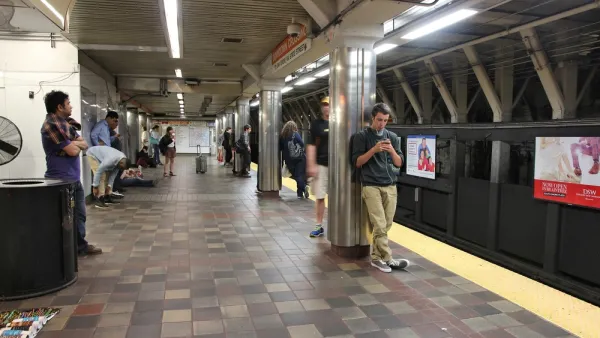
The Sad Saga of Three East Coast Subways
With so much attention placed on the woes facing D.C. Metro, it's important to recognize that it is hardly the only subway facing critical infrastructure investment needs.
The Return of the Ferry to the Big Apple—to All Five Boroughs
Ferries, New York City's first commuter mode, will return big-time if Mayor Bill de Blasio gets his way. Judging by how well the proposal in his February 3 State of the City address was received, he will.
A Year Later, Sandy Recovery Shows That Building Resilience Takes Time
Despite warnings of the threats posed by rising seas and more extreme storms in the years leading up to Hurricane Sandy, the New York region's preparations lagged behind where experts thought they should be. Has anything changed since Sandy?

Planetizen Federal Action Tracker
A weekly monitor of how Trump’s orders and actions are impacting planners and planning in America.

Eastern Nebraska is running out of electricity
Data centers and electrification are straining eastern Nebraska’s grid, throttling economic development.

Study reveals best places in the U.S. for cycling, walking
New research from Streetlight Data examines bicycle and pedestrian miles per capita in the 100 largest U.S. cities by population.

DSA members accuse Mamdani of 'abandoning values' over housing redevelopment
New York City's mayor plans to replace about 2,000 units of public housing with private, mixed-income housing.

All sides of BRT debate unhappy with CDOT’s most recent move
The Colorado Department of Transportation is no longer considering center-running bus lanes for Colorado Boulevard.

Massachusetts bogs generate both power, and cranberries
Putting solar panels above farmland is one way Massachusetts is advancing toward its goal of net-zero carbon emissions by 2050.

FREE Course: Walkable City 1: Why Walkability?
After describing his path towards focusing on walkability as the essence of good planning, Jeff Speck marches through his five principal reasons for making more walkable places.
Reinventing Malls: Planning Alchemy—Turning Gray Fields Into Gold
The course focuses on the opportunities and imperatives that shape reinvention of mall sites.

City of Rosemead
Rutgers University, Edward J. Bloustein School of Planning and Public Policy
One Hundred Miles
University of Michigan School for Environment and Sustainability (SEAS)
Hunter College, City University of New York (CUNY)
The Architects Foundation
City of Cambridge
The Pocatello Development Authority
The Urban Renewal Agency of the City of Pocatello