The latter half of the twentieth century saw the slow decline of train travel and the deterioration of America's grand railroad stations. Amid growing rail readership, the country is embarking on a new era of station construction.


"Today, with train travel regaining popularity—Amtrak ridership has jumped 49 percent since 2000—and high-speed passenger rail projects or improvements under construction in California, Michigan, and the Northeast Corridor, another era of railroad station construction is dawning," writes Jeffrey Spivak. "This time, nearly every station project includes intercity train service, and most incorporate other forms of transit, too. In this era, then, train service is returning to some stations that had abandoned it, and rail hubs once again are seen as magnets for real estate activity and opportunity.
"What we’re seeing now is a real resurrection of train transportation in the United States," says Rod Diridon Sr., executive director of the Mineta Transportation Institute, a public policy research center in San Jose, California. "We’re going to see a wholesale return of integrated rail transportation and the return of the station as the iconic focal point in downtowns."
Spivak surveys the variety of rail station renovation, new construction, and planning projects underway across the United States.
Read the full story: All Aboard: Rail Centric Construction Gets Back on Track
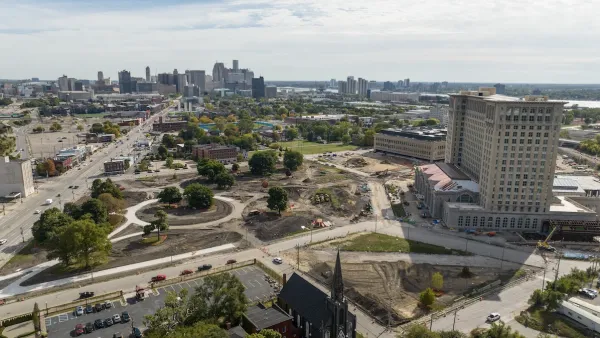
Detroit To Build New Bus, Train Hub Next to Historic Station
The new station will serve intercity buses and offer connections to Amtrak service.
Amtrak unveils proposal to restructure, split into 3 divisions
Agency officials say the new structure would offer more transparency and accountability.
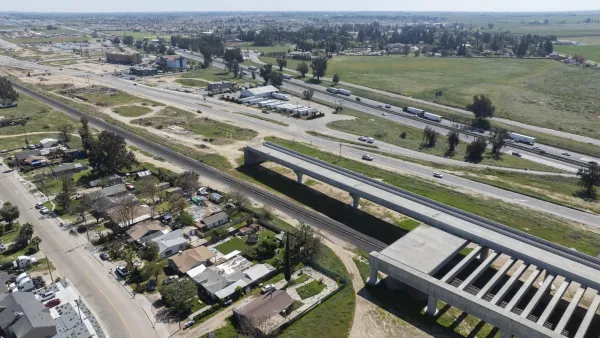
California rail builders sign MOU advancing statewide high-speed network
The agreement aims to create an interconnected high-speed rail network and bring down the cost of construction.

Planetizen Federal Action Tracker
A weekly monitor of how Trump’s orders and actions are impacting planners and planning in America.

Eastern Nebraska is running out of electricity
Data centers and electrification are straining eastern Nebraska’s grid, throttling economic development.

Study reveals best places in the U.S. for cycling, walking
New research from Streetlight Data examines bicycle and pedestrian miles per capita in the 100 largest U.S. cities by population.

Austin plans light rail extension — before breaking ground on light rail
The planned extension is three miles long and will take riders straight to Austin-Bergstrom International Airport.

Chicago cuts ribbon on $300,000, self-cleaning public toilet
The public toilet is the city’s first, and may pave the way for a rollout of similar facilities.

Sharp cuts to Oregon public transit, rail on the horizon without additional funding
Transportation workgroup has until Dec. 15 to send its report to Gov. Tina Kotek

FREE Course: Walkable City 1: Why Walkability?
After describing his path towards focusing on walkability as the essence of good planning, Jeff Speck marches through his five principal reasons for making more walkable places.
Reinventing Malls: Planning Alchemy—Turning Gray Fields Into Gold
The course focuses on the opportunities and imperatives that shape reinvention of mall sites.

City of Charlotte
City of Rosemead
Rutgers University, Edward J. Bloustein School of Planning and Public Policy
University of Michigan School for Environment and Sustainability (SEAS)
Hunter College, City University of New York (CUNY)
The Architects Foundation
City of Cambridge
The Pocatello Development Authority
The Urban Renewal Agency of the City of Pocatello