Laurie Olin, the preeminent landscape architect, is being presented this week with the prestigious National Medal of Arts. The well deserved honor is a big deal not only for Olin and his firm, but for all landscape architects.


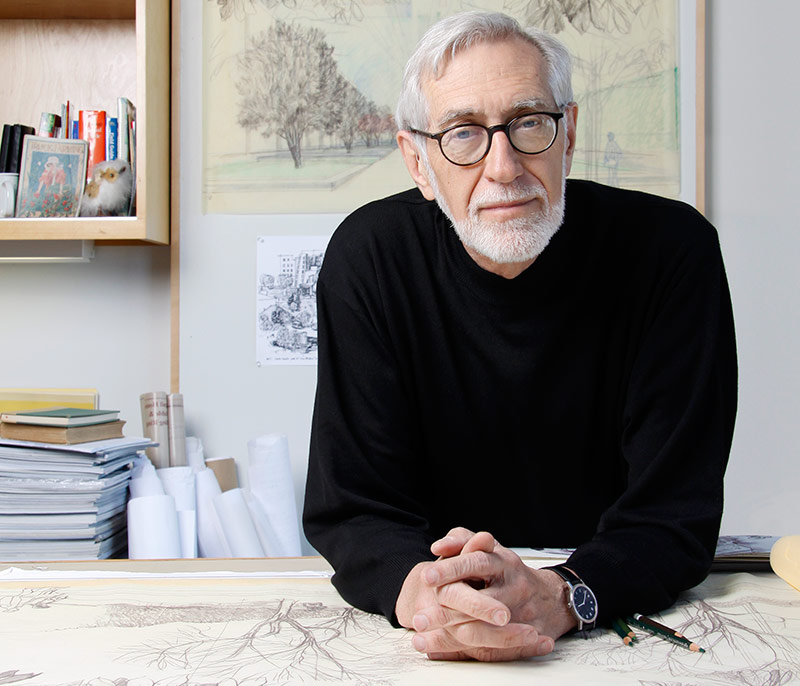
This is a big week for landscape architects. Laurie Olin, one of our profession’s most respected practitioners, educators and leaders will soon be standing on stage next to celebrities such as George Lucas, Herb Alpert and Elaine May, being presented with the prestigious National Medal of Arts by President Obama. Awarded by the National Endowment for the Arts, it is the highest honor given to artists by the US Government. Olin is the fourth landscape architect to receive the award, joining superstars of the profession Lawrence Halprin, Dan Kiley and Ian McHarg.

The White House press release describes Olin as a “preeminent landscape architect,” who is “renowned for his acute sense of harmony and balance between nature and design.” It goes on to say he has “dedicated his energy to shaping many iconic spaces around the world and to educating new leaders in his art.” Indeed. Such is common knowledge to landscape architects and, hopefully, most architects, but this recognition will surely come as news to many in the general public who have misconceptions about what landscape architecture is all about. In this sense, the honor is almost as important to us as it is to him.

The list of all Olin has achieved in his illustrious career would take up too much space here. But a few important highlights include the ASLA Medal, the highest honor given by the American Society of Landscape Architects (ASLA), Fellowship in the American Academy of Rome, and – just this year – the Thomas Jefferson Foundation Medal in Architecture. As you would imagine, his work has also won numerous awards. For every high-profile project we have seen splashed across design magazines and websites (think Bryant Park, Columbus Circle, the Washington Monument, and the Getty, for instance) there are many dozens of others he has overseen with equal care and focus, each improving the quality of life for people in cities, on campuses, and in parks, resorts and museums around the world. Add to these the work produced by those who have learned from his artistry, intellect and high ethical standards – his students at Penn and those professionals who have passed through his office –– and his legacy becomes perhaps the most significant of any landscape architect since Olmsted.

Olin’s collective work displays the heart and mind of a true urbanist. Regardless of scale – whether a major master plan or a small park or campus space – his landscapes are all about accommodating the layers of human movement through a given space while maximizing its experiential quality. In my opinion, he is the best ever at making places in the urban realm that succeed not only as models of efficiency, as they seamlessly integrate pedestrians and transit of all types, but also as fully realized landscapes that are as beautiful as they are functional. Columbus Circle in New York City is a perfect example of this, to which anyone who remembers what the space was like before it was redone can attest.

I have had the great fortune of knowing Laurie for over a decade. He has worked with me on several projects at Duke University and we served together on the jury for ASLA’s professional design awards. During this time, I have learned a lot from him about planning and design. I have also come to realize that his genius lies in his ability to make really complicated problems seem easy. The more complex, the better, it seems.

While there are plenty of designers who manipulate sites to better accommodate their art, Laurie chooses pragmatism over pretense, and creates spaces that are artful, yet rooted in a fundamental desire to simplify – and improve – the world in which we live. You often hear the terms elegant and timeless used to describe the landscapes he creates; this is because he designs specifically to the sites themselves, and not to any preconceived statement he is trying to make. There is no signature Olin style, no artifice that sets his work apart.

It would be unfair to heap all of this praise on Laurie and not acknowledge what he, himself, would have brought up a long time ago: he is very far from a one-man shop. His firm, OLIN (formerly Hanna Olin and then the Olin Partnership) is led by partners very capable of carrying the firm’s legacy into the future, and supported by one of the most talented groups of young designers working anywhere. Collectively, the firm has received major awards from ASLA, AIA, Cooper Hewitt, ULI, and others. Even so, I am confident that everyone at OLIN recognizes and appreciates his singular persona and identity.

To say there is something special about Laurie is a bit of an understatement. No matter who else is the room or what the topic of discussion is, his opinions are what inevitably seem to matter most. He possesses a gravitas that I can only imagine makes life a lot easier. As an example of this, several years ago he came to Duke to present his designs for a major campus landscape to our Board of Trustees, a group used to being presented to by famous architects and landscape architects, thus not prone to getting star-struck. However, once Laurie was finished with his presentation, and had them eating out of his hand and willing to approve anything he wanted, they did something I had never seen them do before – or since: they erupted into giddy applause. This completely unexpected reaction made me proud to know him; and it made me proud that I, like him, am a landscape architect.
That ovation was just a small dose of what he will be receiving this week.

Congratulations, Laurie. This honor is well deserved.


Cultivating Color and Community: Seasonal Planting at Descanso Gardens
Descanso Gardens’ annual planting of 35,000 tulip bulbs showcases the power of seasonal design to enhance public spaces and engage visitors.

How To: Drought-Resistant Gardening
Curbed surveyed landscape architects specializing in drought-resistant lawns for their best "tips and tricks."

Why Are Utilities So Ugly?
A landscape architect in Tucson shares a professional lament: intrusive, ugly utilities.

Planetizen Federal Action Tracker
A weekly monitor of how Trump’s orders and actions are impacting planners and planning in America.

Amtrak, CN end decades-long dispute with eight-year agreement
The new operating agreement establishes an updated framework for the companies to work together, including processes to resolve disputes.

Northwest rail fans eager for Sept. 30 debut of Amtrak’s Airo fleet
Get ready for that new train smell and more seats. But they won’t go faster or run more frequently on the Cascades route in Washington and Oregon.

Trump administration unlawfully slashed $7 billion in clean energy grants, judge rules
The Environmental Protection Agency ended the Solar For All program, which provided the grants, after President Donald Trump’s inauguration.

Record-breaking wildlife overpass in Colorado brings 91% reduction in animal collisions
Prior to the overpass, vehicles were hitting one deer per day on Colorado’s Interstate 25.

California lawmakers approve just 5% of much-needed LA28 transportation funding
State legislators appear just as unwilling as Trump to pay for Olympics-related transportation projects.

FREE Course: Walkable City 1: Why Walkability?
After describing his path towards focusing on walkability as the essence of good planning, Jeff Speck marches through his five principal reasons for making more walkable places.
Reinventing Malls: Planning Alchemy—Turning Gray Fields Into Gold
The course focuses on the opportunities and imperatives that shape reinvention of mall sites.

City of Thousand Oaks
City of Wisconsin Rapids
Harvard University Graduate School of Design
The Architects Foundation
University of Cincinnati Online
The Pocatello Development Authority
The Urban Renewal Agency of the City of Pocatello

