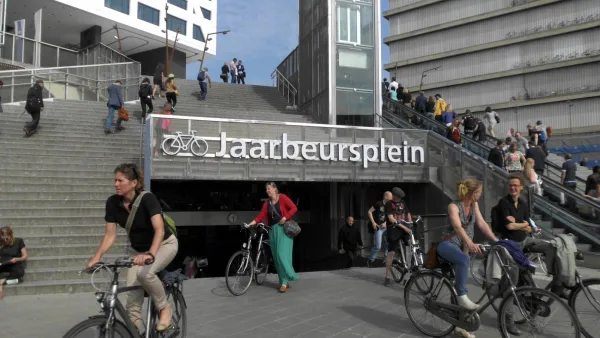
Is it possible for a city to have too many bikes? In Amsterdam, a city known as much for its cycling culture as for its canals, the battle for street space and parking spaces has some residents pondering whether there are too many bikes.


"While cities like New York struggle to get people onto bikes, Amsterdam is trying to keep its hordes of bikes under control," reports John Tagliabue. "In a city of 800,000, there are 880,000 bicycles, the government estimates, four times the number of cars. In the past two decades, travel by bike has grown by 40 percent so that now about 32 percent of all trips within the city are by bike, compared with 22 percent by car."
The primary problem in Amsterdam seems to have less to do with congestion and more to do with where to store your bike once you reach your destination.
“There are too many bikes,” said Michèl Post, an official with the Fietsersbond, or Cyclists’ Union. “At train stations, shopping malls, in residential areas, everywhere there are more bikes than bike racks.”
“When you look at the large squares, on a Friday night the place is completely covered with bikes,” he went on. “There is also a question of aesthetic values.”
Read the full story: The Dutch Prize Their Pedal Power, but a Sea of Bikes Swamps Their Capital
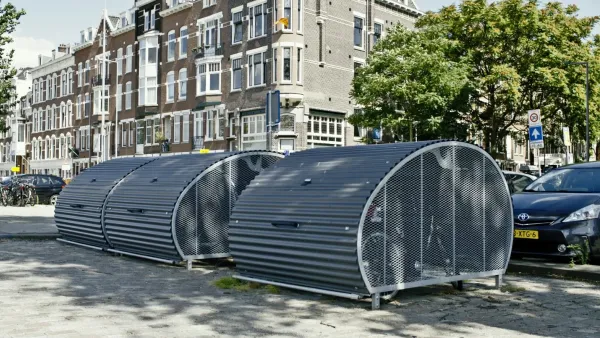
NYC Launches Citywide Secure Bike Parking Network
The new parking hubs will span 500 locations and offer an alternative to taking bikes on crowded transit or up multi-story apartment stairs.

California Law Delays Bike Parking Requirements
A state law that delays new building code updates after the destructive Eaton and Palisades fires means bike advocates won’t see meaningful changes to bike parking rules for at least two years.
Supporting Cycling Takes More Than Just Bike Lanes
Safe, protected bike lanes are a key part of a city’s bike infrastructure — but secure parking, e-bike charging, and other amenities can also influence people’s shift to cycling.

Desperate measures: Advocates weigh draining Lake Powell to fill Colorado River
Draining the reservoir could reduce evaporation losses by a couple hundred thousand acre-feet.

Eastern Nebraska is running out of electricity
Data centers and electrification are straining eastern Nebraska’s grid, throttling economic development.

Malls are becoming the midtowns of the future
Mall and office park redevelopments are a generational opportunity to create new nodes of urbanity.

NYC breaks ground on anti-flooding infrastructure project
New York City's new system will reduce stormwater flows to local sewers by 90%.

One Kentucky town’s secret to affordable housing
The Smoketown Community Land Trust has already built seven affordable homes for community members.

Houston gains petal-shaped cooling infrastructure to make streets more ‘delightful’
The city has installed the pavilions along 15 blocks in Houston.

FREE Course: Walkable City 1: Why Walkability?
After describing his path towards focusing on walkability as the essence of good planning, Jeff Speck marches through his five principal reasons for making more walkable places.
Reinventing Malls: Planning Alchemy—Turning Gray Fields Into Gold
The course focuses on the opportunities and imperatives that shape reinvention of mall sites.

City of Rosemead
Rutgers University, Edward J. Bloustein School of Planning and Public Policy
One Hundred Miles
University of Michigan School for Environment and Sustainability (SEAS)
Hunter College, City University of New York (CUNY)
The Architects Foundation
City of Cambridge
Montrose County
The Pocatello Development Authority