Joseph Lhota, the chairman and chief executive of the Metropolitan Transportation Authority, has announced his resignation at the end of this year. Who will be next to lead the nation's largest public transportation system?


While Governor Andrew Cuomo conducts a nationwide search for the new transit chief, Fernando Ferrer, the vice chairman of the authority's board, will serve as acting chairman, and Thomas Prendergast, president of New York City Transit, will run daily operations as interim executive director. Lhota's replacement will take over "the most important public transit job in the nation," serving the 15 million people who live in the New York City area. However, this crucial job also comes with "a big, unwieldy bureaucracy with a $12.6 billion annual budget and 65,400 employees, most of whom are union workers who have been laboring without a contract."
The new leader will need sharp political skills to navigate negotations. For example, the transit system faces large cuts in future operating budgets, and suburban legislators are pushing to cut a payroll tax that funds the MTA by $1.2 billion. It will be imperative for the new chief to stop this rollback and even convince the city for more funding to maintain subway stations. He or she will also be responsible for a $29 billion capital plan through 2014, including $4.76 billion for Hurricane Sandy recovery. Lhota was praised for overseeing the system during Hurricane Sandy, which means the new leader will undoubtedly have big shoes to fill.
Read the full story: Wanted: Transit Wizard
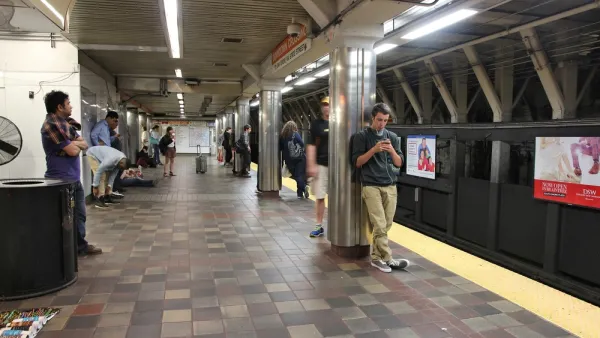
The Sad Saga of Three East Coast Subways
With so much attention placed on the woes facing D.C. Metro, it's important to recognize that it is hardly the only subway facing critical infrastructure investment needs.
The Return of the Ferry to the Big Apple—to All Five Boroughs
Ferries, New York City's first commuter mode, will return big-time if Mayor Bill de Blasio gets his way. Judging by how well the proposal in his February 3 State of the City address was received, he will.
Unable to Obtain Insurance, NY MTA Finds Innovative Way to Prepare for Future Storms
After incurring $4.8 billion in repair costs from superstorm Sandy, NY's MTA had a hard time buying insurance. It's utilizing an innovative tool - called a catastrophe bond - to help prepare financially for a damaging storm surge in the near future.

Planetizen Federal Action Tracker
A weekly monitor of how Trump’s orders and actions are impacting planners and planning in America.

California plans to bury El Niño’s downpour
If the state plays its cards right, it may be able to store a billion acre-feet of El Niño’s water in aquifers.

Desperate measures: Advocates weigh draining Lake Powell to fill Colorado River
Draining the reservoir could reduce evaporation losses by a couple hundred thousand acre-feet.

Bay area voters pass ‘crucial lifeline’ for transit
Proposition RTM, which will fund Bay Area transit, has approval from 61% of voters as of 9:45 p.m. on Nov. 3.

Voters across the country reject data centers
Dozens of communities voted on measures to restrict the buildout of data centers.

US buildings threatened, destroyed by fires set to triple by 2060
Researchers found a high fire risk for socioeconomically vulnerable neighborhoods in the American West.

FREE Course: Walkable City 1: Why Walkability?
After describing his path towards focusing on walkability as the essence of good planning, Jeff Speck marches through his five principal reasons for making more walkable places.
Reinventing Malls: Planning Alchemy—Turning Gray Fields Into Gold
The course focuses on the opportunities and imperatives that shape reinvention of mall sites.

City of Rosemead
Rutgers University, Edward J. Bloustein School of Planning and Public Policy
One Hundred Miles
Hunter College, City University of New York (CUNY)
The Architects Foundation
University of Cincinnati Online
City of Cambridge
Montrose County
The Pocatello Development Authority