Tired of all those year end "Best of" lists? This should cleanse your palate. Marlys Harris has gathered a list of the nine worst decisions made by planners in the history of the Twin Cities.



You don't have to be a resident of Minneapolis or St. Paul to gather that building a street-killing network of skyways throughout your downtown may not have been the smartest decision in hindsight. Harris has assmebled a list of eight other "planning moves" that she deems the worst in Twin Cities history. Some entries may surprise, such as her condemnation of the power of neighborhood groups in Minneapolis, who she says, "have managed to block a number of worthy projects."
Other faux pas include the elimination of 524 miles of electric trolley lines, which the Twin Cities are now spending billions to replace with light rail, and "the slicing of downtown St. Paul in two" by the contruction of Interstate 94. "'Separating downtown from the Capitol was obviously a terrible decision,' said Mayor Chris Coleman at a meeting of the Urban Land Institute a couple of months ago. Those lousy decisions, he added, can be with us for 100 years."
Read the full story: 9 worst urban planning moves in Twin Cities history

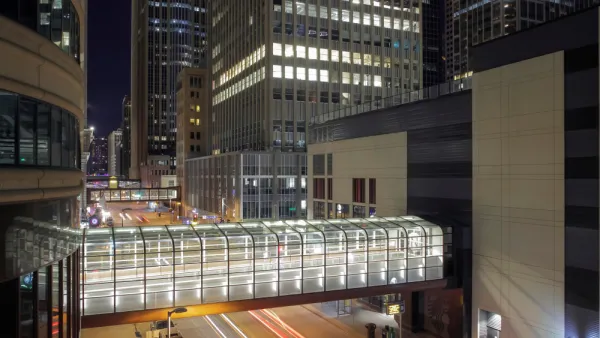
The Pandemic Has Not Been Kind to Pedestrian Skyways in the Twin Cities
Already a source of eternal controversy for their effects on street life and local business, pedestrian skyways have proven even more problematic during the pandemic.
Videos Critique Twin Cities' Skyways
Skyways in Minneapolis and St. Paul have been a major part of the two cities downtowns for years, but are also blamed for killing their streetlife. A new video competition challenged filmmakers to explore that dichotomy.

Looking Back on 60 Years of Land Development in the Twin Cities
In 1960, about 12 percent of the Twin Cities metro's land was already developed. By 2020, about 34 percent had been developed. Many factors influenced how the region has changed since 1960.

Planetizen Federal Action Tracker
A weekly monitor of how Trump’s orders and actions are impacting planners and planning in America.

California plans to bury El Niño’s downpour
If the state plays its cards right, it may be able to store a billion acre-feet of El Niño’s water in aquifers.

Chicago breaks ground on $3 billion megadevelopment
The new neighborhood, titled Foundry Park, will one day host 3,700 residences.

California High-Speed Rail Authority CEO resigns after $600,000 scandal
Under Ian Choudri, the authority used taxpayer dollars to fund first class flights and trips to nightclubs.

Want to study the Missouri River? Soon, you may need unanimous approval from 10 states
Legislation would require 10 governors’ permission to study or build projects moving water outside the basin.

Desperate measures: Advocates weigh draining Lake Powell to fill Colorado River
Draining the reservoir could reduce evaporation losses by a couple hundred thousand acre-feet.

FREE Course: Walkable City 1: Why Walkability?
After describing his path towards focusing on walkability as the essence of good planning, Jeff Speck marches through his five principal reasons for making more walkable places.
Reinventing Malls: Planning Alchemy—Turning Gray Fields Into Gold
The course focuses on the opportunities and imperatives that shape reinvention of mall sites.

City of Rosemead
Rutgers University, Edward J. Bloustein School of Planning and Public Policy
One Hundred Miles
Hunter College, City University of New York (CUNY)
The Architects Foundation
University of Cincinnati Online
City of Cambridge
Montrose County
The Pocatello Development Authority