Alex Ulam discusses the challenges of redesigning mid-century urban landscapes to accommodate contemporary tastes and social activities, drawing on examples like Dan Kiley's North Court at Lincoln Center and Boston City Hall Plaza.


The stark plazas, parks, and courtyards from the modernist era were designed to complement minimalist mid-century buildings, rather than serve as active social spaces, writes Ulam. "Some renowned modernist spaces such as the Spartan granite plaza in front of Mies van der Rohe's Seagram Building were not even designed with the intention that people would linger. 'When Mies van der Rohe saw people sitting on the ledge, he was surprised,' Phillip Johnson is said to have commented. 'He never dreamed they would.'" Nowadays, people desire to relax in open spaces with cafes, parks, shade, and restrooms. The public plazas of Dan Kiley's North Court at Lincoln Center in New York City and Lawrence Halprin's Skyline Park in Denver, Colorado, have already been redesigned from their modernist form to fit the contemporary context. However, Ulam adds, "although nobody has proposed inserting a lawn and trees into the Seagram Building Plaza, some say that the current open space redesign juggernaut is threatening to eradicate an important part of the country's architectural history." Should these landscape landmarks be given the same protections their concrete, steel and glass neighbors receive?
The preservation of works of modernist landscape architecture can be traced to Charles Birnbaum, president of the Cultural Landscape Foundation (TLCF). In 2008, TLCF led a campaign Marvels of Modernism "to call attention to dozens of significant post-war landscapes that had been allowed to fall into disrepair and were threatened with destruction" and "to encourage sensitive renovations that respect the original design intent of landscape architecture masterworks." He was one of many preservationists who opposed the controversial redesign of Kiley's North Court, which served to introduce the public "to the thorny issues surrounding the preservation of works of modernist landscape architecture."
"The design community is still divided over whether Kiley's design for the North Court could have been updated in such a way as to appease the preservationists and accommodate Lincoln Center's programming," says Ulam. "However, the conditions at other modernist-era plazas certainly calls for substantial overhauls." For example, the Anthony J. Celebrezze Federal Building Plaza in Cleveland developed severe drainage problems, which the landscape architecture firm OLIN used as an opportunity "to better connect the plaza with the rest of the city." The traditional cobblestone campus of the State University of New York at Albany was redesigned by Thomas Balsley Associates to create a more inviting space with benches, lighting, a lawn, and an interactive fountain. HM White Site Architects was asked to "create a new outdoor space on top of a setback at the 17th floor of 850 Third Avenue, a 1960s-era Emery Roth office building, which would serve as small meeting areas as well as a pleasant view for the interior offices."
Other modernist landscapes have not been easy to redesign such as Boston City Hall Plaza, a Brutalist complex of buildings known as the "brick desert" and "one of the most widely disliked places in Beantown." There is no greenery, shade, or seating; and large puddles result from the inadequate drainage system. “The public hates this place; they just hate it,” said Birnbaum, who put the place on TCLF’s Marvels of Modernism list. “This is what happens with a lot of these landscapes when they are not taken care of.” The Greening America's Capitals, a new federal initiative that is a joint program of the EPA-HUD-DOT Partnerships for Sustainable Communities, has developed a plan "oriented toward mitigating the harsh manmade conditions of the plaza with many of the landscape strategies that society has come to demand from contemporary public spaces." Bosques of trees will soften the Brutalist aesthetic, but the historic brick foundation will be preserved. “The concept behind city hall and the plaza was a synergistic relationship, but it didn’t really function on a human scale,” said Birnbaum. "What Gary is doing with these insertions is really reinforcing the design intent, by bringing some humanity to the place.”
Read the full story: Softening Modernism's Hard Edge

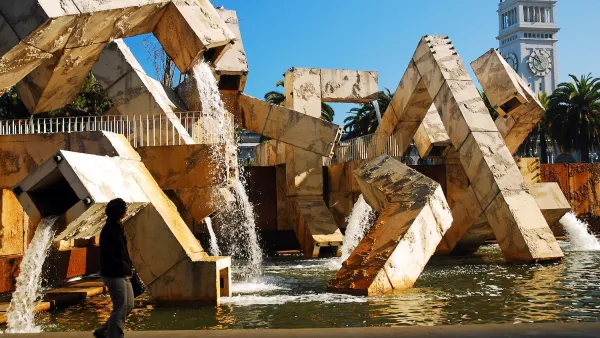
San Francisco to Dismantle its Polarizing Brutalist Fountain
The Vaillancourt Fountain stands as a symbol of the tension between the city’s past and future.
What ‘The Brutalist’ Teaches Us About Modern Cities
How architecture and urban landscapes reflect the trauma and dysfunction of the post-war experience.
The Significance of Architecture in Music Videos
What can be learned from music videos about popular culture's relationship to architecture?

Planetizen Federal Action Tracker
A weekly monitor of how Trump’s orders and actions are impacting planners and planning in America.

Northwest rail fans eager for Sept. 30 debut of Amtrak’s Airo fleet
Get ready for that new train smell and more seats. But they won’t go faster or run more frequently on the Cascades route in Washington and Oregon.

Trump is considering data centers on 6 states' public land — some state officials say they had no idea
If the administration approves the proposed projects, data center and data center-related developments will cover 17,600 acres of public land.

After decades of planning, Sacramento gains new light rail station
Trains will arrive every 15 minutes during peak hours and every 30 minutes during non-peak hours.

Massive tunnel-boring machine breaks ground on Gateway Project
The Trump administration revoked funding for the project in October 2025, and then restored it earlier this year.

Airo trainsets begin service on Amtrak Cascades route
The trains feature panoramic windows, complementary wifi and over 300 seats per train set.

FREE Course: Walkable City 1: Why Walkability?
After describing his path towards focusing on walkability as the essence of good planning, Jeff Speck marches through his five principal reasons for making more walkable places.
Reinventing Malls: Planning Alchemy—Turning Gray Fields Into Gold
The course focuses on the opportunities and imperatives that shape reinvention of mall sites.

City of Thousand Oaks
City of Wisconsin Rapids
Harvard University Graduate School of Design
The Architects Foundation
University of Cincinnati Online
The Pocatello Development Authority
The Urban Renewal Agency of the City of Pocatello