Chris Fusco and Tina Sfondeles look at the growing rate of bike crashes reported in Chicago over the past decade. As Mayor Rahm Emanuel seeks to make it "the bike friendliest city in the country," can Chicago protect the riders it hopes to attract?


Reflecting the growing number of cyclists in the city, and growing conflicts with motor vehicles, Fusco and Sfondeles report that, "the number of bike crashes reported to the Chicago Police Department rose by 38 percent between 2001 and 2011." With an agressive plan to increase the city's share of protected bike lanes and a multimillion-dollar bike-sharing program due to launch next year, the authors ask if the city is doing enough to ensure the safety of cyclists.
"Most agree that the 33.5 miles of protected and buffered bike lanes that
the mayor plans to have in place by the end of this year will make
biking safer. But some say City Hall is failing to make simpler,
lower-cost safety improvements - especially at crash-prone bike
intersections," note Fusco and Sfondeles.
John Pucher, a planning professor and transportation researcher at Rutgers University, "says those new routes and the addition of bike-sharing might
actually make cycling in the city less dangerous."
"As you have more and
more people cycling, you have this notion called safety in numbers," he
says. "Motorists start to expect to see them crossing at intersections,
and that generally makes it safer."
So far, this doesn't seem to be the case.
Read the full story: Two-wheel trouble: Bike crashes in city up 38% over the past decade

A Buffer is Better
What's the best street design to keep bicyclists safely out of the door zone? A buffered bike lane beats a conventional bike lane or "wide curb lane" according to a recent study published in TRB, based on observations in Chicago and Cambridge, Mass.
A ‘shady’ deal: Chicagoans rally against planned Amtrak maintenance facility
The $900 million facility would allow Amtrak to maintain entire trains in one building, which the company says will reduce delays.
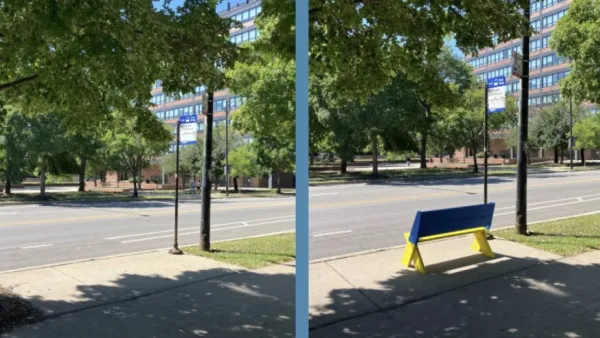
Guerilla urbanists are building DIY bus stop benches in Chicago
The new benches are not officially sanctioned or permitted, but the residents who placed them hope they will be the start of a network of DIY benches across the city.

Planetizen Federal Action Tracker
A weekly monitor of how Trump’s orders and actions are impacting planners and planning in America.

Amtrak, CN end decades-long dispute with eight-year agreement
The new operating agreement establishes an updated framework for the companies to work together, including processes to resolve disputes.

Judges permit Denver to divert 77,000 acre feet from the Colorado River for reservoir expansion
Overuse and climate change have caused the Colorado River’s water levels to plummet.

NYC DOT wants faster, more permanent street upgrades
The city is examining ways to build more concrete infrastructure without getting entangled in 'decades-long' projects.

'Something we’ve never seen before:' rising utility rates could strain city finances nationwide
Data centers, climate change and other factors have caused utility rates in the United States to increase by 38% since 2020.

Trump to overrule local leaders, lease millions of acres of America’s Pacific Island territories’ seafloors to mining companies
International law says that the Indigenous people of America’s territories have a right to prior and informed consent regarding projects that impact their countries.

FREE Course: Walkable City 1: Why Walkability?
After describing his path towards focusing on walkability as the essence of good planning, Jeff Speck marches through his five principal reasons for making more walkable places.
Reinventing Malls: Planning Alchemy—Turning Gray Fields Into Gold
The course focuses on the opportunities and imperatives that shape reinvention of mall sites.

Harvard University Graduate School of Design
KFH Group Inc.
Greater Baltimore Committee
The Architects Foundation
University of Cincinnati Online
The Pocatello Development Authority
The Urban Renewal Agency of the City of Pocatello