Research and Innovative Technology Administration (RITA) announces the winners of the Connected Vehicle Challenge that asked people to submit ideas, using the Dedicated Short-Range Communications (DSRC) technology to its full potential.


There are 76 entries total. Five out of six winners are submissions made by the academia from the Univ. of Buffalo, UC Riverside, UC Berkeley, Univ. of Illinois, and Clemson Univ. The ideas range from enhancing vehicle safety to increasing the accuracy of GPS. Doug Lundquist of the Univ. of Illinois even proposes an emissions trading scheme for cars à la cap-and-trade.
Alex Goldmark writes:
"The most sweeping entry, Clemson's Integrated Intelligent Transportation Platform, envisions a complete travel experience guided by DSRC features, from reserving and planning electric vehicle charging stops for longer trips, to buying and paying for a cup of coffee by speaking to your dashboard while driving. They made this 11 minute video showing off all the features."
RITA is a research division of the U.S. Dept. of Transportation.
Read the full story: Now that Cars Can Talk to Each Other What Should They Say?
Amtrak announces new ‘System Expansion Committee’
The five initial members will oversee the expansion of rail service and the development of sustainable funding strategies.
New USDOT safety strategy highlights enforcement, embraces autonomous cars
The new National Roadway Safety Strategy emphasizes safety technology and enforcement and promises to further crack down on immigrant truck drivers with illicitly obtained licenses.
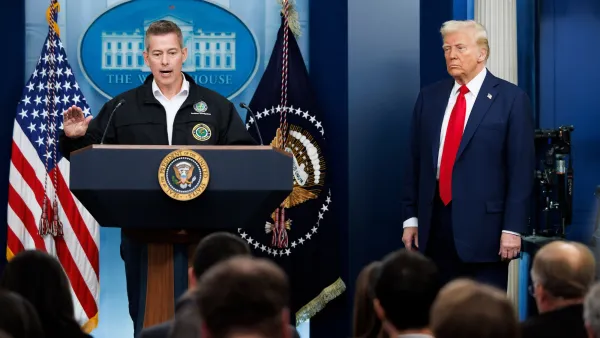
USDOT secretary plans to pull $1.73B from 'DEI bike lanes'
The move jeopardizes dozens of road safety projects around the country.

Planetizen Federal Action Tracker
A weekly monitor of how Trump’s orders and actions are impacting planners and planning in America.

Eastern Nebraska is running out of electricity
Data centers and electrification are straining eastern Nebraska’s grid, throttling economic development.

Study reveals best places in the U.S. for cycling, walking
New research from Streetlight Data examines bicycle and pedestrian miles per capita in the 100 largest U.S. cities by population.

DSA members accuse Mamdani of 'abandoning values' over housing redevelopment
New York City's mayor plans to replace about 2,000 units of public housing with private, mixed-income housing.

All sides of BRT debate unhappy with CDOT’s most recent move
The Colorado Department of Transportation is no longer considering center-running bus lanes for Colorado Boulevard.

Massachusetts bogs generate both power, and cranberries
Putting solar panels above farmland is one way Massachusetts is advancing toward its goal of net-zero carbon emissions by 2050.

FREE Course: Walkable City 1: Why Walkability?
After describing his path towards focusing on walkability as the essence of good planning, Jeff Speck marches through his five principal reasons for making more walkable places.
Reinventing Malls: Planning Alchemy—Turning Gray Fields Into Gold
The course focuses on the opportunities and imperatives that shape reinvention of mall sites.

City of Rosemead
Rutgers University, Edward J. Bloustein School of Planning and Public Policy
One Hundred Miles
University of Michigan School for Environment and Sustainability (SEAS)
Hunter College, City University of New York (CUNY)
The Architects Foundation
City of Cambridge
The Pocatello Development Authority
The Urban Renewal Agency of the City of Pocatello