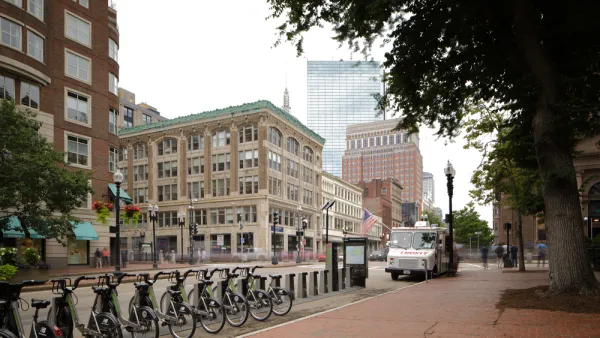
Mayor Thomas Menino declared that "the car is no longer king in Boston" as the Hubway bike-sharing system made its debut this week, putting the city abreast with Washington D.C.


Kimberly Adams writes, "Boston already has an active cycling community. There are more than 38 miles of bike lanes in the city, which bikers use to run errands and to get to and from work."
"The new Hubway system allows Bostonians to pick up a bike from one of 61 bike stations around the city and drop it off at a different station when they are done. At least 40 of the stations opened Thursday, and the rest are scheduled to be up and running in the next week," she adds.
The Registered Annual membership rate is $85 with a $60 special introductory offer through July. Casual 3-Day and Casual 24-Hour prices are $12 and $5, respectively.
Read the full story: Hubway Bike-Sharing Program Gets Rolling

Boston Installs New Bike Lanes as Part of GoBoston 2030 Initiative
The city wants to cut its car use in half by 2030 as part of an aggressive set of "aspirational" goals.
America's Best Bike Cities
With gas prices at an all time high, bike riding has never looked better. Shermans Travel identifies the top cities to bike through, noting a bounty of amenities to save on costs for the urban biker.
'Worst Biking City' Attempts To Lose The Title
Boston has not had a good relationship with cyclists. However, Mayor Thomas M. Menino is a cycling advocate, a city bike czar is on staff, bike lanes and facilities have been added, and a turn-around is evident even to its critics.

Planetizen Federal Action Tracker
A weekly monitor of how Trump’s orders and actions are impacting planners and planning in America.

Amtrak, CN end decades-long dispute with eight-year agreement
The new operating agreement establishes an updated framework for the companies to work together, including processes to resolve disputes.

Northwest rail fans eager for Sept. 30 debut of Amtrak’s Airo fleet
Get ready for that new train smell and more seats. But they won’t go faster or run more frequently on the Cascades route in Washington and Oregon.

St. Louis Metro to test if single-car trains can reduce operating costs, maintain rider satisfaction
The pilot program will run from October to spring 2027, and begin with one single-car train operating on Metrolink’s Red and Blue lines.

Pennsylvania is building data centers in abandoned mines
Housing data centers in mines provides an alternative to destroying local forests and may spare residents from data centers’ noise and air pollution.

If Corpus Christi can’t revive desalination plant project, it may owe Texas $235 million
Earlier this month, city officials declined to pursue developing the plant for the second time in a year.

FREE Course: Walkable City 1: Why Walkability?
After describing his path towards focusing on walkability as the essence of good planning, Jeff Speck marches through his five principal reasons for making more walkable places.
Reinventing Malls: Planning Alchemy—Turning Gray Fields Into Gold
The course focuses on the opportunities and imperatives that shape reinvention of mall sites.

City of Thousand Oaks
City of Wisconsin Rapids
Harvard University Graduate School of Design
The Architects Foundation
University of Cincinnati Online
The Pocatello Development Authority
The Urban Renewal Agency of the City of Pocatello