A new website created by the Center for Neighborhood Technology calculates how much an average household in your neighborhood would spend on transportation, with results for cars and public transit.


Tod Newcombe reports that the site "uses several sets of data to arrive at average transportation costs. They include money spent on car ownership for your community as well as public transit costs. Other data sets, taken from Census block group data, such as average commute times, job density, transit connectivity, and household income, are factored in."
Called Abogo, the site also calculates the average CO2 emissions related to transportation choice.
Over at the New York Times, reporter Tara Seigel Bernard talks with CNT head honcho Scott Bernstein:
"Abogo's Web site also provides a list of tips on ways to lower your costs. Reducing the number of miles you drive, for instance, may qualify you for a reduction on your insurance premium.
Ideally, Mr. Bernstein said you want to ask yourself this question: Can I spend most of my money within walking distance of my home?
Read the full story: Online Tool Calculates Transportation Cost

Happy Place of the Olden Days
Scott Bernstein joins in the Happiness Index conversation, starting with references to the Anatomy of Melancholy.

Cost of living too high? Planners to the rescue!
Excessive costs of living force many people to work more than optimal hours, leaving less time for family and fun. Local policies that favor affordable housing and transportation increase freedom, opportunity and happiness.
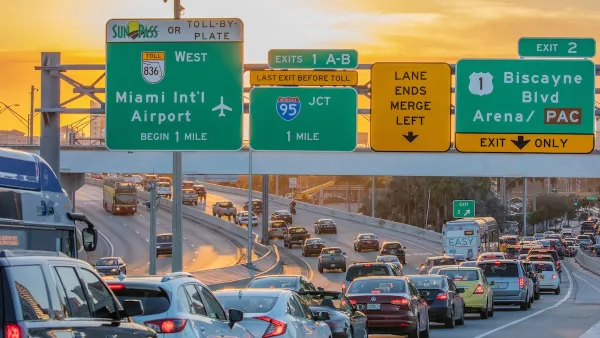
Miami, Houston Residents Spend Most on Transportation
South Floridians and Houstonians spent roughly 20 percent of their income on transportation in regions that offer few alternatives to driving.

Planetizen Federal Action Tracker
A weekly monitor of how Trump’s orders and actions are impacting planners and planning in America.

Amtrak, CN end decades-long dispute with eight-year agreement
The new operating agreement establishes an updated framework for the companies to work together, including processes to resolve disputes.

Nation's most wind-powered state turns to coal as data centers increase energy demand
For the first time in decades, Iowa has increased its generation of coal power.

Alabama scores up to $2.5 billion federal loan for largest infrastructure project in state’s history
The Mobile River Bridge and Bayway Project aims to ease congestion at Alabama’s worst bottleneck.

Trump is considering data centers on 6 states' public land — some state officials say they had no idea
If the administration approves the proposed projects, data center and data center-related developments will cover 17,600 acres of public land.

Despite court ruling, Trump is keeping nearly all wind projects in the US on hold
At least 110 wind energy projects have not heard from the government since a federal judge ruled that the Trump administration's freeze on wind turbine clearances was likely illegal.

FREE Course: Walkable City 1: Why Walkability?
After describing his path towards focusing on walkability as the essence of good planning, Jeff Speck marches through his five principal reasons for making more walkable places.
Reinventing Malls: Planning Alchemy—Turning Gray Fields Into Gold
The course focuses on the opportunities and imperatives that shape reinvention of mall sites.

KFH Group Inc.
Greater Baltimore Committee
Eagle County Government
The Architects Foundation
University of Cincinnati Online
The Pocatello Development Authority
The Urban Renewal Agency of the City of Pocatello