


















Is there an ideal model for a city's circulation, a "supermodel"? Fanis Grammenos reviews a new paper that proposes the use of organic forms first recognized by Christopher Alexander.


In a recent article, Witold Rybczynski praised the genius of architect and author Christopher Alexander and deplored the fact his great work is absent from architecture and planning schools curricula. Instead, he grieved, schools are busy with obscure academic wanderings on deconstructivism or other mind-numbing –isms. The rigour and depth of research such as Alexander's are given up in preference for abstruse esoteric theorizing or preaching. Though he created a large following, he fathered no "–ism", simply a seminal book. Neither did he profess that the "Patterns" he recognized in his book A Pattern Language would be essential in solving the energy crunch, social disparities, alienation, ugliness, crime and other man-made city problems.
While absent in academia, Alexander still exerts influence in these two fields. Many practitioners admit to having his Pattern Language "handy on the desk as a constant reference". On the research side, his disciples, collaborators and many followers, among whom I humbly place myself, continue the exploration.
A major contribution is the latest paper by a team of four (Michael Mehaffy, Sergio Porta, Yodan Rofe and Nikos Salingaros) which advances Alexander's work to its logical next stage: a general circulation network model for a city that subsumes and integrates many preceding detailed patterns; a super-model, an Alexandrian SimCity one might say.

The paper touches on many current topical and contested issues and settles a few. As I understood it, the paper:
- Pronounces the social/spatial doctrine of the "Neighborhood Unit" dead by research and declares "neighborhood" and "community" terra non-grata for determinism. It posits that one cannot "design" a neighbourhood or a community; each emerges where and when conditions are conducive and they take shape within or in spite and across preordained boundaries. This finding may surprise some who write about "architecture of community" or others who circumscribe fictional "villages", "towns" and neighbourhoods in the flux of the urban archipelago.
- Restores the primacy of traffic in creating wealth and "society". The surprise here is "society". Planners have reckoned traffic as the Jekyll and Hyde of contemporary cities. Welcomed and sought after for the goods it bestows, despised and incriminated for its savage hunger for space and speed. But while it can erode city space and increase risk, it can also irrigate social growth by means connecting goods, ideas and people. Interestingly, an old Greek term for a wide street is "leophoros", a people-bringer, a social super-collider.
- Reinforces and adopts the "sanctuary" cell as an organizing unit. It finds that a cellular structure evolves just as naturally in city districts as in organisms. The new cells are selectively permeable and averse to through traffic and thus become sanctuaries for home-based activities. Were possible, their tranquility and delight are enhanced by a focal green space.
- Accepts "hierarchy" as an underlying structuring principle that is common to fractal natural systems such as veins, brains, and trees, among many. Hierarchy of lengths and widths of connectors influences which will become Main Street, side street, footpath or dead-end."
- Reiterates and strengthens the 400 m rule, persistent in foot-based settlements and surfacing in most planning documents. This time it becomes the inviolable measure of a well-functioning network. It sets up the scale of human comfort that is intended to permeate neigbourhoods and districts."
- Repositions firmly the public uses (nuclei) where they have spontaneously emerged throughout history: at the crossroads of main roads and their extensions, not in fictional "centres". The "Emergent Neighborhood" model reconstructs a sound foundation for their location.
Why bother with a supermodel? The same unassailable rationale that stood behind creating the master-compendium of 260 "patterns" applies equally well to creating one that summarizes many. One step up in the organization ladder: from genomes to organs and to a full organism. Another good reason is that it might help refocus the planning discourse where Alexander placed it in the 70s: on the rational analysis of conflicts and their physical resolution.
A third ground is the common aspiration of all disciplines for a unified theory that explains the whole gamut of observable phenomena; a fundamental belief that order underlies the apparent chaos.
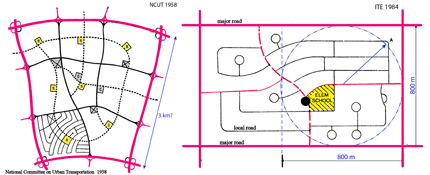
Finally, one very practical ground. Ever since the denigration of the transportation network models set out by NCUT (1958) and ITE (1984), an intellectual vacuum was created that was soon filled with vague notions of the "organic" network, the "village" image and the "small town" perfection or simply "the grid". Organic networks are fascinating to look at but hardly applicable to cities directly. The same applies to images of villages and towns. The growth and ultimate form of each of these networks emerges from a codified set of relationships conducive to survival. A model that draws on and expresses contemporary relationships is needed to fill the void.
With this newcomer, there are now three contemporary alluring supermodels that have more similarities than differences: The "Urban Network", the "Fused Grid" and now the "Emergent Neighborhood"; "contemporary", because they are all born of the dynamics and tensions of a young and unprecedented era – ours. They all arrive at similar organizing principles even though each starts from a distinct mix of premises.
The paper promises more research to supplement the logic of its propositions. In addition the authors may look at how to reintegrate explicitly Alexander's previous neighborhood and district related patterns. Moreover, no large scale pattern would be complete without incorporating the intercity connectors and their relationship to the local network, a challenge that has yet to be taken up. The authors seem set to do hard-nosed analyses of traffic, accessibility, mobility and economic efficiency to strengthen the model so that it can supplant current –isms and be applied.
With three "patterns" on the table there is little excuse to handcraft picturesque solutions for a problem that has deep organizing dynamics. Centered on these models a new research focus may even give birth to a discipline – URBANOMICS – that deals with laws that drive and shape urban development.
The continuing absence of fundamental laws has left the field dependent on images that inevitably generate endless and tiresome imitation. The proposed model fills a gap and may rekindle not only elemental thinking but also diversity.
Descriptions of the latest and previous models can be found here:


Why Christopher Alexander Still Matters
The author of "A Pattern Language" and "Notes on the Synthesis of Form" had an outsize influence far beyond architecture and urbanism—and still does.

Christopher Alexander, Influential Author of "A Pattern Language," Passes Away at 85
Christopher Alexander died on March 17, leaving behind a towering legacy of influence on the fields of architecture, planning, and urban design.
The Surprisingly Important Role of Symmetry in Healthy Places
New research suggests there might be a "symmetry deficit disorder" in today's built environments, with significant impacts on health, well-being, and even sustainability.

Planetizen Federal Action Tracker
A weekly monitor of how Trump’s orders and actions are impacting planners and planning in America.
Maui's Vacation Rental Debate Turns Ugly
Verbal attacks, misinformation campaigns and fistfights plague a high-stakes debate to convert thousands of vacation rentals into long-term housing.
San Francisco Suspends Traffic Calming Amidst Record Deaths
Citing “a challenging fiscal landscape,” the city will cease the program on the heels of 42 traffic deaths, including 24 pedestrians.

Defunct Pittsburgh Power Plant to Become Residential Tower
A decommissioned steam heat plant will be redeveloped into almost 100 affordable housing units.

Trump Prompts Restructuring of Transportation Research Board in “Unprecedented Overreach”
The TRB has eliminated more than half of its committees including those focused on climate, equity, and cities.

Amtrak Rolls Out New Orleans to Alabama “Mardi Gras” Train
The new service will operate morning and evening departures between Mobile and New Orleans.

Urban Design for Planners 1: Software Tools
This six-course series explores essential urban design concepts using open source software and equips planners with the tools they need to participate fully in the urban design process.
Planning for Universal Design
Learn the tools for implementing Universal Design in planning regulations.

Heyer Gruel & Associates PA
JM Goldson LLC
Custer County Colorado
City of Camden Redevelopment Agency
City of Astoria
Transportation Research & Education Center (TREC) at Portland State University
Jefferson Parish Government
Camden Redevelopment Agency
City of Claremont