President Barack Obama and Vice President Joe Biden are in Florida today to announce a funding package for a variety of high speed rail projects. In total, $7.9 billion in funding is being announced.


"Most of the money will go to improving existing rail service – paving the way for faster service, but not for the kind of bullet trains that zip along faster than 150 miles an hour in Japan and Europe. More than a billion dollars, for instance, will go to speed train travel between Chicago and St. Louis to up to 110 miles per hour – faster than it is now, but a far cry from the super fast trains that are increasingly common elsewhere.
But two of the largest pots of money being distributed are being devoted to actual bullet train projects."
One of the large projects is the $45 billion high speed rail line connecting Northern and Southern California. $2.25 billion will be directed to that project.
The other big project is an 84-mile link between Tampa and Orlando, which will receive $1.25.
The funding will focus on 13 corridors throughout the U.S.
Read the full story: Obama Promoting Rail Plan on Florida Visit
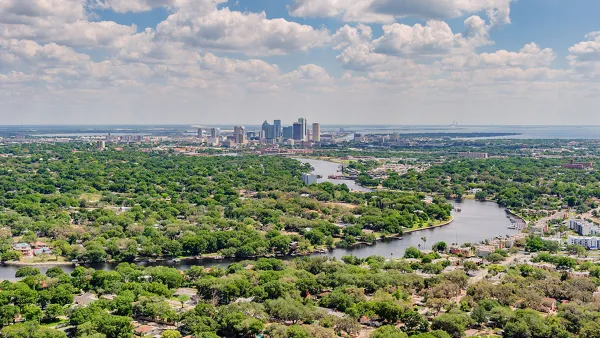
Tampa to Orlando High Speed Rail Back on the Table
Brightline thinks it can build a high speed rail connection between Tampa and Orlando without public money, and Governor Rick Scott looks ready to let them.
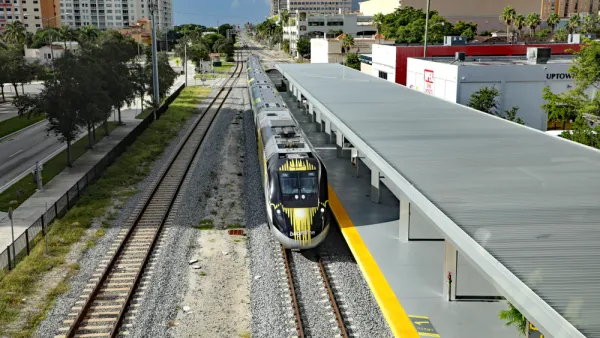
Brightline Opening to Central Florida Delayed
The high-speed rail connection between West Palm Beach and Orlando will not open on time for the holiday weekend as originally planned.
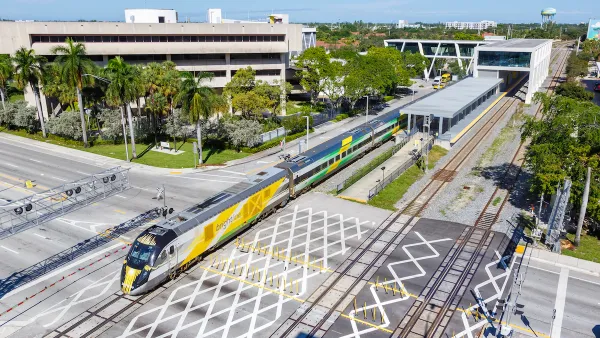
Brightline Completes Higher-Speed Rail Construction in Florida
Florida will soon be home to 170 miles of higher-speed, intercity rail service.

Planetizen Federal Action Tracker
A weekly monitor of how Trump’s orders and actions are impacting planners and planning in America.

Eastern Nebraska is running out of electricity
Data centers and electrification are straining eastern Nebraska’s grid, throttling economic development.

Study reveals best places in the U.S. for cycling, walking
New research from Streetlight Data examines bicycle and pedestrian miles per capita in the 100 largest U.S. cities by population.

Federal government nominates new FTA administrator
Mark Aesch is currently the founder and CEO of a transportation management consulting firm.

Developers reveal $10 billion stadium plan as ‘Hail Mary’ to keep Bears in Chicago
The plan would also boast a public park, high- and mid-rise buildings and a youth sports complex.

As Texas embraces carbon storage, a Black community questions the risks
Texas now issues permits for companies to store carbon dioxide underground. East Texas residents fear safety risks, and skeptics doubt the climate benefits.

FREE Course: Walkable City 1: Why Walkability?
After describing his path towards focusing on walkability as the essence of good planning, Jeff Speck marches through his five principal reasons for making more walkable places.
Reinventing Malls: Planning Alchemy—Turning Gray Fields Into Gold
The course focuses on the opportunities and imperatives that shape reinvention of mall sites.

City of Charlotte
City of Rosemead
Rutgers University, Edward J. Bloustein School of Planning and Public Policy
University of Michigan School for Environment and Sustainability (SEAS)
Hunter College, City University of New York (CUNY)
The Architects Foundation
City of Cambridge
The Pocatello Development Authority
The Urban Renewal Agency of the City of Pocatello