A university in British Columbia is opening a "biological pest control laboratory" to develop strategies for small and urban farms to control pests through microbe- and insect-based systems.


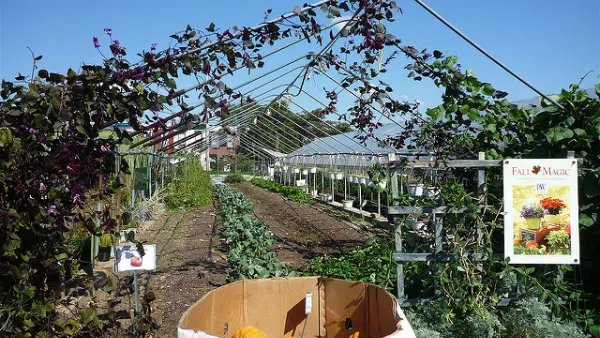
With increasing demand for food and decreasing amounts of arable land on which to grow it, some suggest urban farming may be the best way to feed the world's urban population. The methods being developed have that type of agricultural setting in mind, accounting for dense urban environments that could have a garden next door to -- or on top of -- a skyscraper.
"Cities all over the world and here in B.C. are integrating farming into the urban environment, from small-acreage market gardens to green-roof food production and community gardens in parks and sustainable housing developments.
But for people and commercial food production to coexist in a densely populated urban environment, alternatives must be found to replace chemical pest control, said Deborah Henderson, director of Kwantlen's Institute for Sustainable Horticulture."
Read the full story: B.C. on the cutting edge of urban agriculture


Urban Farming Addressing Hunger (and More) in Pittsburgh
Urban farming provides opportunities to increase food security in addition to other benefits.
Minnesota Grants May Bolster Urban Farming's Legitimacy
For the first time, the state of Minnesota is offering money specifically for urban agriculture, in a win for urban farmers who want to challenge the notion that agriculture is necessarily a rural enterprise.

Agrihoods Still Proving Popular
Agrihoods emerged in the 1990s as a master-planned alternative to the golf-centered communities of the past. Many of these developments are going strong, and gaining in popularity.

Planetizen Federal Action Tracker
A weekly monitor of how Trump’s orders and actions are impacting planners and planning in America.

Amtrak, CN end decades-long dispute with eight-year agreement
The new operating agreement establishes an updated framework for the companies to work together, including processes to resolve disputes.

Northwest rail fans eager for Sept. 30 debut of Amtrak’s Airo fleet
Get ready for that new train smell and more seats. But they won’t go faster or run more frequently on the Cascades route in Washington and Oregon.

St. Louis Metro to test if single-car trains can reduce operating costs, maintain rider satisfaction
The pilot program will run from October to spring 2027, and begin with one single-car train operating on Metrolink’s Red and Blue lines.

Pennsylvania is building data centers in abandoned mines
Housing data centers in mines provides an alternative to destroying local forests and may spare residents from data centers’ noise and air pollution.

If Corpus Christi can’t revive desalination plant project, it may owe Texas $235 million
Earlier this month, city officials declined to pursue developing the plant for the second time in a year.

FREE Course: Walkable City 1: Why Walkability?
After describing his path towards focusing on walkability as the essence of good planning, Jeff Speck marches through his five principal reasons for making more walkable places.
Reinventing Malls: Planning Alchemy—Turning Gray Fields Into Gold
The course focuses on the opportunities and imperatives that shape reinvention of mall sites.

City of Thousand Oaks
City of Wisconsin Rapids
Harvard University Graduate School of Design
The Architects Foundation
University of Cincinnati Online
The Pocatello Development Authority
The Urban Renewal Agency of the City of Pocatello