From bicycle highways to a ban on the cul-de-sac, the built environment is the focus of many of The New York Times Magazine's ideas of the year.


The utopian idea of bicycle highways is becoming a reality. Copenhagen has one in the works, and a series of bicycle interstates has been proposed for the U.S. as well.
"The bicycle highway - no red lights, no cars - is every cyclist's fantasy. There are now signs that infrastructure is catching up with the dream. In October 2008, an association of U.S. state-highway officials approved the concept of a national Bicycle Routes Corridor Plan - the first step in potential American bike Interstates. But this amounts to little more than a go-ahead for states to put bike-route signs on existing roads.
Copenhagen, however, began last month to create the real thing: a system of as many as 15 extra-wide, segregated bike routes connecting the suburbs to the center of the city."
Other ideas include plans to build plant-like structures that absorb CO2, and the addition of noise to quiet hybrid cars.
Read the full story: The 9th Annual Year in Ideas
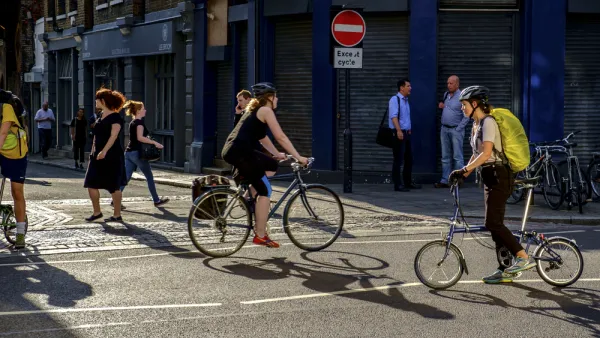
Cycling Infrastructure Gets a Boost in London
London is planning to build multiple "cycle superhighways," among other improvements for bikers.

Norway Has a Plan for $1 Billion in Bicycle Highways
It's not a done deal yet, but Norway's $1 billion plan for inter-city bicycle highways should be enough to inspire envy among cyclists here in the United States.
Killing Culs-de-Sac and Growing Smarter for Seniors
The senior population of Erie County, New York, is rising. A 2006 storm revealed difficulties in providing medical services to these seniors because of the sprawled out and cul-de-sac heavy development model. A bill seeks to make that model smarter.

Planetizen Federal Action Tracker
A weekly monitor of how Trump’s orders and actions are impacting planners and planning in America.

California plans to bury El Niño’s downpour
If the state plays its cards right, it may be able to store a billion acre-feet of El Niño’s water in aquifers.

Desperate measures: Advocates weigh draining Lake Powell to fill Colorado River
Draining the reservoir could reduce evaporation losses by a couple hundred thousand acre-feet.

Chicago voters approve permanent festival grounds, penalty for vacant property owners
Currently, major summer and fall festivals take over public parks for weeks at a time, drawing criticism from nearby residents

NYC votes to cut outdoor dining red tape, speed up permitting
New York City also voted to allow the Department of Transportation to begin work on urgent projects before notifying elected officials.

California appears to reject Prop. 45
The proposition would have expanded the projects that qualify for a streamlined environmental review, effectively paring down the California Environmental Quality Act.

FREE Course: Walkable City 1: Why Walkability?
After describing his path towards focusing on walkability as the essence of good planning, Jeff Speck marches through his five principal reasons for making more walkable places.
Reinventing Malls: Planning Alchemy—Turning Gray Fields Into Gold
The course focuses on the opportunities and imperatives that shape reinvention of mall sites.

City of Rosemead
Rutgers University, Edward J. Bloustein School of Planning and Public Policy
One Hundred Miles
Hunter College, City University of New York (CUNY)
The Architects Foundation
University of Cincinnati Online
City of Cambridge
Montrose County
The Pocatello Development Authority